A correction in dog training is a specific, timed piece of feedback delivered within about a second of a behavior and applied the same way every time, not a raised voice or a yanked leash minutes after the fact.
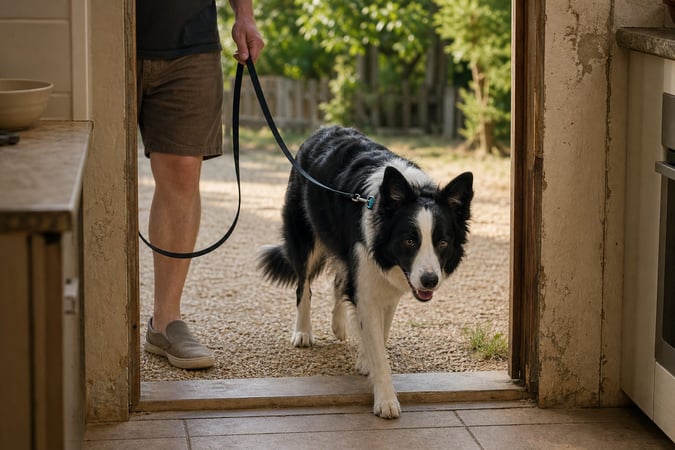
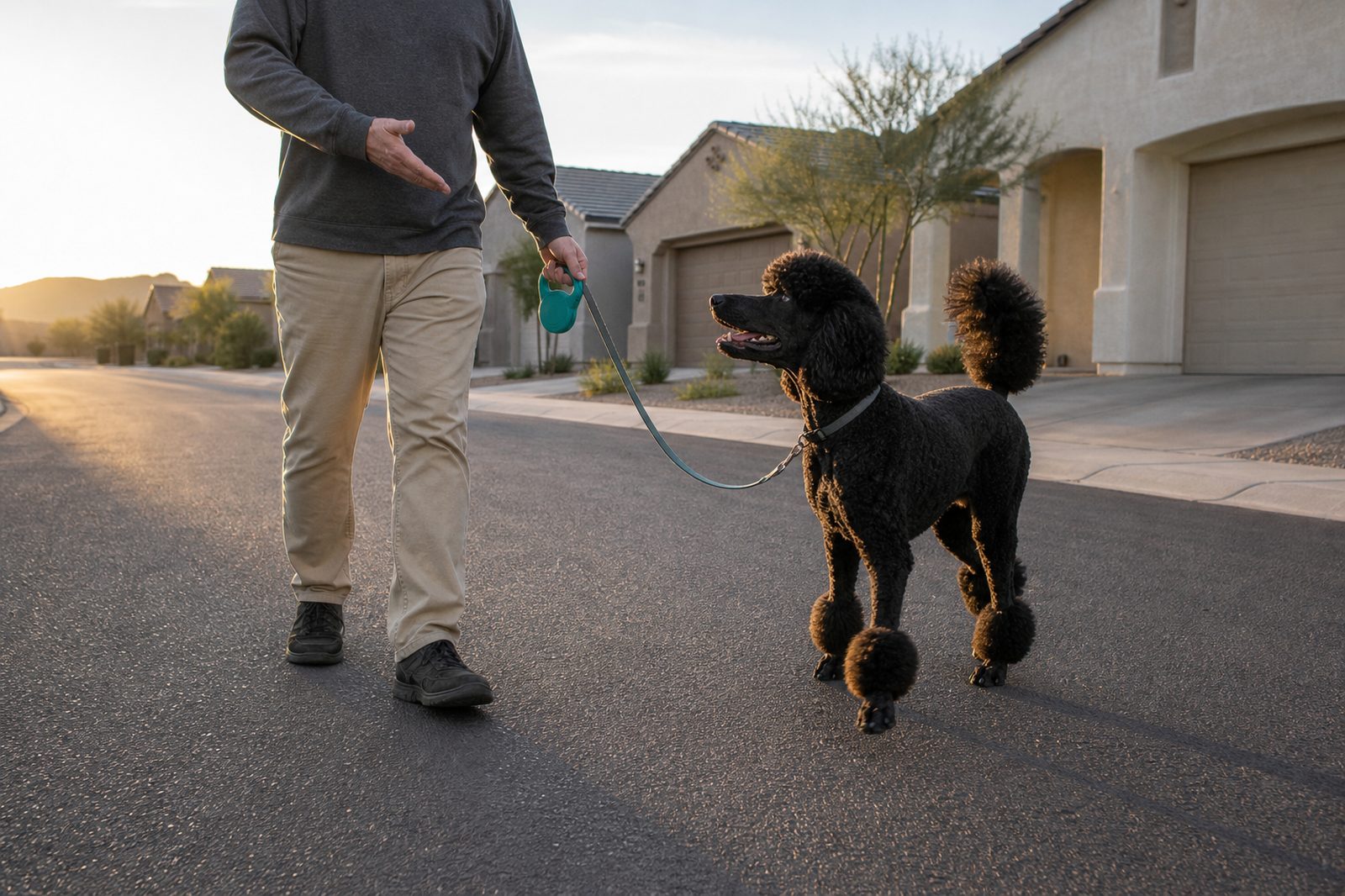
Picture a young dog at a Cave Creek Regional Park trailhead, hitting the end of a six-foot leash as a cyclist rolls past. That six-foot length comes straight from Maricopa County's leash ordinance, which requires it the moment a dog leaves its own property. Now picture the handler doing this well: no yelling, no jerking the leash. She would plant her feet, hold a level line of pressure for about a second, and let it go the instant the dog's attention swings back to her. The whole exchange would be over before the cyclist is out of earshot. That is what a correction is supposed to look like: brief, quiet, and finished before most bystanders would even register it happened.
What Is a Correction in Dog Training?
Break that trailhead moment into its parts and a correction stops being an abstraction. A correction is a specific, timed piece of feedback delivered within about a second of a behavior, applied the same way every time that behavior shows up. That one-second window and the consistency requirement are not a Partners Dogs house rule. They come straight from operant conditioning research: for a consequence to actually change behavior, it has to land while the dog is still doing the thing or within roughly a second afterward, and it has to happen the same way every time.
Miss that window and something else happens instead. A correction delivered five, ten, or thirty seconds late does not land on the lunge toward the bike. It lands on whatever the dog is doing at that moment: sniffing the trail, checking in with the handler, walking normally. None of that is what the handler meant to address. Late feedback does not just fail to work. It teaches the wrong lesson entirely.
What a Correction Is Not
A correction is not a raised voice five minutes after a shoe turns up chewed on the kitchen floor. Chasing a dog around the backyard while it finishes off a slipper does not count either, no matter how loud the dog's name gets, since the dog usually reads the whole scene as a game. Neither does a leash yanked out of frustration because a walk has gone sideways for the third time that week. Those moments share a name with a correction in casual conversation and share almost nothing else with one: no timing, no consistency, no information a dog can use.
One of our Cave Creek reviewers described the difference from the other side of the leash, comparing her dog's old handling to what she learned at Partners:
“the teachers really understand the canine brain so the class is really about training US to know HOW TO TRAIN OUR DOGS EFFECTIVELY.. no more yelling, yanking on leashes, frustration in taking jax outside!! i learned how to communicate in a language MY DOG understands..”
Lisa M., Cave Creek
Yelling and yanking are frustration aimed in a dog's general direction. A correction is information aimed at one specific instant. The two get confused constantly because they can look similar from across a parking lot. They are not the same tool.
Why Does Timing Matter More Than Intensity?
Timing decides whether a correction works at all. Intensity barely factors in. Owners get this backward constantly: corrections tend to get applied out of anger, often well after the behavior, and with more force than intended. That combination is exactly what backfires. A well-timed, low-intensity correction inside that one-second window changes behavior. A hard, late one usually just changes the dog's opinion of the handler.
The consistency half of the rule matters just as much and gets ignored more often. A behavior corrected three times out of five does not get suppressed three-fifths as much. The dog learns the behavior sometimes pays off, and that is a stronger lesson than most owners expect. It is the exact mechanism behind a dog that only listens some of the time. Inconsistent timing does more damage than most owners expect, turning a correction into background noise a dog eventually learns to tune out.
How Correction Timing Changes Across the Four Training Stages
The one-second rule holds constant everywhere. How often a correction is even needed changes a great deal, depending on where a dog sits in the four stages every program at Partners Dogs runs on: Teaching, Reinforcing, Proofing, and Maintenance.
- Teaching: corrections are rare to nonexistent. A dog that has not learned the cue yet has nothing to correct. Sessions here run almost entirely on reward.
- Reinforcing: the dog already understands the behavior, so a correction, if one is needed, looks like a quiet no-reward marker or a light redirect back to the right choice.
- Proofing: the behavior gets tested against real distraction, a mountain biker at Spur Cross Ranch Conservation Area, another dog on the trail, a dropped leash, while corrections still have to land inside that same tight window.
- Maintenance: a fluent behavior needs almost no correction at all. If corrections start climbing back up during Maintenance, that is diagnostic. Something regressed and needs a look, not more pressure.
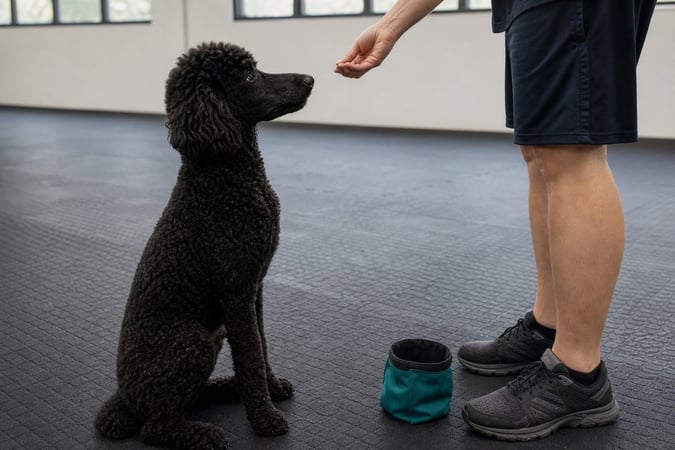
Watching that timing get read correctly by someone who does this daily, and getting immediate feedback on a handler's own timing, is most of what a Group Classes session teaches. Reading a description of a one-second window is one thing. Feeling a trainer catch a handler's own leash pressure landing a beat late is another, and it is usually the faster way to fix it.
Do Force-Free Trainers Use Corrections Too?
Here is the honest answer: yes, though the marketing rarely calls it that. The American Veterinary Society of Animal Behavior's 2021 statement on humane dog training recommends reward-based methods and lists prong collars, choke chains, and shock collars among the tools it advises trainers to avoid. That is a real position from a real veterinary organization, and it deserves to be stated plainly rather than argued with.
But look at what the American Kennel Club's own explainer on operant conditioning already concedes: force-free and reward-focused trainers are not avoiding correction, they are deliberately limiting themselves to two of the four operant quadrants, positive reinforcement and negative punishment, the removal of something a dog wants. Withholding a treat, ending a game the instant a puppy's teeth get too hard, and walking away from a jumping dog are negative punishment by that same discipline's own definition, aimed at the exact same goal a leash correction serves: teaching a dog what does not work. The label is softer. The mechanism is not. A stable, social dog whose owner mostly wants engagement and manners will do fine inside that narrower toolkit, and for a large share of everyday obedience work, two quadrants is plenty.
What that framework asks a family to give up is the other half of how dogs actually communicate, and give-up is the right word. A mother dog does not stop at withdrawing attention; a correction is one more channel in the same conversation. Dogs and people alike learn as much from stress as from success, and removing stress from the equation entirely does not protect a dog. It strips out information a dog needs to build real stability, safety, and happiness.
Practice the timing, not just the theory
Get a Trainer's Eyes on Your Timing
A trainer watching your hands and your dog's response, live, is the fastest way to learn exactly where that one-second window falls for your dog.
Where Does Partners Dogs Land on Corrections?
Every dog we have worked with, and we are well past 70,000 of them since 1997, communicates across the full range dogs use: reward, correction, redirection, all of it. A mother dog corrects a pushy puppy with a growl and a look. Play stops the instant a bite lands too hard. None of that is cruelty. It is information, and dogs read it fluently the moment they meet it. Training that pretends corrections do not exist just keeps quiet about using them.
Our own position is method-agnostic toward one outcome: a good, honest relationship between a parent and their dog. We lean heavily positive because that is more fun for the dog and the handler both, and because reward is where every dog starts in Teaching. But we do not pretend the other side of the conversation does not exist. This is not a philosophy about which quadrant to avoid. It is a stage a dog is in and what that stage calls for. Full detail on how we personalize that mix per dog lives on our methodology page, and families who have been through it rate the result 4.8 stars across 2,000+ reviews.
One Cave Creek parent summed up the result better than any position statement could:
“Lucy, my pup's trainer, was very detailed pre and post training which helped me set boundaries and expectations for my pup's return home.”
Collette D., Cave Creek
Key takeaways
- A correction only works as feedback if it lands within about a second of the behavior; anything later teaches the wrong lesson.
- Consistency matters as much as timing: a behavior corrected three times out of five does not get suppressed three-fifths as much, it teaches the dog the behavior sometimes still pays off.
- How often a correction is needed changes across the four stages, rare in Teaching, occasional in Reinforcing and Proofing, and close to nonexistent once a dog reaches Maintenance.
- Even force-free programs use correction, they just call it negative punishment: withholding a treat or ending a game removes something a dog wants, the same goal a leash correction serves with a softer label.
- Maricopa County's leash ordinance requires a leash the moment a dog leaves its own property, which is why a six-foot length is the practical standard trainers correct against.
Frequently Asked Questions
Is a Correction the Same Thing as Punishment?
In behavioral terms, yes. A correction is a form of positive punishment, something added after a behavior to make it happen less. The word carries harsher connotations in everyday language than the mechanism itself deserves. A well-timed, low-intensity correction a dog understands is specific feedback: sized to the dog and the moment, not flooding, intimidation, or cruelty.
How Long Should a Correction Last?
A second or less, and it should end the instant the dog gives the right response. A correction that lingers past that point stops being feedback and starts being pressure for its own sake, which is not the goal.
What Happens If a Correction Comes Too Late?
It lands on whatever the dog is doing at that moment instead of the behavior you meant to address, so it teaches the wrong lesson or nothing at all. Corrections that consistently arrive late are one of the most common reasons owners feel like nothing is working, when the underlying problem is timing, not the dog.
Do Corrections Happen Less As a Dog Gets Further Along in Training?
Yes. In the Teaching stage there is almost nothing to correct because the dog has not learned the cue yet. By Maintenance, a fluent dog needs corrections rarely, if ever. A sudden increase in how often a trained dog needs correcting during Maintenance usually points to something else going on, not a training gap.
Is Yelling at a Dog a Correction?
Not in any useful sense. Yelling is rarely timed to the exact moment of a behavior, rarely applied the same way twice, and communicates frustration more than information. A dog cannot extract a clear lesson from a raised voice the way it can from a brief, consistent, well-timed correction.
Where Can I Get Hands-On Help With Correction Timing Near Cave Creek or Carefree?
Group Classes at Partners Dogs is the fastest way to get a trainer reading your timing live, and it serves families across Cave Creek, Carefree, and the surrounding 85331 zip code. Watching a trainer catch a handler's leash pressure landing a beat late is usually faster than reading about the one-second window. The same holds for puppies still in the Teaching stage: a professional program builds the cue on reward first, since a puppy that has not learned a cue yet has nothing to correct, and that saves a family from developing bad timing habits before there is anything to time.
Keep reading