Short version
There is no single safe temperature, but two lines hold: at 80°F keep the walk short and test the pavement first, and at 90°F skip the walk.
- 80°F is where vets start cautioning. Above 90°F, multiple vets say stop walking; PetMD advises no more than 5 minutes outside.
- Pavement can run roughly 40 to 60 degrees hotter than the air in direct sun. At 86°F air, asphalt can reach 135°F (WSU College of Veterinary Medicine).
- The 7-second back-of-hand test decides every walk: if you cannot hold it for 7 full seconds, it is too hot for paws.
- Same-day emergency vet triggers: vomiting or diarrhea, glazed eyes or disorientation, collapse, seizures, or a rectal temperature over 104°F.
There is no single safe temperature, but there are two useful lines: at 80°F keep the walk short and test the pavement first, and at 90°F skip the walk.
If you brought home a dog for the trails, nobody told you the summer plan would be 5 a.m. alarms and a thermostat. Welcome to the Valley.
This guide gives Scottsdale and Cave Creek Pet Parents the honest answer first: what temperature is too hot to walk your dog, the real story behind the 80°F and 90°F numbers, the pavement math that matters more than the air temperature, and the summer routine that keeps your dog exercised without a vet emergency. Our approach runs our management-first method: rewrite the routine for the season before you ask the dog to tough it out.
Is there one magic temperature for safe dog walks?
The short version: no. Air temperature is one input, and the other inputs decide the walk.
The real answer depends on the pavement under your dog’s feet, the humidity, and the dog itself: breed, coat, fitness, weight, age, and how used to the heat it is. A fit 3-year-old Lab on grass at 78°F is a different case than a 10-year-old Bulldog on black asphalt at the same temperature. This is the read our trainers do first in any heat consult: the dog in front of you, not the number on your phone. Dr. Stacy Eckman of the Texas A&M College of Veterinary Medicine says it straight: there is no set temperature that is too hot for animals, and the individual dog decides the rest.
So here is the honest working version, boiled from what vets and vet schools actually say:
80°F is the yellow light. Short walks only, test the pavement, bring water, stay in the shade where you can.
90°F is the red light. Skip the walk. Potty break on grass, then back inside.
Where did the 80-degree and 90-degree rules come from?
The short version: each number comes from a real vet source, and the "debate" is really three vets answering three different questions.
The 80°F camp answers "when do I start worrying?" Dr. Michael Hyder, DVM, medical director at VEG ER for Pets: avoid walking your dog when the temperature is over 80°F, and know that the upper 70s can already be dangerous for heat-sensitive breeds (Chewy’s vet-reviewed heat guide). Mississippi State University’s vet school agrees: limit outdoor time when the heat index hits 80°F or above, because humidity makes panting less effective.
The 85°F camp answers "when is the ground the problem?" The AKC, through Chief Veterinary Officer Dr. Jerry Klein, DVM: if the temperature is 85 degrees or over without a chance for the pavement to cool down, the ground may be too hot to walk on safely.
The 90°F camp answers "when do I stop?" Dr. Courtney Pierce, a veterinary lead at Zoetis: 90°F is the walking cutoff; above 85°F, limit walks to 10 to 15 minutes. PetMD’s Dr. Barri Morrison, DVM: in 90°F weather a dog should spend no more than 5 minutes outside.
Use 80 as the yellow light and 90 as the red light, then make the call with the pavement test and an honest look at your dog. No national number measured your asphalt, your humidity, or your Bulldog.
How hot does the pavement actually get?
The short version: in direct sun, asphalt can run roughly 40 to 60 degrees hotter than the air. The numbers are from published research, not folk wisdom.
The numbers come from Dr. James Berens’ thermal-contact-burn research (Journal of the American Medical Association, 1970), quoted by the Washington State University College of Veterinary Medicine:
- 77°F air → 125°F asphalt. Human skin is destroyed in 60 seconds at 125°F. An egg fries on a 131°F surface in 5 minutes.
- 86°F air → 135°F asphalt.
- 87°F air → 143°F asphalt.
A University of Nevada burn-center study found the pavement-burn risk starts around 95°F ambient and climbs exponentially from there. On a 111°F day, pavement in direct sun can reach 147°F.
Now read that against a Phoenix summer: 111 days per year at 100°F or higher (30-year average, National Weather Service), 113 straight days at or above 100°F in 2024, and a city record of 122°F. From May through September, your morning walk starts on pavement that may not have cooled from yesterday. Concrete runs cooler than asphalt but still burns; grass runs coolest. Asphalt releases heat slowly and can stay too hot hours after sunset, so test it at night too.
The thermometer on your phone answers the wrong question. Your dog walks on the pavement, not the phone.
Our trainers walk this ground every day, and the read we give Pet Parents is simple: in July, assume the asphalt is guilty until the back of your hand proves otherwise. Test the actual surface your route uses. The dark sealcoat on your cul-de-sac runs hotter than the concrete sidewalk, and both run hotter than the number on your phone.
Should you walk your dog?
The short version: use this table, but the pavement test always has the final word.
Built from the vet-sourced bands above. Shift one row stricter for heat-sensitive dogs (flat-faced breeds, seniors, puppies, overweight dogs, thick coats, heart conditions).
| Air temperature | What to do | Rules |
|---|---|---|
| Under 75°F | Walk. Normal summer-dawn walk. | Still test the pavement in direct sun. Bring water. |
| 75-80°F | Short walks, morning or evening. | Pavement test every time. Shade and grass routes. Watch flat-faced and thick-coated dogs closely. |
| 80-90°F | Yellow light. Short walks only, pavement test mandatory. | Water on you. Cut it short at the first heavy pant. High-risk dogs: potty breaks only. |
| 90-100°F | Red light. Potty breaks on grass, then inside. | 5 minutes outside maximum (PetMD). Cooling support and water on standby. |
| 100°F and up | No walks. Indoor day. | A 2016 Phoenix Parks and Recreation Board rule closes city trails to dogs at 100°F and above. See our guide to the heat-walking law. |
How do you do the pavement test right?
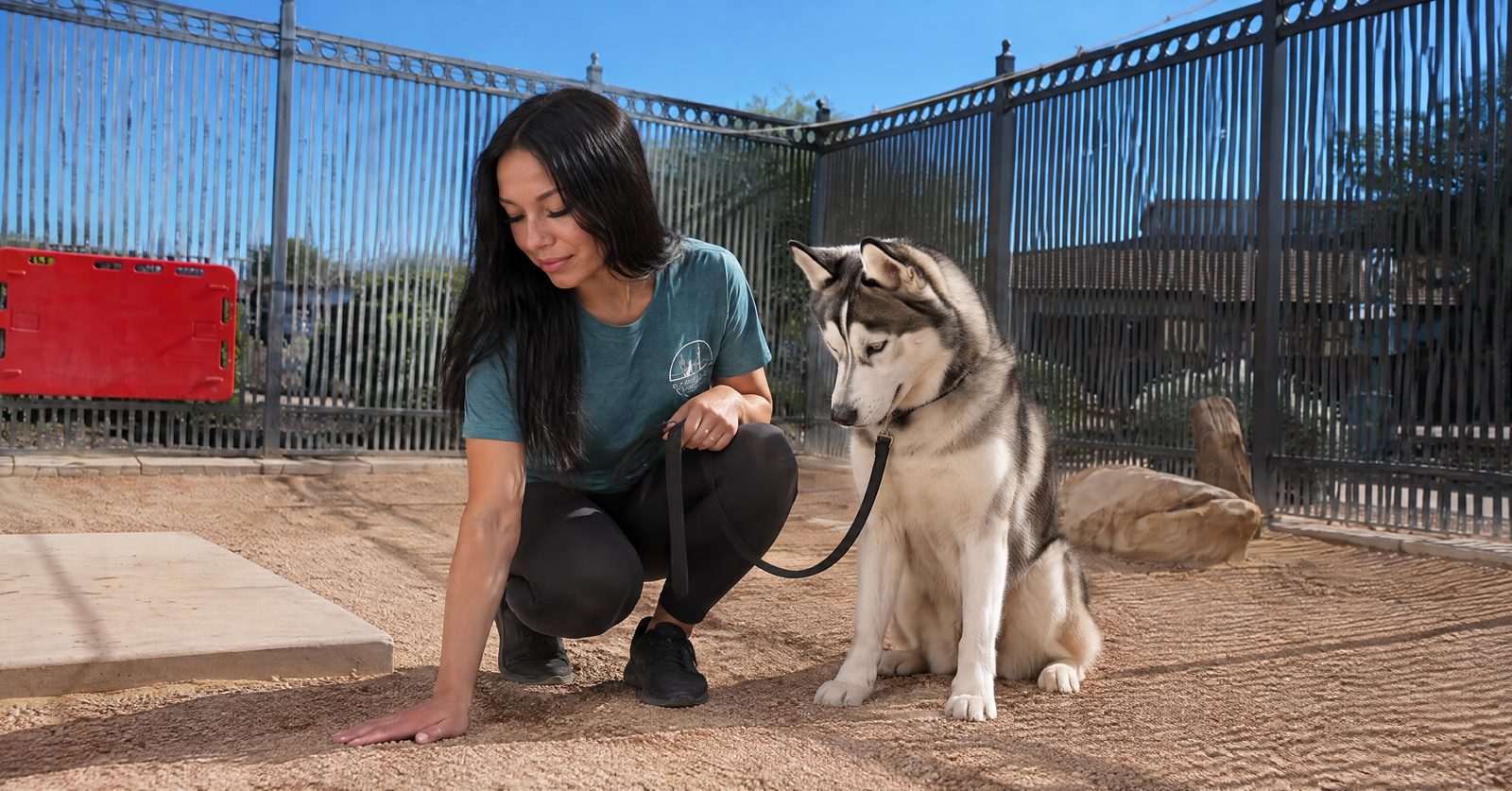
The short version: press the back of your hand to the pavement and hold it for 7 seconds. If you cannot, the walk is off.
The test comes from a vet school. Dr. Raelynn Farnsworth of the WSU College of Veterinary Medicine: press the back of your hand against the pavement, and if you cannot hold it there for a full seven seconds, it is too hot for your dog’s paws. The back of the hand has thinner skin, closer to what a paw pad feels.
Three rules: test where you will walk, not where you park; test at walk time, because pavement keeps heating into the afternoon and stays hot after sunset; and use seven seconds, no cheating. PetMD says 5 seconds and the AKC says 10. Seven is the vet-school number.
Know its limits. The test checks for burns, not overheating: a dog can overheat on cool grass at 95°F with high humidity, because then the danger is the air, not the ground. And paw conditioning matters. A dog walked on varied surfaces all spring has tougher pads than a dog that spent May on the couch. Our guide to the pavement test and summer booties covers conditioning your dog to booties before you need them.
Which dogs overheat first?
The short version: dogs cool themselves by panting, so anything that makes panting harder moves the red line earlier for that dog.
Dogs do not sweat the way you do. They dump heat by panting, with only a little sweating through their noses and foot pads. When the air is hot or humid, panting stops working. That is the whole physics:
- Flat-faced breeds. Pugs, Bulldogs, French Bulldogs, Boxers. Shorter airways make panting harder, and panting is the entire cooling system. Keep high-risk dogs inside above about 80°F.
- Thick, heavy coats. Huskies, German Shepherds, Chow Chows. Even the upper 70s can be dangerous for these dogs.
- Seniors, puppies, and overweight dogs. Less margin, slower recovery. The Maricopa County heat chart adds a full risk point for each.
- Unacclimated dogs. A dog that lives in air conditioning is not conditioned for July. Texas A&M’s vet school flags indoor, unacclimated dogs as higher risk.
- Dogs with heart or lung conditions. Less circulatory and respiratory reserve. Ask your vet for that dog’s personal ceiling.
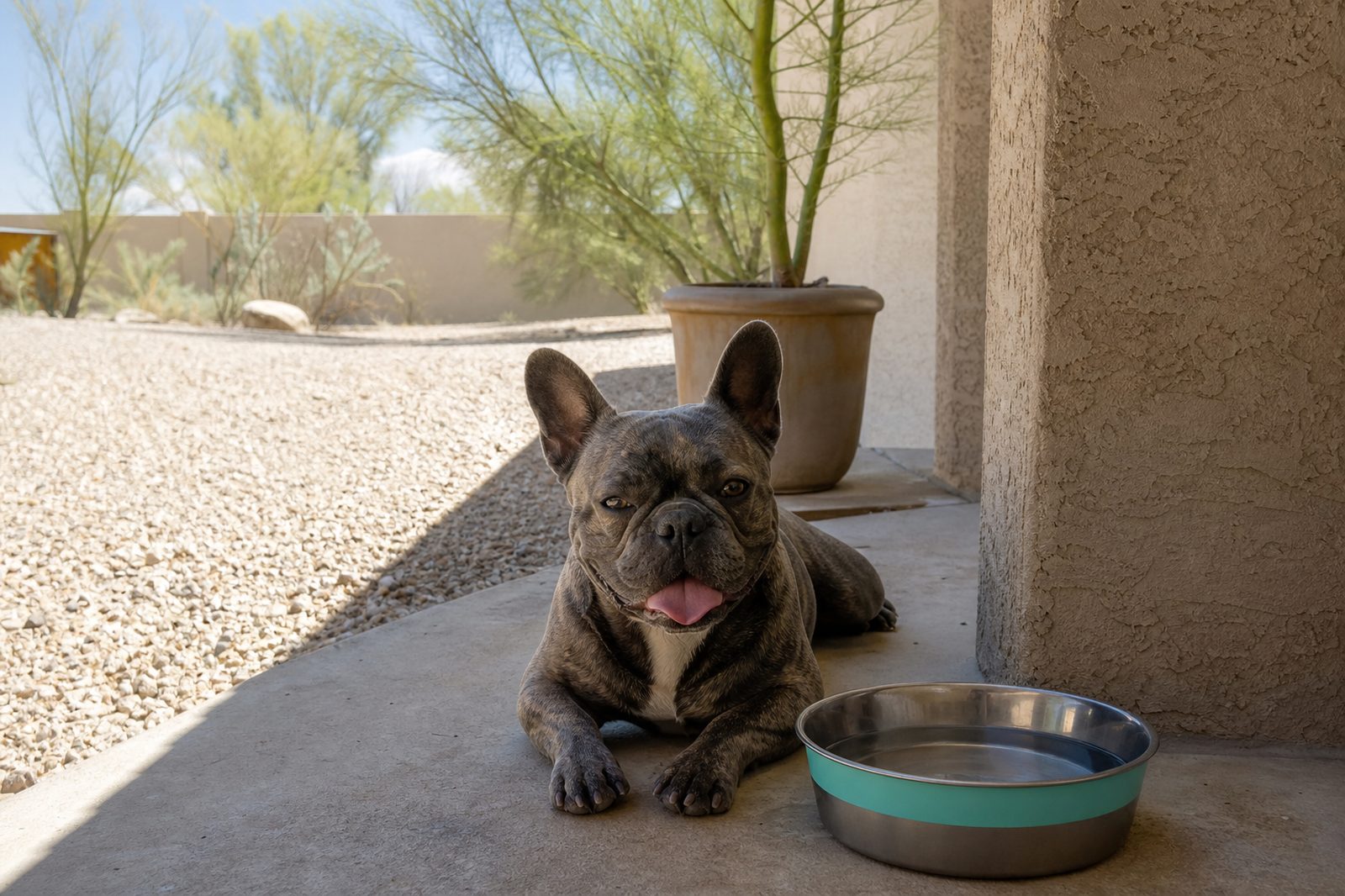
One more factor: humidity. Phoenix is dry most of the summer, which lets panting work. When the monsoon pushes humidity up in July and August, the same 95°F afternoon becomes meaningfully more dangerous. Watch the heat index, not just the temperature: that is the core of hot weather dog walking safety.
What does overheating look like, and when do you go to the vet?
The short version: heavy panting and bright-red gums mean stop and cool the dog now. Vomiting, disorientation, or collapse mean the emergency vet, today.
Early overheating looks like heavy panting, thick drool, bright-red gums, and a dog that goes quiet or lies down and will not get up. Stop the walk, get to shade or air conditioning, and cool with cool (not cold) water and a fan. Offer water. Do not force it.
Heatstroke is the next stage and it is a same-day emergency: vomiting or diarrhea (sometimes bloody), glazed eyes, stumbling, a racing heart, then collapse or seizures. Normal body temperature runs 101 to 102.5°F. Over 104°F is heatstroke. Over 106°F is severe.
Go to the emergency vet the same day if you see any of these:
- Vomiting or diarrhea, especially with blood
- Glazed eyes, disorientation, or stumbling
- Collapse, inability to stand, or seizures
- Rectal temperature over 104°F
- Any heatstroke sign that does not improve within minutes of cooling
While you head there, keep cooling: wet the dog with cool water, especially the belly, and keep air moving. Never use ice water. It constricts blood vessels and traps heat inside. Virginia Tech’s veterinary school is explicit: cooling efforts must not delay travel to the vet.
Do not skip the vet visit because the dog "seems fine now." Heatstroke can injure the kidneys, liver, GI tract, and brain, and the damage can show up hours or days later. This is first aid, not a diagnosis. Our full explainer on heatstroke signs and what to do before the vet goes deeper.
What does a Phoenix summer walking schedule look like?
The short version: walks move to dawn and dusk, the middle of the day becomes training time.
From roughly May through September, Phoenix averages 111 days at 100°F or higher. A normal walking schedule does not survive that. A rewritten one does:
Walk before 8am or after sunset. Before 8am, air and pavement temperatures are at their lowest. After sunset the pavement still needs time to cool, so run the 7-second test even at night. In July, "after sunset" can still mean 100°F air. The pavement test decides.
Make the midday walk disappear, not shorter. A 15-minute walk at 2pm in July is the worst of both worlds: enough heat exposure to matter, not enough exercise to satisfy the dog. Replace it, do not shrink it.
Train indoors instead. A dog with a job settles better than a dog with a longer walk. Fifteen minutes of real training, nose work, or pattern games tires a dog out more honestly than an hour of trudging, and it builds skills that hold up in October when the trails open back up. Our guide to exercising your dog when it hits 115°F lays out the full indoor program.
Use DaySchool as the summer solution. Climate-controlled, structured training reps plus supervised group play, one trainer per ten dogs, Mon-Fri 7am-6pm and Sat 8am-4pm. Dogs need to be 20 weeks or older, current on vaccines, and comfortable in group play; a PD360 Assessment confirms the fit.
The honest gate: DaySchool is a group day for the genuinely social dog. A reactive or fearful dog gets nothing from being thrown into that day, so reactive and fearful dogs start in DayCamp instead, the structured on-ramp with the same climate control, where the dog sleeps at home. The assessment is where a trainer calls the fit, because Pet Parents guess wrong about this all the time.
Never leave the dog in the car "for a minute." Our hot-cars guide covers the Arizona law and the math.
What do the numbers say?
What mistakes make heat walking worse?
- Trusting the air temperature. The air says 86°F and feels manageable. The asphalt says 135°F, and 125°F destroys skin in about a minute. Test the ground, not the sky.
- Walking at noon to "tire the dog out." Exercise is one of the biggest triggers for heat-related illness in dogs. In July, a tired dog is a dog that trained indoors.
- Skipping the pavement test. Seven seconds, back of the hand, at walk time, where you will actually walk. The cheapest insurance in dog ownership.
- Leaving the water at home. The Maricopa County heat chart subtracts a full risk point for water being available. Bring it and offer it.
- Trusting the evening. Pavement releases heat slowly and can stay too hot hours after sunset. Test it at night too.
Route by fit
Match the program to the dog
Start with the assessment. Start with a PD360 Assessment: a senior trainer evaluates your dog across nine dimensions and routes it honestly. DaySchool for social dogs, DayCamp for dogs that need behavior work first. Summer is the wrong season to guess.
Key takeaways
Key takeaways
- There is no single magic temperature. 80°F is the yellow light (short walks, pavement test, water). 90°F is the red light (potty breaks only).
- Pavement can run roughly 40 to 60 degrees hotter than the air in direct sun. At 86°F air, asphalt can hit 135°F (WSU College of Veterinary Medicine).
- The 7-second back-of-hand test decides every walk: if you cannot hold it for 7 full seconds, the walk is off.
- Flat-faced breeds, thick-coated dogs, seniors, puppies, overweight dogs, and unacclimated dogs overheat first. Humidity makes everything worse.
- Same-day emergency vet triggers: vomiting or diarrhea, glazed eyes or disorientation, collapse, seizures, or a rectal temperature over 104°F. Cool with cool water on the way, never ice.
- Rewrite the summer routine instead of shrinking the walk: dawn and dusk walks plus indoor training, with DaySchool as the climate-controlled summer solution.
Frequently Asked Questions
Is 80 degrees too hot to walk my dog?
It is the caution line, not the stop line. Keep the walk short, run the 7-second pavement test, bring water, and stick to shade and grass. For flat-faced breeds, seniors, puppies, and overweight dogs, 80°F is closer to the stop line: potty breaks only.
How can I tell if the pavement is too hot for my dog's paws?
Press the back of your hand to the pavement for 7 full seconds. If you cannot hold it, it is too hot for paws. Test where you will actually walk, at walk time. It checks for burns, not overheating: a dog can still overheat on cool grass in hot, humid air.
What are the first signs my dog is overheating on a walk?
Heavy panting, thick drool, bright-red gums, and a dog that goes quiet or lies down and will not get up. Stop the walk, get to shade or air conditioning, and cool with cool water and a fan. Vomiting or diarrhea, glazed eyes, stumbling, collapse, or seizures mean heatstroke: emergency vet, same day.
Is it illegal to walk my dog in the Phoenix heat?
On City of Phoenix trails, yes at 100°F and above: a 2016 Phoenix Parks and Recreation Board rule closes trails to all dogs at that temperature (not PCC 24-54, a common mix-up). Off-trail, use the 80°F and 90°F lines plus the 7-second pavement test to decide the walk. Our guide to the heat-walking law covers the penalties and the full picture.
What is the first step if my dog can't get enough exercise this summer?
Book a PD360 Assessment. A senior trainer evaluates your dog across nine dimensions and routes it honestly: DaySchool for social dogs, DayCamp for dogs that need behavior work first. DaySchool runs climate-controlled all summer, Mon-Fri 7am to 6pm and Sat 8am to 4pm. Summer is the wrong season to guess.
Where should you go from here?
Summer in Phoenix is a management problem, not a toughness contest. Test the pavement, respect the two lines, rewrite the routine, and let DaySchool carry the training load through the hot months. Your dog comes out of September exercised and healthy.
Scottsdale: 8642 E Shea Blvd, 85260. Cave Creek: 4640 E Forest Pleasant Pl, 85331. Serving the Phoenix Valley.