At a glance
Cooperative care dog training teaches your dog to take part in vet visits: a chin-rest start button that means go, plus handling drills practiced at home and a muzzle conditioned like any other tool. Condition first, expose gradually, respect the opt-out, and partner with your vet when stress is real.
- Your dog's vet fear usually started with flooded, rushed, restrained first visits. You rebuild it in the opposite order: slow and chosen, with every rep rewarded.
- The start button is a chin rest. Chin down means go. Chin up means pause. You respect the signal by making the drill easier, not by quitting.
- Train handling at home in short reps: ears, paws, mouth, tail, mock exams. Then rehearse at the clinic with no exam at all.
- A conditioned muzzle is a safety tool. Condition it before you ever need it, the same as any tool.
- Conditioning has limits. True panic needs your vet and a behavior specialist, plus honest medication options. Training articles do not replace veterinary care.
If you are a Scottsdale or Cave Creek Pet Parent whose dog plants its brakes at the clinic door, this guide gives you the full protocol: why vet visits go wrong, the start-button drill, the at-home handling plan, muzzle conditioning, and where training stops and the vet takes over. For the training framework behind every term below, see our methodology.
What is cooperative care dog training?
Cooperative care dog training teaches your dog to be an active, willing participant in its own handling, from exams and vaccines to nail trims at home.
The opposite is coerced care: hold the dog down, get the exam done, apologize to everyone in the room. Coerced care works once. It charges interest every visit after.
Our position is plain. We condition before pressure, in this and everything. Cooperative care lives in the Teaching phase of our method: the dog learns what touch means before touch matters. Positive reinforcement is the primary method and the base of this work, and the balance rule still holds around it: fair, minimal, well-timed correction stays legitimate and necessary in the rest of the program. The four phases run Teach > Reinforce > Proof > Maintain, and vet work follows the same order.
Condition before pressure. Every tool, every procedure, every dog.
Our trainers run this same start-button protocol in Private Lessons at home: chin rest on the living-room rug before it ever shows up on a clinic table.
Why do vet visits go wrong for so many dogs?
Most dogs' first vet memories are a three-part recipe for fear: flooded with novelty, rushed through handling, and restrained while it hurts.
Think about what a puppy meets at its first clinic visit. New smells, strange dogs, a cold steel table, hands everywhere, then a needle. Nobody rehearsed any of it. The dog panics, gets held still, and learns the lesson the clinic accidentally teaches: struggling is the only vote you get.
The numbers back the picture. A University of Adelaide study of 26,555 owner surveys found 41% of dogs showed mild-to-moderate fear during vet exams and roughly 14% showed severe or extreme fear (PLOS ONE, retrieved 2026-09-16). A separate owner-perception survey found 22% of owners would bring their dogs in more often if the visits were less stressful (PMC, retrieved 2026-09-16). Fear at the vet is common, and it keeps some dogs from getting care on time.
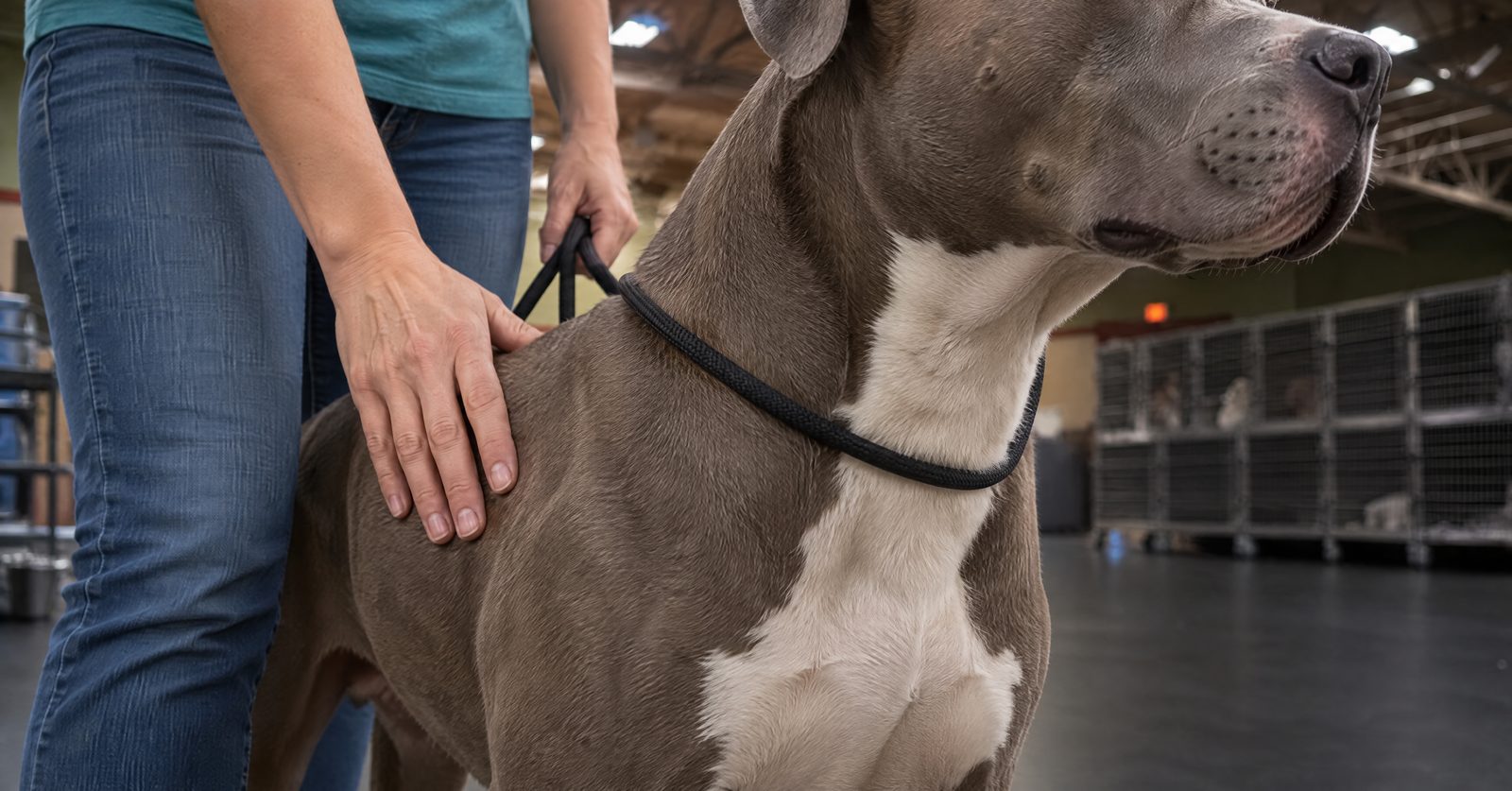
It shows up as the dog that will not cross the parking lot, the one frozen on the table, or the one that snaps. A snap at the vet is not always fear, either: some dogs run on over-arousal or frustration at being pinned. We read the dog in front of us and plan from what is actually happening.
What is a start button behavior?
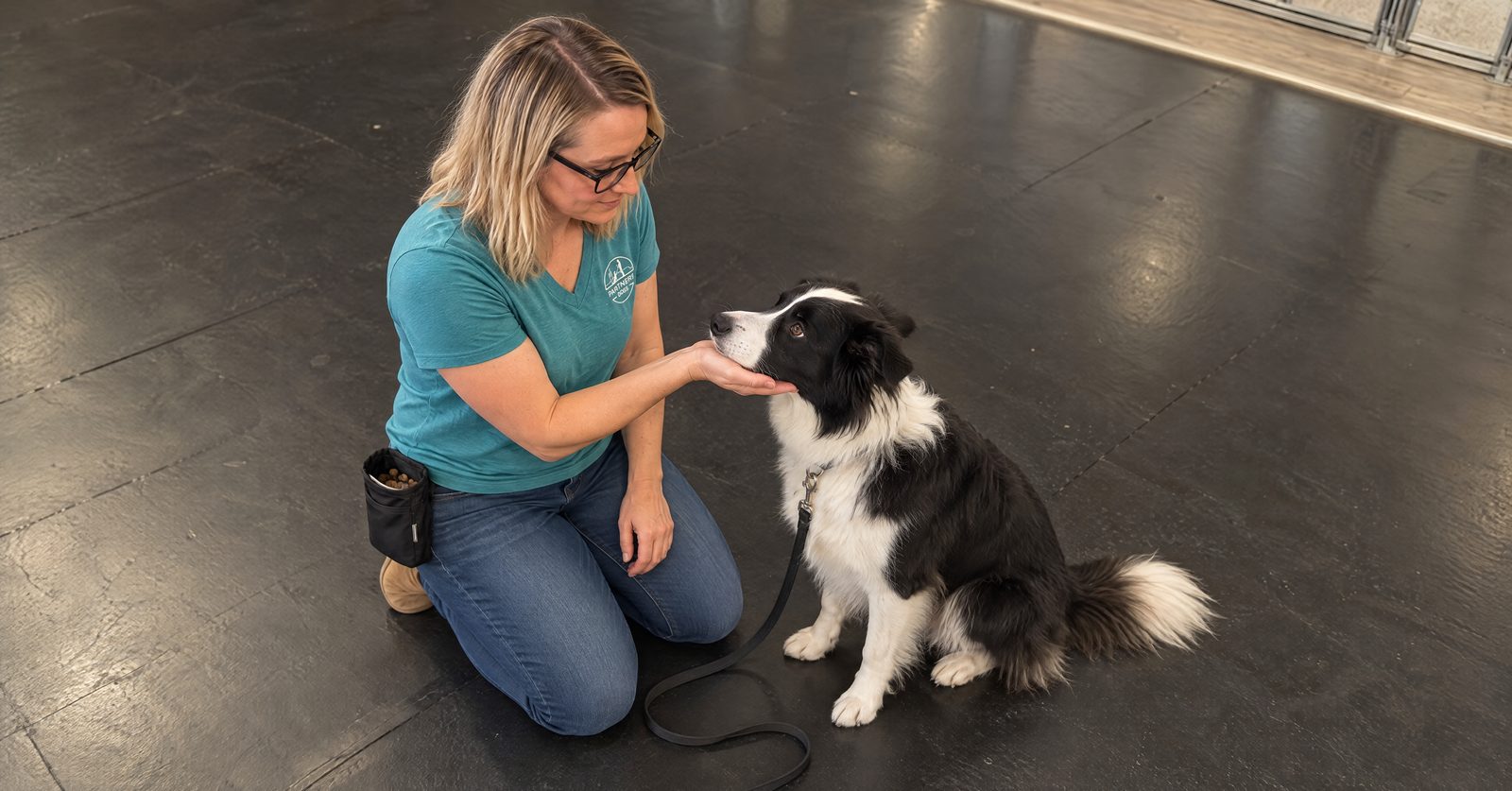
A start button is a trained behavior your dog offers to say "I'm ready, go ahead." The standard one is a chin rest.
Here is how it works in practice. You teach your dog to rest its chin in your open palm or on a towel. Chin down, you may begin touching paws or ears, whatever the drill is. The moment the dog lifts its head, you stop touching. Hands off. The dog learns within a few sessions that its signal controls the work, which is exactly what lowers the stress: predictability plus an exit.
And here is the part people get wrong. Respecting the opt-out does not mean quitting the drill. It means you make the drill easier. The dog lifts its chin at paw-touch number three? You go back to two touches, pay well, and end on a win. Dogs that learn their "no" gets heard start saying "yes" more, because the exchange is honest. Trainers use this same loop for everything from nail trims to crate entries: the dog learns that opting in is always safer than opting out, and the habit transfers to every handling situation, clinic or otherwise.
This is the same ethic we apply to tools, covered in our e-collar science article: nothing gets strapped on or powered up before the dog is conditioned to understand it. A chin rest is conditioning. A muzzle is conditioning. The principle does not change with the equipment.
How does the five-stage conditioning protocol work?
You train the vet visit at home, in order, before the real visit ever happens. One action per step, short sessions, three to five times a week:
- Teach the chin rest. Hold your open palm just under your dog's chin. Mark and treat the instant the chin lands on your hand. Build to a 5-second hold, then 10. Add the cue word "chin" only after the behavior is solid.
- Add touch during the rest. While the chin stays down, touch an ear, then treat. A paw, then treat. Lift a lip, then treat. Chin comes up? Touch stops. Re-offer, ask for one easier touch, pay generously, quit while you are ahead.
- Run mock exams. Stethoscope pressed to the ribs. Hands running down each leg. Tail lifted gently. Thermometer touched to the hip (not inserted; that is the vet's job). Stand-stay on a bath mat that will become the dog's exam "station."
- Rehearse the clinic with no exam. Drive over. Walk in. Treats for entering the lobby. Treats for standing on the scale. Then leave. Do this two or three times with zero handling from staff. You are rewriting the building's meaning, one short happy visit at a time.
- Chain it at the real visit. Bring the mat. Ask for the chin rest. You feed treats through the exam while the vet works, or the vet feeds while you hold the rest. Short exams first: one procedure per visit beats five at once while the behavior is new.
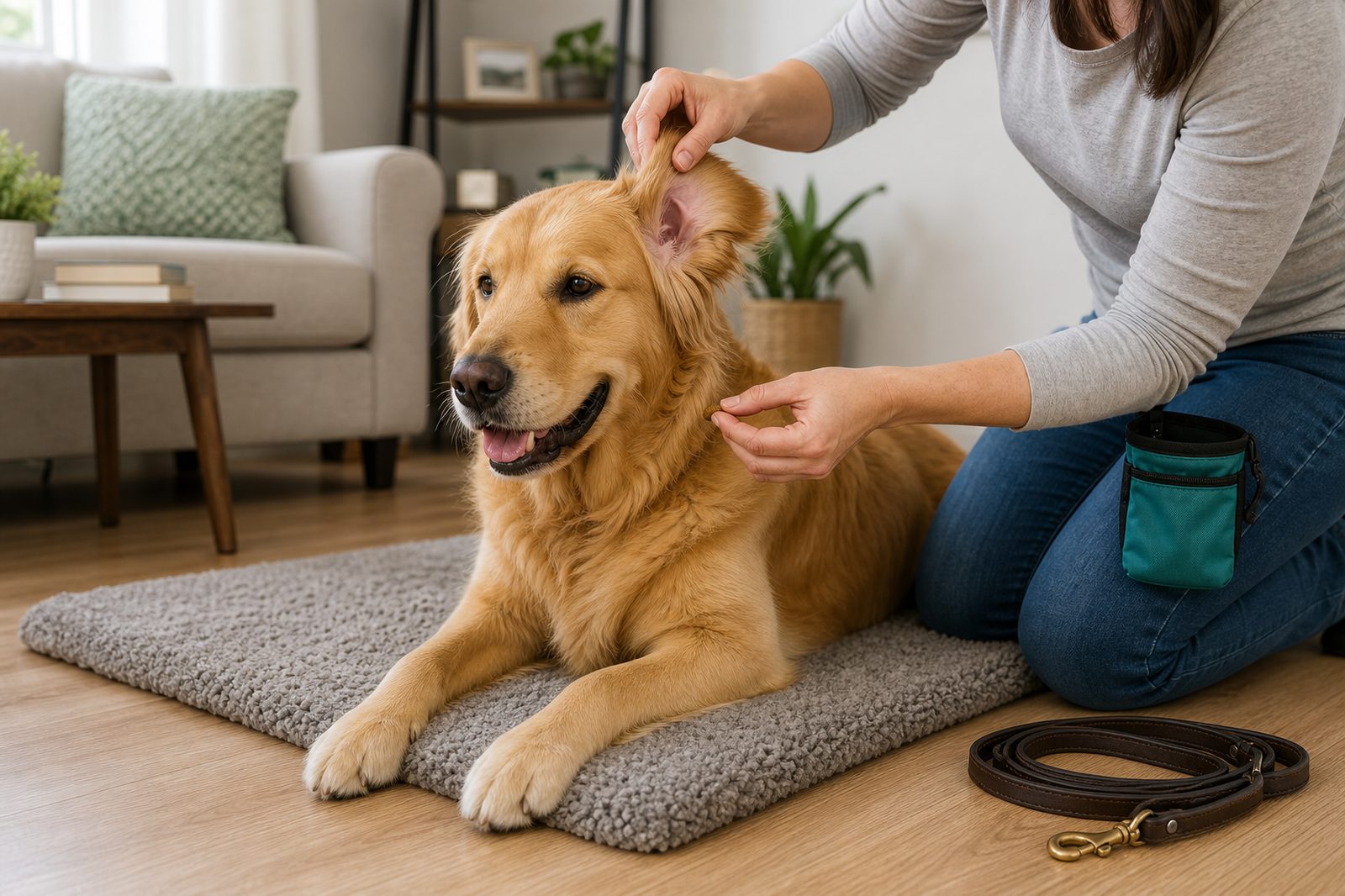
A note on proofing, since our method runs the five D's (duration, distraction, distance, direction, difficulty): a chin rest in your kitchen is Teach. A chin rest in a loud lobby with another dog barking is Proof, and you earn your way there. Do not skip the middle. If the kitchen-to-lobby jump stalls, a trainer at our Scottsdale campus can run the middle rounds: mock exams on a real table, with a coach reading the dog.
Should your dog be muzzle trained for vet visits?
Yes. A conditioned muzzle is a safety tool, and every dog should have one conditioned before it is ever needed.
Some Pet Parents hear "muzzle" and feel judged. Drop that. Vet staff muzzle scared dogs daily to keep everyone safe, and a dog that rehearsed the muzzle at home walks into the exam with one less novel stressor. The dog that meets the muzzle for the first time mid-panic meets it as a threat. Condition first.
The protocol mirrors every other tool we condition:
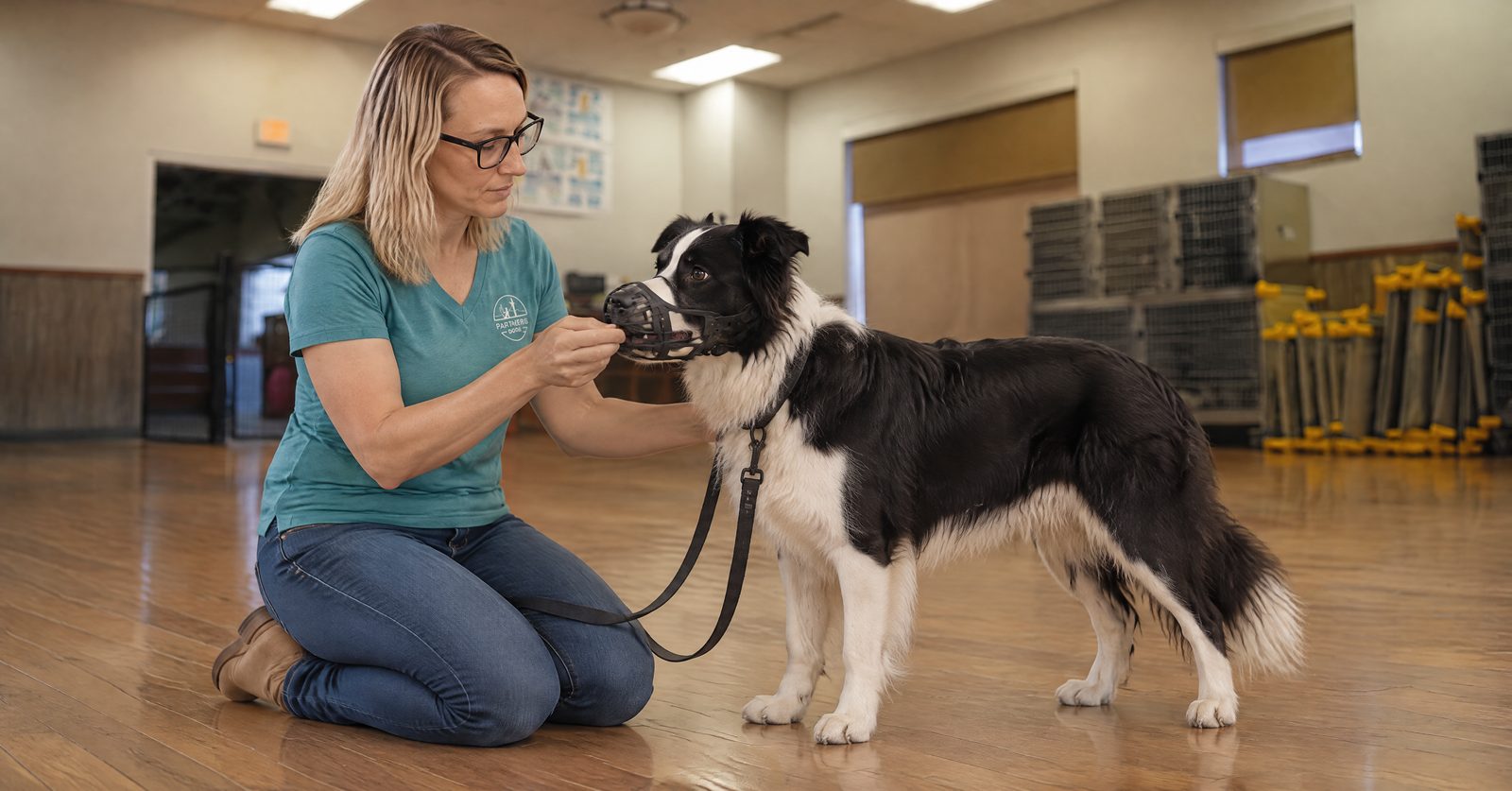
- Muzzle equals treats. Show the muzzle, feed high-value treats near it, then through the gaps. The dog's nose follows the food into the basket on its own.
- Build nose time. The dog learns that pushing its nose into the muzzle produces treats, repeatedly. You are after a dog that sees the muzzle and shoves its own face in.
- Add straps without fastening. Drape them. Lift them. Treat. Only fasten when the dog is unbothered by strap movement.
- Build wear time. Fasten, treat, unfasten. Then fasten and take a short walk around the house. Work up over sessions, not within one session.
Use a basket muzzle: the dog can pant and take treats through it, which the PDSA muzzle-training walkthrough also requires of a well-fitted muzzle (retrieved 2026-09-16). If your dog paws at the muzzle constantly, you moved too fast. Go back a step. Speed is never the metric.
Can you make vet visits truly fear free?
You can get close with conditioning, but honesty matters: some fear is realistic, and the goal is a dog that copes, not a dog that feels nothing.
Partners' position first: we train the behavior that makes exams work, we keep the handling predictable, and we do not promise feelings we cannot deliver. A dog that has been conditioned well may still dislike a blood draw. Dislike with a chin rest and treats is a different universe from panic on a table. Take the win.
What helps on the clinic side:
- Short, separated procedures. One stressful thing per visit while the dog is learning. Stacking the nail trim, the vaccines, and the ear cleaning into one appointment is flooding.
- Pauses built in. A vet team that stops when the dog is over threshold and resumes when it settles is practicing the same start-button ethic you trained at home. Ask for it directly.
- You in the room. Research on owner presence during exams encouraged keeping owners with their dogs during routine exams where practical (JAVMA, retrieved 2026-09-16). Stay with your dog.
- Treats through the whole exam. Bring the good stuff. A dog that can eat is a dog that is coping. A dog that will not take food it normally loves is telling you it is over threshold. Believe it.
This is also the checklist a coach runs with you in Private Lessons: one short coached session on the living-room mat, then you run the reps through the week. The trainer's job is the timing on the opt-out, catching the chin lift early while you learn to see it.
When is training not enough?
Conditioning does not fix true panic. If your dog cannot eat, cannot think, and cannot offer a single trained behavior at the clinic, that is a medical case wearing a training costume.
Medic factors get checked first in our method, and this topic is the clearest example of why. Pain, thyroid trouble, GI problems, and medication effects can all drive the behavior that looks like a vet-phobia. Rule out medical causes first (Merck Veterinary Manual, retrieved 2026-09-16). We partner with your vet on this. No training article substitutes for veterinary care.
Here is the honest gate:
- Mild to moderate stress: the protocol above works. Start-button drills, graduated exposure, muzzle conditioning. Most dogs land here.
- Severe, rehearsed panic: the dog needs its vet and a qualified behavior specialist before it needs more reps. Conditioning layered over unmanaged panic just rehearses panic with better snacks.
- Situational medication: a fair question to ask your vet. For the right dog, short-acting medication prescribed for vet visits lowers the stress spike enough that conditioning can take hold. It is a tool in the plan, full stop. We will not name drugs here; that conversation belongs to you and your veterinarian.
If a trainer promises that conditioning alone fixes every case, they are selling something. The honest ones know where their lane ends.
What do the numbers say?
Conditioning works when you put in the reps.
What mistakes make vet fear worse?
- Flooding the first visit. Bringing an unprepared puppy to a full exam plus vaccines plus a nail trim teaches the dog that clinics are ambushes. Stage the exposure.
- Restraint as the plan. Holding a panicking dog still until the exam is over trains the dog that struggling is pointless, not that exams are safe. Teach the behavior, then do the exam.
- Only going when something is wrong. If every clinic trip ends in pain, the building becomes a predictor of pain. Happy visits with no exam exist for exactly this reason.
- Quitting at the first opt-out. The dog lifts its chin, and the drill dies forever. The opt-out buys an easier rep, not retirement.
- Skipping the muzzle because it feels bad. The unconditioned muzzle appears mid-crisis. The conditioned muzzle was boring months ago.
Step one
Vet-Visit Training at Home, With a Coach
Start with a PD360 Assessment: a senior trainer reads your dog across nine dimensions and routes you to the right starting point. For handling work beyond the basics, Private Lessons run the full conditioning protocol at your home, then hand you written take-home drills.
Key takeaways
Key takeaways
- Cooperative care teaches your dog to participate in handling through a start button: signal in, work happens, signal out, work stops. Most vet fear is learned from flooded, rushed, restrained first visits, so you rebuild in the opposite order.
- The chin rest is the standard start button. Respect the opt-out with an easier rep, not by quitting.
- Train handling at home first (ears, paws, mouth, tail, mock exams), then rehearse the clinic with no exam, then chain it at real visits.
- A conditioned basket muzzle is a safety tool. Condition it like any tool: before pressure, at the dog's pace.
- Conditioning has real limits. True panic needs the vet and a behavior specialist, and situational medication is an honest option to discuss with your vet.
- The numbers: 41% of dogs show mild-to-moderate vet-exam fear, ~14% severe/extreme (University of Adelaide, 26,555 surveys); 22% of owners would visit more often if visits were less stressful.
Frequently Asked Questions
What is the first step if my dog already panics at the vet?
Book a PD360 Assessment. A senior trainer reads your dog across nine dimensions and tells you honestly whether this is a training case, a vet-and-behaviorist case, or both. For dogs in true panic, we route you to your vet first: conditioning layered over unmanaged panic rehearses panic.
What is a start button behavior?
A trained signal your dog offers to start a procedure, usually a chin rest on your hand or a towel. Chin down means go ahead. Chin up means pause, and you stop touching. It gives the dog a vote, which lowers stress through predictability. Respect the pause with an easier rep.
Should I muzzle my dog for vet visits?
If your dog might snap, yes, and condition the muzzle at home first. Use a basket muzzle so the dog can pant and take treats. Lure the nose in with food, build nose time, then strap handling, then brief fastened wear over several sessions. A dog that has rehearsed the muzzle calmly has one less stressor on exam day.
Can my vet sedate my dog for exams?
Ask your vet about situational medication for visits. For the right dog, a short-acting prescription lowers the stress spike enough that conditioning can take hold. It is a legitimate tool in the plan, not a shortcut. We do not name or recommend specific drugs here; dosing and suitability are between you and your veterinarian.
How long does cooperative care training take?
Weeks, not days. Most dogs learn a reliable chin rest and basic handling tolerance in three to six weeks of short sessions, three to five times a week. Muzzle conditioning runs on the same timeline. Dogs with deep, rehearsed vet panic take longer, and some need vet-supported medication alongside the training. Start before you need it.
Where to go from here
A dog that trusts the process at the vet is a dog you conditioned on purpose, in order, at its pace. Start the chin rest this week. Run the handling drills before the next appointment. Condition the muzzle before you need it. If the panic runs deeper than training, bring us the dog and we will tell you honestly what it needs, starting with the assessment.
Scottsdale: 8642 E Shea Blvd, 85260. Cave Creek: 4640 E Forest Pleasant Pl, 85331. Serving the Phoenix Valley.
Which program fits
Vet-Visit Training at Home, With a Coach
Start with a PD360 Assessment: a senior trainer reads your dog across nine dimensions and routes you to the right starting point. For handling work beyond the basics, Private Lessons run the full conditioning protocol at your home, then hand you written take-home drills.