Dog daycare incident prevention runs on a four-step sequence: read rising arousal early, redirect at the first threshold, cycle rest breaks through the day, and hand off to a trainer, not just an attendant, when redirection is not enough. Partners Dogs runs roughly a 10:1 dog-to-trainer ratio at DaySchool, the structure that makes each step possible before a scuffle starts, not after.
Picture a mid-morning play session on a Phoenix metro DaySchool floor. A lab mix and a shepherd mix are chasing a flirt pole, and somewhere around the third pass the chase gets faster, the bodies get stiffer, and one dog starts cutting the other off instead of running alongside it. Nothing has gone wrong yet. This is the exact moment the whole system exists for, and what happens in the next few seconds is not luck. It is a trained sequence a facility either has or does not.
What Do Staff Watch For Before Play Turns Into a Problem?
The clearest predictor of a fight is rising excitement, not breed or size. A dog that is about to have a problem usually shows it in posture and pace before it shows it in a growl: a faster, choppier gait, a body that goes stiff mid-stride, ears pinned forward, a mouth that closes from an open pant, or a pitch change in the barking around the group. None of these signs mean a fight is guaranteed. They mean a dog has crossed from loose, relaxed play into a state that needs a response.
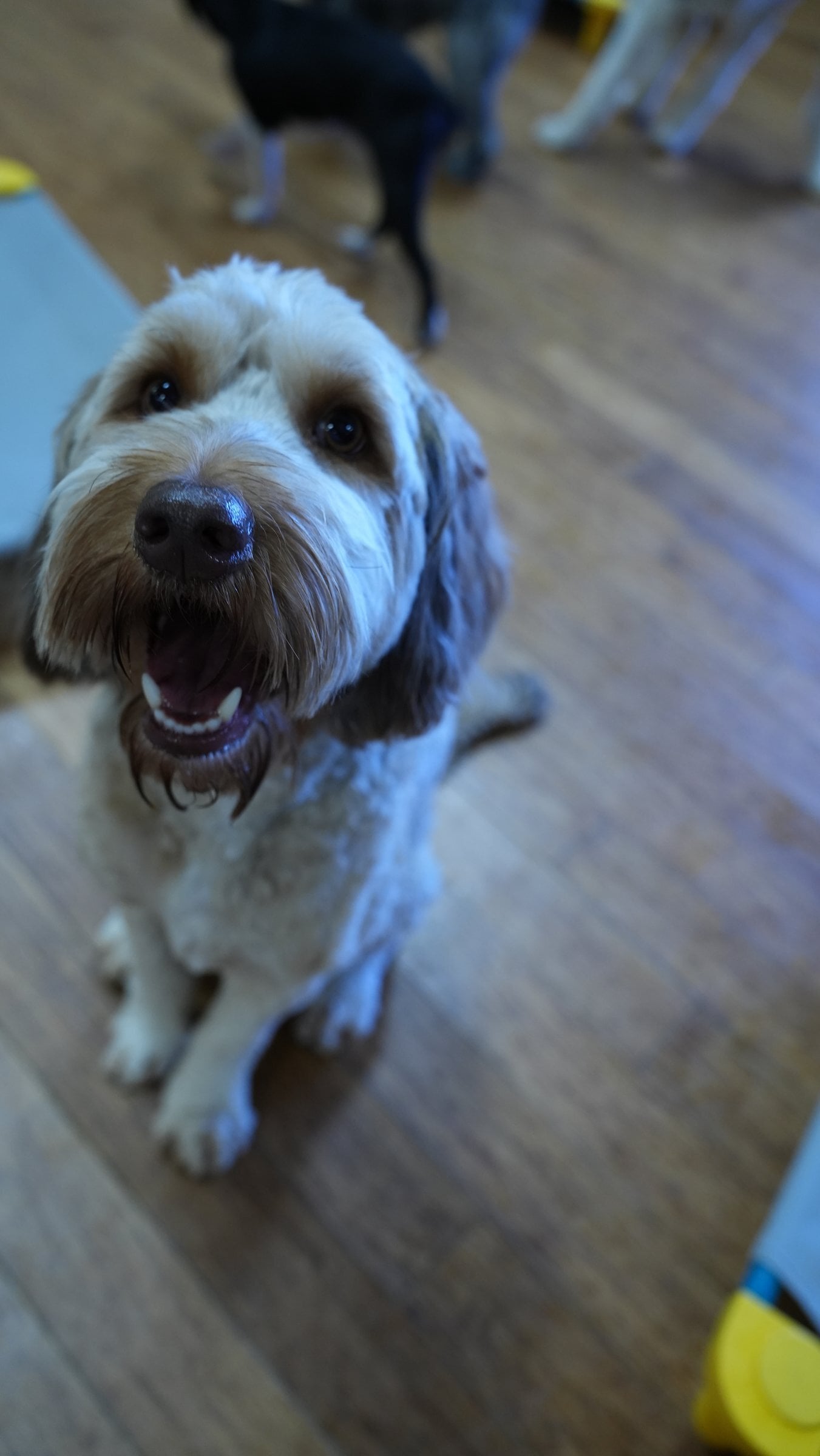
Staff at a structured DaySchool are trained to read this shift the way a lifeguard reads a swimmer struggling before they call for help, watching the whole floor instead of waiting for an obvious warning sign. That kind of attention comes from the roughly 10:1 dog-to-trainer ratio Partners Dogs runs at DaySchool. A floor with too few eyes on too many dogs cannot catch a posture shift, it can only react once the noise starts.
"Each dog is evaluated before they are approved for doggie daycare and there are multiple trainers all day, so you can be confident that your dog is in good hands."
Megan M., Cave Creek
"I have complete confidence my dogs are handled with care and the trainers are familiar with my dogs so they know of any potential triggers."
Karin H., Cave Creek
What Happens the Moment a Dog's Arousal Starts to Climb?
A redirect is a small, routine interruption, not a crisis response. The moment a staff member sees arousal climbing, the intervention is deliberately low-key: a recall back to the handler, a body reposition that breaks the two dogs' eye contact, a toy swap that changes the game, or a brief physical separation to different zones of the floor. None of these look dramatic from the outside, and that is the point. Waiting until a fight starts to intervene means the intervention has to be bigger, louder, and riskier for everyone involved.
Common redirect tools include:
- A verbal or physical recall that pulls one dog's attention off the other
- Repositioning a handler's body to physically break the dogs' line of sight
- Swapping in a different toy or activity to reset the energy of the interaction
- A short, calm separation to opposite ends of the play space
The threshold for using one of these is intentionally early. A staff member does not wait for a growl or a hard stare to act, they act on the pace and posture change that comes before it, which is why the ratio matters more than any single rule on a wall.
Why Does Every Dog Get a Break, Not Just the One Getting Wound Up?
Rest cycles are scheduled for the whole group, not just triggered by one dog acting up. Open-play group settings run on continuous stimulation for hours, and continuous stimulation is exactly what pushes a dog's arousal past the point where a simple redirect works. Structured programs build pauses into the day on purpose: dogs rotate out of active play into quieter zones on a schedule, not only when a specific dog shows signs of overexcitement.
This does two things at once. It gives every dog a chance to come down from a high before they ever reach a threshold that needs a redirect, and it removes the awkward dynamic of singling out one dog as "the problem" in front of the group, which can itself raise tension. A rest cycle is boring by design. Boring is the goal.
Who Steps In When Redirection Does Not Work?
Most daycares, including the large open-play chains, genuinely do supervise their play groups. That is a fair thing to concede, and it is worth saying plainly: watching dogs play is not nothing. The real difference shows up in who intervenes and how far their training goes once a simple redirect does not settle a dog down. An attendant can manage routine redirects, toy swaps, and rest rotations all day. What an attendant is not trained to do is read whether a dog's rising arousal is normal excitement, a guarding response, or an early sign the dog needs a different kind of day entirely.
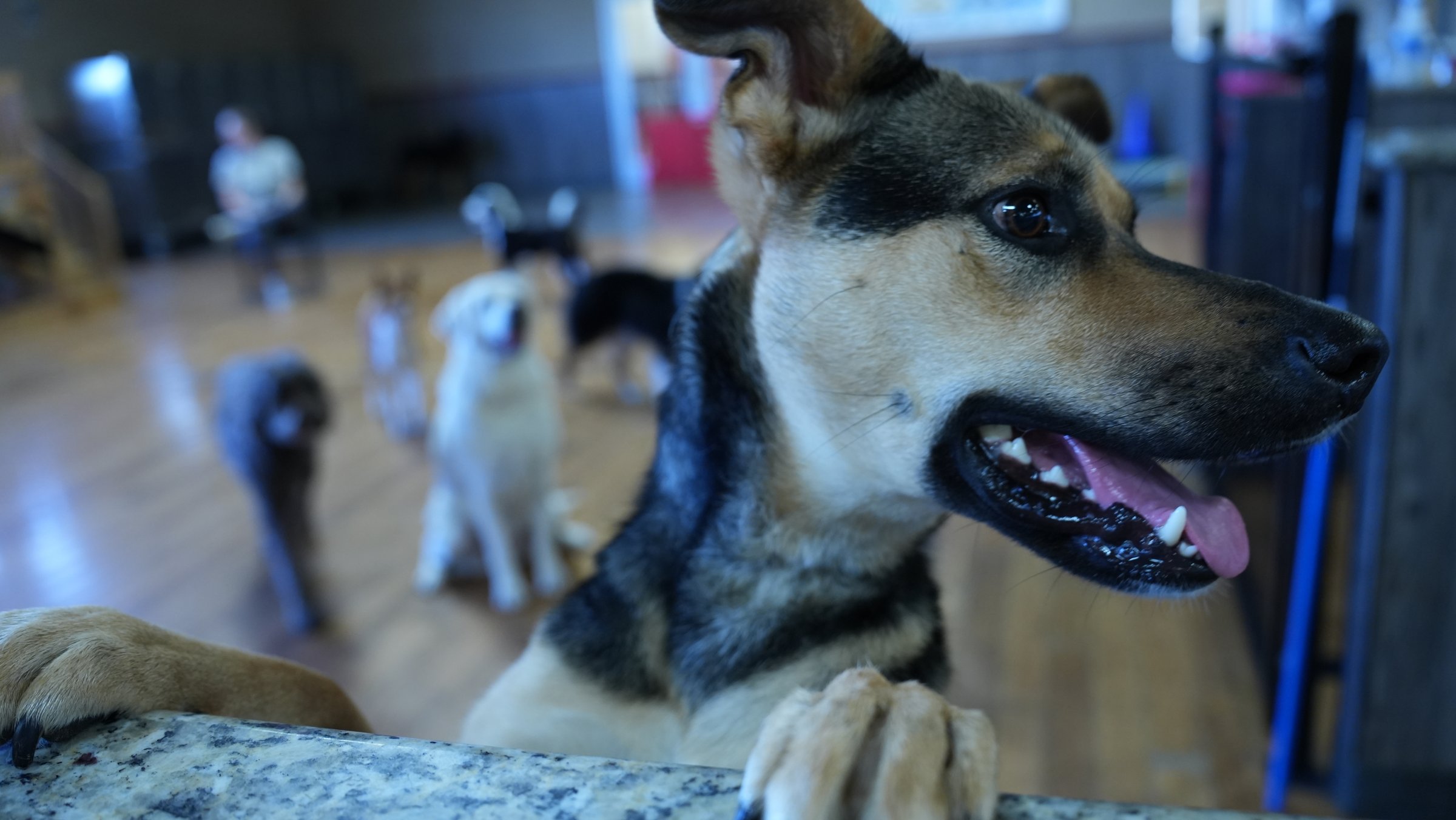
That decision goes to a trainer, not an attendant, at a Partners Dogs floor. A trainer-run escalation tier means the person making the call on whether a dog stays in group play, moves to a smaller group, or comes out of the group for the day has the background to read behavior, not just manage a schedule. This is the specific, checkable difference between a facility built around containment and one built around trained intervention: a named sequence with a defined handoff point, not just more eyes in the room.
How Is Guarding Around Toys or Space Handled Differently?
Resource guarding is treated as its own category, separate from general play arousal. A dog that stiffens over a favorite toy, a resting spot, or even a staff member's attention is not doing the same thing as a dog whose chase play has run too hot. Guarding triggers are lower-drama on the outside and easy to miss if staff are only watching for obvious rough play, which is why groupings pay attention to items on the floor and rotate high-value toys out of open group settings rather than leaving them in circulation all day.
A dog with a known guarding pattern gets managed with specific, individual protocols rather than a blanket rule for the whole group. If a family already knows their dog guards food, toys, or space at home, that is worth naming before the first day. The resource guarding assessment covers exactly this kind of pattern in more depth than a daycare intake conversation can.
Come watch a session
Watch a Structured Day Before You Decide
The easiest way to judge a daycare's process is to see the floor and ask staff how they handle a redirect. Tour a Phoenix metro DaySchool day and see the ratio and the sequence at work.
When Does a Dog Need More Structure Than Daycare Provides?
Some dogs are simply not ready for open group play, and daycare structure alone will not fix that. A dog that needs frequent redirects every session, struggles to settle during rest cycles, or shows a repeated guarding pattern is telling staff something a checklist cannot fully answer on its own. This is a normal outcome, not a failure of the dog or the family, and it is exactly what the escalation tier described above is designed to catch early rather than after a real problem develops.
When a trainer flags this pattern, the next step is a structured PD360 look at what is driving it, not an attendant's after-the-fact hunch. A PD360 Assessment scopes the behavior in detail and points to whether the dog needs a more structured day program, individual coaching, or a different pace of socialization entirely. Reactive, undersocialized, or newly adopted dogs often do better in a smaller, more deliberately built group before they are ready for a large open floor. That distinction only matters if the daycare is watching closely enough to notice it in the first place.
Partners Dogs has trained 70,000+ dogs, and across that experience the same pattern shows up again and again: the dogs who do best in group settings are the ones whose early signals got caught and managed, not ignored until they became loud.
Key takeaways
- Partners Dogs runs roughly a 10:1 dog-to-trainer ratio at DaySchool, the structure that lets staff catch rising arousal before a redirect is even needed.
- Redirect tools include a recall, a handler body reposition, a toy swap, or a short separation. All of these get used at the first shift in posture and pace, rather than after a growl or hard stare.
- Rest cycles are scheduled for the whole group throughout the day, not only triggered when one dog starts acting up.
- When a redirect does not settle a dog down, the decision moves to a trainer, not an attendant. That person decides whether the dog stays in group play, moves to a smaller group, or comes out for the day.
- Partners Dogs has trained 70,000+ dogs across its Phoenix metro DaySchool programs, and the dogs who do best are the ones whose early signals got caught and managed.
Frequently Asked Questions
What signs tell a staff member two dogs are about to have a problem?
Staff watch for a shift in posture and pace before any growling starts: a stiffer body mid-stride, a faster or choppier gait, ears pinned forward, or a pant that closes into a tight mouth. These are read as the earliest signals, well before a lifted lip or a hard stare, which is why intervention happens through a low-key redirect rather than a dramatic separation.
Does every dog get pulled from play the moment they show excitement?
No. Excitement itself is normal and expected in group play. Redirects happen at a specific threshold, when arousal is climbing past playful into something faster and stiffer, not at the first sign of a dog having fun. Scheduled rest cycles also apply to the whole group throughout the day, not only to a dog that is showing signs of overexcitement.
What happens if a dog does not settle after a redirect?
If a low-key redirect, such as a recall or a toy swap, does not bring a dog's arousal back down, the decision moves to a trainer rather than staying with an attendant. A trainer can judge whether the dog needs a longer separation for the rest of the session, a smaller group setting going forward, or a closer look through a PD360 Assessment.
Can I ask what happened during my dog's day if there was an incident?
Yes. A structured program can walk a parent through exactly which stage of the sequence was used with their dog that day, from an early redirect to a rest-cycle pull to a trainer-level review, rather than a vague summary. That level of detail is only possible when the process is a named sequence in the first place, not just general supervision.
Is resource guarding handled the same way as a normal play scuffle?
No. Guarding around a toy, a resting spot, or a person is treated as its own category with individual protocols: rotating high-value items out of group circulation rather than leaving them in the general redirect-and-rest sequence used for play arousal. A known guarding pattern is worth flagging before a dog's first day so staff can plan around it.
Is paying for professional day school training in the Phoenix metro area actually worth it?
The value shows up in the process, not just the price tag: a roughly 10:1 dog-to-trainer ratio, a named redirect-and-rest sequence, and a trainer-level escalation tier catch rising arousal before it becomes an incident, instead of relying on an attendant to react once a fight has already started. That difference applies the same way across Scottsdale, Cave Creek, and the rest of the Phoenix metro area. It comes from how the day is structured, not from location.