At a glance
Daycare with training vs regular daycare is not a pricing tier, it is a different product: one is supervised free play, the other runs a curriculum through the same hours. A tired dog at pickup only tells you the day was long, not that anything was taught. For a Phoenix-area owner comparing options, the real differences are the staffing ratio, the daily record of what your dog worked on, and what you are paying for.
Every daycare in the Phoenix area advertises a tired, happy dog by pickup time. Both a play-only room and a training-based day will wear a dog out; the real difference in daycare with training vs regular daycare shows up in what changes between drop-off and pickup, not in how worn out your dog looks at the end. This piece breaks down what a training-based day adds, where a plain play room is still the right call, and what Partners Dogs charges for the difference.
Daycare With Training vs. Regular Daycare: Why the Word Doesn't Mean the Same Product
The word "daycare" covers two very different businesses in the Phoenix area, and nobody bothered to give them separate names. One is a warehouse-style daycare with a handful of attendants watching 20 to 50 dogs at a time, almost pure free play, and no record of the day beyond a photo at pickup. The other runs on a curriculum, with staff trained to teach and correct behavior, not just watch it happen. Both call the result "daycare." Both hand your dog back tired.
That similarity is exactly why price looks like the only variable. If one facility charges noticeably more a day than the one down the street, the natural assumption is a nicer building or a longer pickup window. Sometimes that is the whole story. When the pricier option is DaySchool, the extra dollars buy three things: a different staffing model, a curriculum your dog is working through, and a written account of the day, not a fancier lobby.
What a Play-Only Room Is Built to Do
A play-only room does one job, and it often does it well: it lets dogs burn energy and practice being loose and social around other dogs, supervised by people watching for fights and overheating rather than grading behavior. For a dog who already has decent manners at home and just needs exercise and company on a workday, that is enough. This is the setup at most standard daycares across Scottsdale, Cave Creek, and the rest of the valley: open floor space, a handful of attendants, and a schedule built around play blocks and rest breaks.
None of that is a knock on the model. A play-only room that is upfront about being supervised free play, priced accordingly, is doing exactly what it says it does. The trouble starts when a facility charges training-daycare prices for a play-only day.
What Changes When Training Runs Through the Day
Swap the attendants for trainers and give the day a curriculum, and the same hours turn into something closer to a working shift for your dog.
| Option | Staffing | Structure & tracking | Day rate |
|---|---|---|---|
| Play-only / warehouse daycare | 1 attendant per 20 to 50 dogs | Free play, no curriculum, no written record | Varies by provider, often the lower sticker price |
| DaySchool (training daycare) | 1 trainer per 10 dogs | Grade-level curriculum, 130+ behaviors tracked, daily Pupdate | Drop-in or membership pricing; see the pricing page |
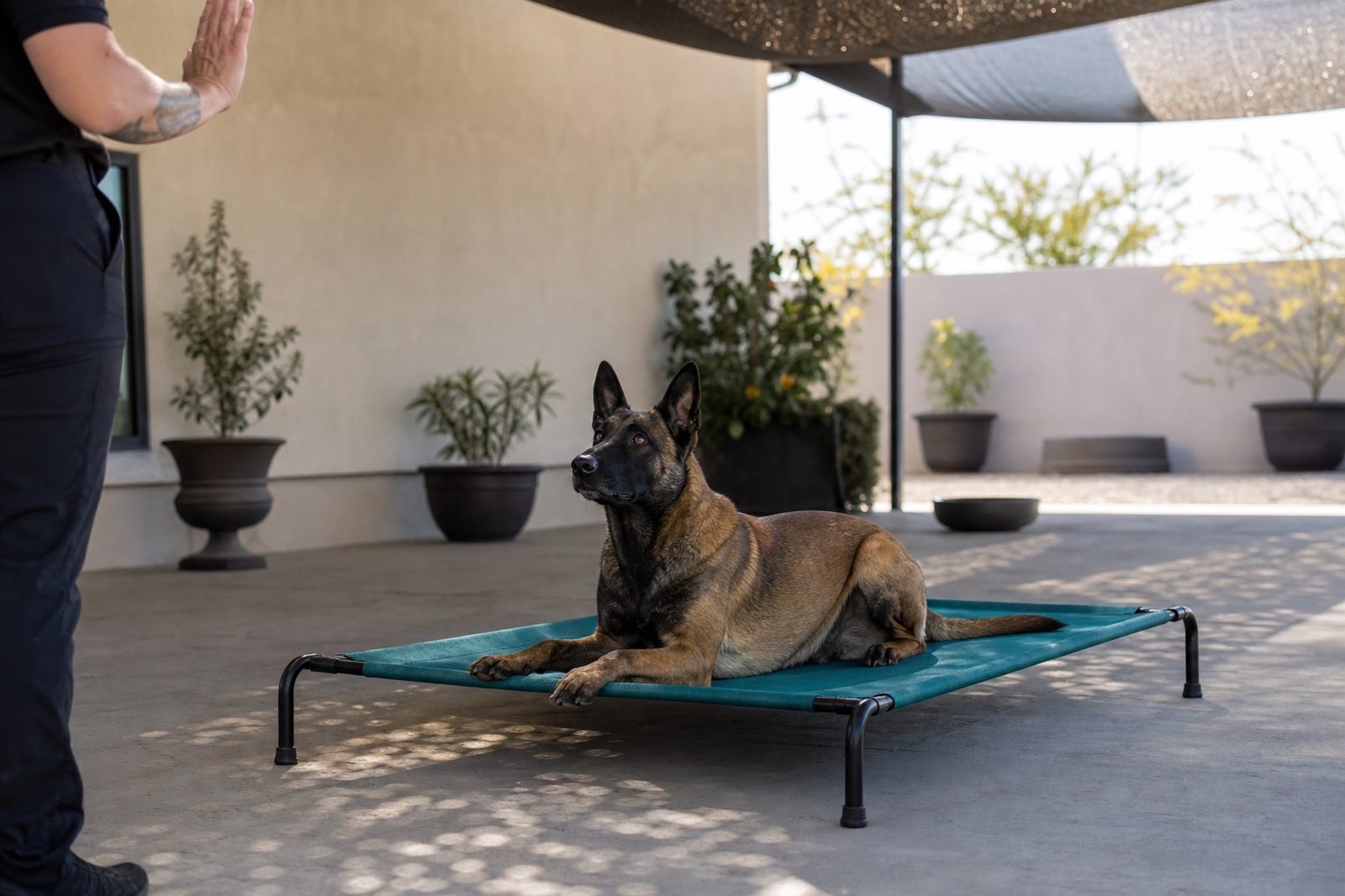
The middle column is where the price difference lives. A DaySchool day is built around the same grade-level curriculum taught in Group Classes, so your dog leaves not just tired, but a session further into the grade they are currently working. Play still happens, dogs still nap, but a trainer runs structured blocks between those breaks instead of watching the room from a chair.
A Scottsdale client, Kate L., described the same shift in one line:
"I also appreciate that there is structure and it isn't a free for all."
That is the whole difference in eleven words.
Staffing Math: What One Trainer per 10 Dogs Changes
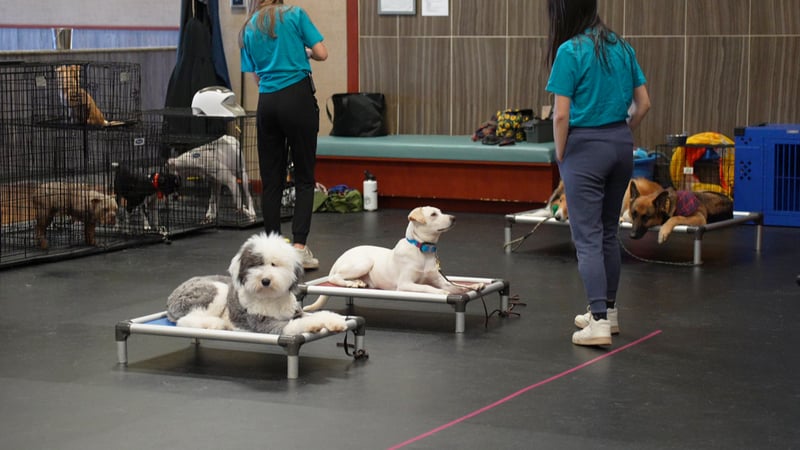
Twenty to fifty dogs sharing one pair of eyes means intervention is reactive: a fight gets broken up, an overheated dog gets pulled, but nobody is coaching an overexcited greeter down before it turns into a scrap. Ten dogs sharing one trainer means the ratio supports active teaching, not just crowd control. That trainer can catch the moment a dog fixates on the door, redirect a dog before jumping turns into a habit, and rotate a spent dog into a rest area instead of letting them grind on adrenaline all day.
Brandon S., a Scottsdale client whose dog went through board and train and now visits weekly, put it plainly:
"Every trainer and staff member I have met and worked with has been kind, patient, and very attentive to our dog."
That kind of attention comes from the staffing ratio DaySchool runs on, part of why Partners Dogs holds a 4.8-star rating across 2,000-plus reviews.
How the Grade-Level Curriculum Turns a Day Into Progress
That grade-level curriculum, the same one covered in Group Classes, tracks more than 130 behaviors across eight grades, from Pre-School Puppy through Dogtorate. Each one is proofed through four stages: Teaching, Reinforcing, Proofing, and Maintenance. Only then does it count as learned.
- Pre-School Puppy through Kindergarten: foundation manners and threshold behavior.
- Elementary through High School: everyday obedience under real distraction.
- College through Dogtorate: off-leash reliability and advanced impulse control.
In a daycare context, that curriculum is not abstract. A dog working through overexcitement at the door gets a trainer running arrival routines with him instead of just letting him bounce off the gate. A dog still jumping on people during greetings gets corrected the same way, by every staff member, instead of getting mixed signals depending on who is closest. A dog working on not listening around distractions gets that skill proofed in the hardest room in the building, a floor full of other dogs.
See it firsthand
Watch What a Trainer Changes in One Day
See what a DaySchool day includes, hour by hour, before you decide where your dog's day should go.
What a Pupdate Tells You That a Photo Can't
A photo at pickup proves attendance. Whether the day worked is a separate question. A Pupdate is the daily written and photo record DaySchool sends home: what your dog worked on, what to reinforce at home, and which dogs they played with, tied back to the grade they are currently working through.
Jessica D., who boarded her dog at the Scottsdale campus, described what that record does for a worried owner:
"The photo and video “pupdates” put my mind at ease. I could see he was happy and well taken care of."
A plain play-only room can send a cute photo. It cannot tell you your dog held a settle command for the first time, because nobody there is tracking that.
When a Play-Only Room Is the Right Call
None of this makes a plain play room the wrong choice for every dog. For some dogs and some households, it is the right one.
- A dog with solid house manners who just needs exercise and company. If your dog already settles, does not jump, and comes when called, you may be paying for curriculum work your dog has already finished.
- A budget-limited household that needs reliable coverage. A basic play room is usually the cheaper option, and cheaper daycare that gets used every week beats a pricier plan that gets skipped.
- A dog who does not do well with a full day of structure. Some dogs, especially older ones set in their ways, settle better into loose free play than a day of guided sessions.
- A short-term or occasional need. If you need coverage for one trip or one busy week, the training upside of a curriculum-based day takes weeks to show up, not a single visit.
The fair way to compare two rooms is what each one publishes about the day, not just what it charges for it. A play-only room that is upfront about being supervised free play, at a lower price, is doing exactly what it promises.
Still deciding
Which Program Actually Fits Your Dog?
Answer a few questions about your dog's current manners and energy, and get pointed at the program built for that dog, not the one with the loudest ad.
What DaySchool Costs: Day Rate and Membership
A single DaySchool day is priced per visit, and a membership lowers that effective day rate while adding a discount across everything else: boarding, grooming, private lessons. See current rates and the exact math on the pricing page.
If your dog's needs go beyond a training daycare, a reactive, fearful, or newly adopted dog needs a different program: DayCamp, priced and staffed for that heavier lift. See our full DaySchool-vs-DayCamp breakdown for which program fits which dog. This article is about the training-daycare tier, not that one.
Frequently Asked Questions
Is daycare with training worth the extra cost?
For a dog still working on manners, greetings, or listening around distraction, yes. You are paying for a 1-trainer-to-10-dog ratio and a grade-level curriculum instead of pure supervision, and that shows up as measurable behavior change, not just a tired dog. For a dog who already has solid house manners and just needs exercise, a plain play room can be the better value.
Does my dog still get to play at DaySchool, or is the whole day training?
Yes. A DaySchool day still includes play and rest breaks; a trainer runs structured teaching blocks between them instead of just watching the room from a chair. Your dog gets the same socializing and energy burn as a play-only day, plus a session further into whatever grade of the curriculum they are currently working.
How many dogs does one trainer supervise at DaySchool?
One trainer per 10 dogs, compared with the 20 to 50 dogs per attendant common at standard daycares. That ratio is what makes real-time coaching possible instead of just crowd control.
What is a Pupdate?
A Pupdate is the daily photo and video update Partners Dogs sends home from every DaySchool day, covering what your dog worked on, what to reinforce at home, and which dogs they played with. It arrives through the Pet Parent Portal, not a public livestream.
How much does DaySchool cost?
A single drop-in day is priced individually, and a membership brings the effective day rate down while adding a discount on boarding, grooming, and private lessons. Current rates and tiers are on the pricing page.
Is a plain play-only daycare a bad choice?
No. It is the right choice for a dog who already has good manners and just needs exercise and company, or for a family on a tight budget that needs reliable coverage more than coaching. It is only the wrong comparison when a facility prices itself like a training program without running one.
Ready when you are
Give Your Dog's Day a Curriculum
Drop-in days and memberships are both available, with current rates on the pricing page, and every day ends with a written Pupdate home.
Keep reading