Straight answer
Dog intelligence is pattern recognition: noticing that trigger A leads to outcome B, and learning new patterns quickly.
- Intelligence is one thing: recognizing patterns, and especially learning new ones fast.
- "Smartest breed" lists measure obedience trainability as judged by obedience judges. Coren did honest work on what he measured; the listicles repackaged it.
- Drive reads as smart. Drive is motivation and arousal. It changes how fast training goes.
- Breed is a hypothesis, not a verdict. The dog standing in front of you gives the answer.
- Intelligence is trainable. Every pattern a dog learns strengthens the machinery for the next one. Intelligent dogs are made, not born.
Search "dog intelligence" and the internet hands you a ranking: Border Collie on top, Afghan Hound near the bottom, presented like settled science. It measures one narrow thing: how quickly a dog takes orders from a stranger in a ring. This article replaces the ranking with the working definition we train from: what dog intelligence is, how dogs learn patterns, and how to build it in the dog you already have. For the framework behind the terms below, see our training methodology.
What Is Dog Intelligence?
The short version: intelligence is the ability to recognize patterns, and especially to learn new patterns quickly.
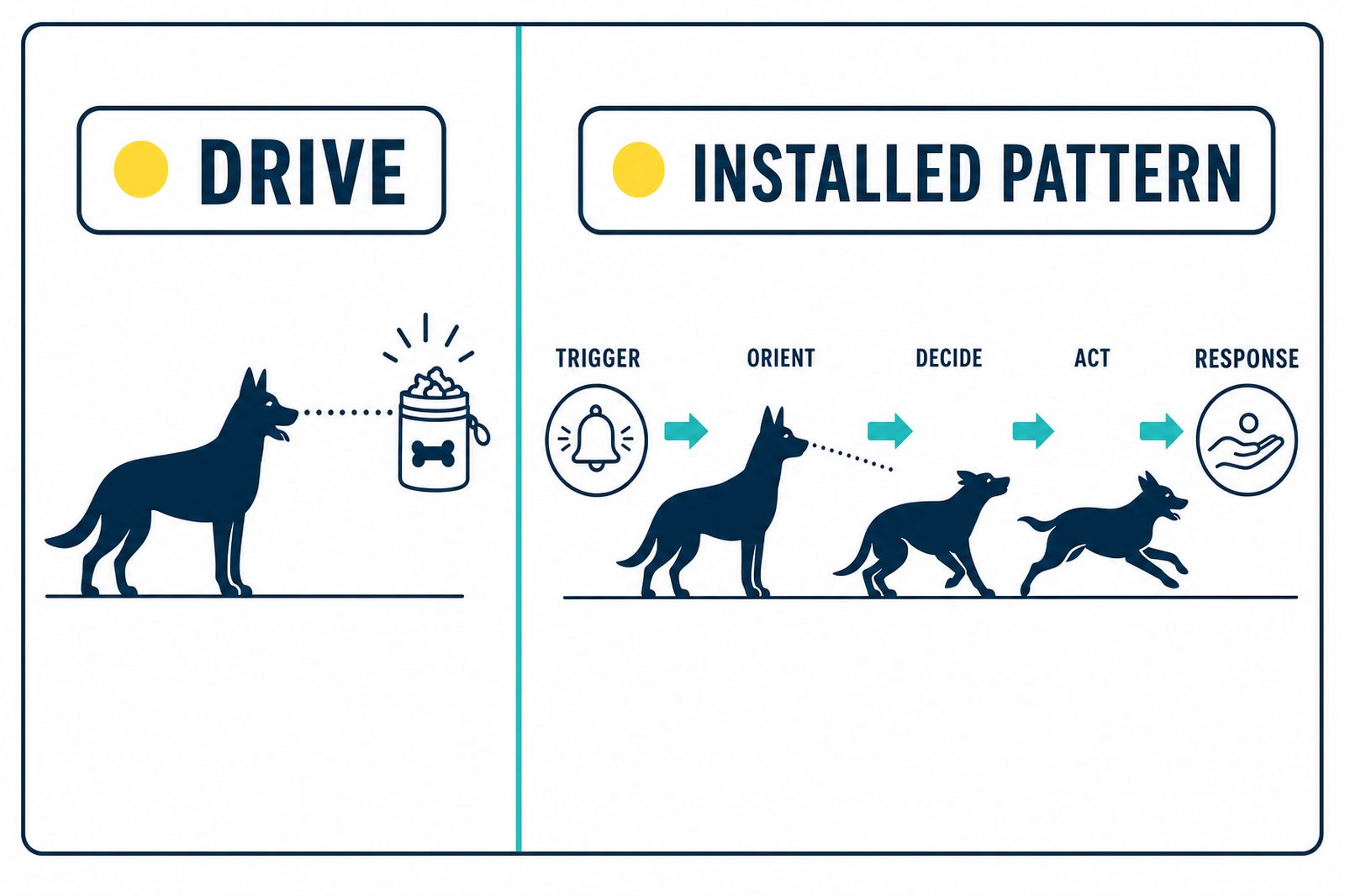
Every smart thing a dog does runs this machinery: trigger, pattern, response. The leash appears and your dog is at the door. The treat pouch clicks and your dog sits before you ask. That is conditioned pattern recognition, compounded by repetition.
Give a dog nothing to figure out and it figures out the sequence that tips the trash can. The same machinery runs in the destructive dog and the brilliant dog. The difference is which patterns got installed. That read, which patterns the dog already runs and which ones are missing, is the first job of a PD360 Assessment: nine dimensions of the individual dog, not the breed on the paperwork.
Why Do "Smartest Breed" Lists Mislead?
The short version: the lists rank obedience trainability as judged by obedience judges. They never measured intelligence.
So: are some dog breeds smarter? The lists cannot answer that question. They measured something else. Stanley Coren, a University of British Columbia psychology professor, published The Intelligence of Dogs (Wikipedia) in 1994 (second edition 2006). Credit where it is due: he defined three types of dog intelligence. Instinctive: doing the work the dog was bred for. Adaptive: solving problems alone. Working and obedience: learning from humans. The famous rankings cover only the third.
His method was honest about what it measured. Surveys sent to American and Canadian Kennel Club obedience trial judges drew 199 responses. Breeds needed 100+ responses to qualify. The result: 130 breeds in 79 ranked positions across six tiers, Border Collie first, Afghan Hound 79th. The top tier learned a new command in under 5 repetitions with 95%+ first-command obedience. The bottom tier needed 80 to 100+ repetitions and obeyed 25% of the time or less.
The problem is downstream. Coren measured how readily a dog learns from a human in an obedience context, which is heavily confounded by drive and willingness to work. Then listicle culture repackaged a survey of obedience judges as "smartest dog breeds." The failure sits downstream: honest survey data became a verdict it was never designed to be. A 2009 Helton study confirmed the general pattern with a different method, though some researchers, Ádám Miklósi among them, dismiss survey-based cognition findings outright. Coren himself noted that judges reported exceptions in every breed, and that "a lot comes down to training" (ScienceAlert).
An Afghan Hound sits at 79th because it will not perform for a stranger in a ring. Willingness to perform is what the ranking scored. As Frans de Waal put it (IFLScience), Afghans are "perhaps more like cats, which are not beholden to anyone."
By the Numbers
Is Drive the Same as Intelligence?
The short version: drive reads as smart because drive pays the repetition bill. Drive is motivation and arousal. Intelligence is pattern recognition.
Put a hot dog in your hand and a Labrador learns "sit" in an afternoon. Put nothing the dog values in your hand and the same Labrador needs a week. Same dog, different reinforcement.
Breeds selected for cooperative work with humans tend to carry high handler-focused drive, so they rehearse more repetitions per session and climb the rankings. The reading says "smarter." The fairer reading: "more repetitions per unit of your time."
And when the "smart" dog chews the couch, that is pattern invention: a fast pattern-recognition machine with no useful patterns invents its own.
What Else Shapes a Dog's Learning Ability?
The short version: base learning speed, genetics, environment, and personality each move the needle. Read each one as information.
Base learning speed. Some individuals acquire patterns faster. Arden and Adams found a canine "g" factor across 68 working border collies, and the spread inside that single breed was enormous: on a maze detour test, the best dog finished in about 3 seconds and the worst took nearly 2 minutes.
Genetics. Breed matters as predisposition. A herding breed reads tiny human cues. A scent hound follows its nose past your voice. They arrive with different default patterns, which changes what training should emphasize.
Environment and upbringing. A puppy raised with varied surfaces, sounds, people, and problems builds a pattern library early. A dog raised in a barren backyard builds a thinner one. Pattern libraries are buildable at any age.
Personality. Bold dogs experiment and fail fast, which accelerates pattern discovery. Cautious dogs observe longer before acting: a different learning strategy, with its own strengths.
Why Is Breed a Hypothesis, Not a Verdict?
The short version: breed gives you a starting prediction. The dog standing in front of you gives the answer.
Plenty of "smart breed" dogs wash out. Plenty of so-called stubborn breeds excel once someone trains the individual instead of the stereotype. Intelligence runs in many directions: Lea and Osthaus reviewed 300+ papers and found other species matching or beating dogs in every domain tested.
We run the dog in front of us.
Can Dog Intelligence Be Trained?
The short version: yes. Every pattern a dog learns strengthens the machinery for learning the next one. Intelligent dogs are made, not born.
Pattern recognition is a skill, and skills improve with practice. A dog that has learned fifty patterns has learned the bigger skill: how to learn. The next pattern arrives faster because the dog knows the meta-pattern: pay attention, try something, notice what pays, repeat what pays.
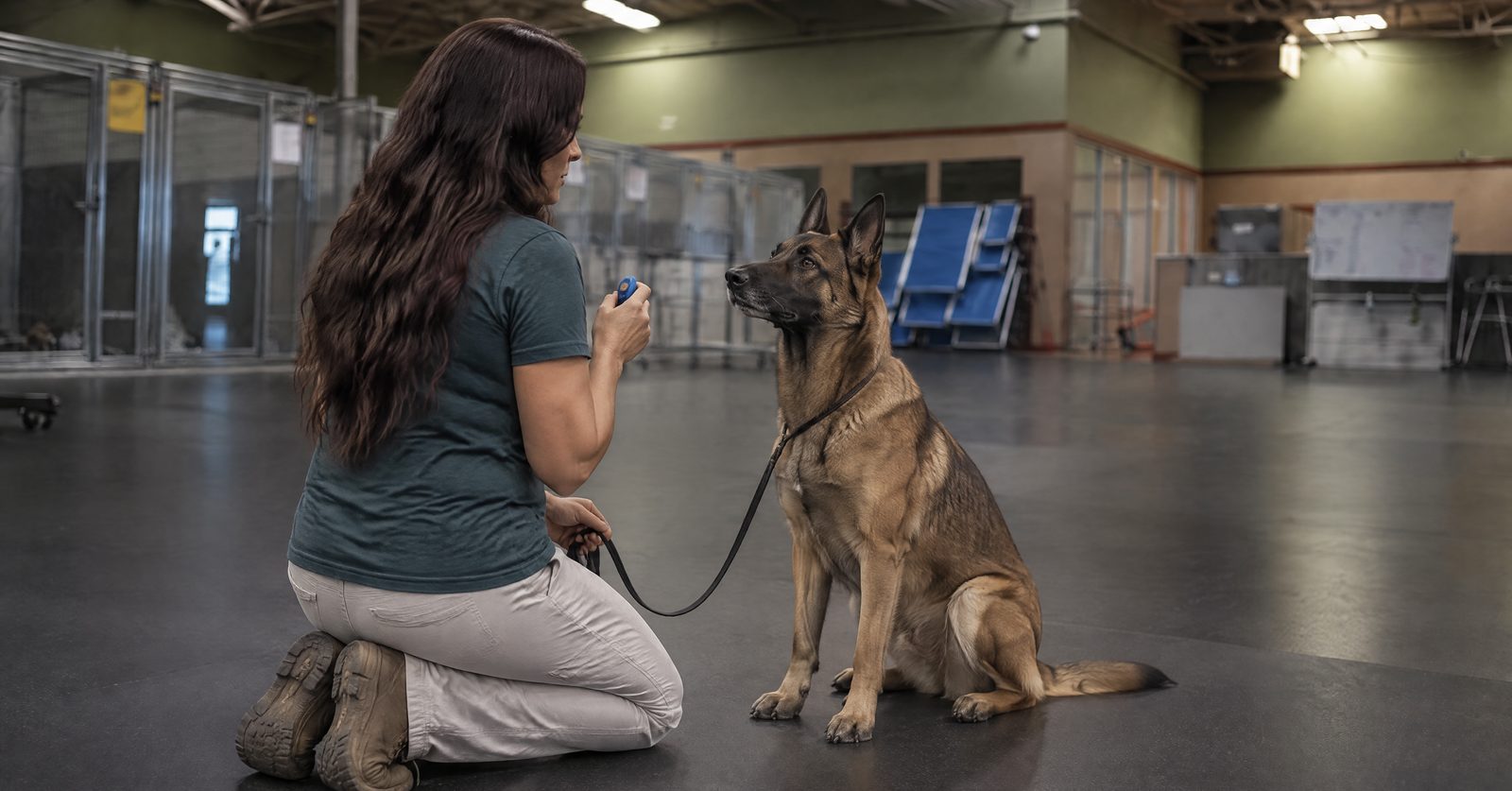
This is why a Partners session looks the way it does: short reps, a precise marker, the dog offered a problem and paid for solving it. The dog is not memorizing a sit. It is learning that trying things in the presence of a human pays. That meta-pattern is the real product of every lesson, and it is why the fiftieth pattern arrives faster than the fifth.
That is why teaching a dog tricks is pattern-recognition training in disguise: every trick reps the learning machinery.
Chaser is the ceiling, read honestly. One border collie, worked intensively for three years by psychology professor John Pilley, learned 1,022 object names; researchers stopped because of their own time limits. That is evidence of capacity: what one well-trained dog can reach.
And age is no barrier. Even senior dogs keep learning new patterns.
How Does This Change How You Train?
The short version: stop asking how smart your dog is and start building the skill. Install a clean pattern, reinforce it, proof it, maintain it.
If intelligence is pattern recognition, training is pattern installation, in four phases: Teach (2) installs the pattern; Reinforce (3) builds fluency; Proof (4) generalizes it; Maintain (5) keeps it sharp.
A "sit" that only works in your kitchen is one pattern. A "sit" that survives duration, the squirrel, distance, and facing away is one pattern generalized across dozens of contexts. Progression prevents regression.
Patterns are installed through operant conditioning. Positive reinforcement is our primary method and the base of every program. Fair, minimal, well-timed correction is also legitimate and necessary. Never the starting point: only after the alternative is understood, at the lowest level the dog notices, like a tap on the shoulder. The other quadrants are legitimate tools, not taboos: fair pressure ends the moment the dog responds, and fair correction, never the starting point and only after the alternative is understood, at the lowest perceptible level, keeps patterns honest. The quadrant is a tool; trainer skill determines the result.
Problem behaviors get the same treatment, because they are patterns too. Replacing a bad pattern starts with teaching a good one: a better pattern out-installs the old one. The PD360 system tracks every targeted behavior across the four phases, so trainers measure progress instead of claiming it.
What This Means for Your Dog
The short version: stop matching your dog to a breed label and start assessing the individual.
Evaluate the dog in front of you: how it learns and what drives it. The patterns and the gaps write the profile. Training from that profile works. Training from a stereotype guesses.
That is what the PD360 Assessment measures: the individual. How your dog learns and what motivates it: the solid patterns and the missing ones. Then the assessment matches your dog to the right program. If you are choosing a trainer, look for the assessment-first posture.
Start here
Book the PD360 Assessment
The in-person evaluation that reads your dog's learning speed, drives, and current patterns across nine dimensions, then matches the individual dog to the right program.
Myth vs. Fact
| Myth | Fact |
|---|---|
| Some breeds are just smarter. | Breed rankings measure working and obedience trainability, a reading confounded by drive and willingness to work. Intelligence is pattern recognition: individual, multi-dimensional, and trainable. |
| A dog that learns a command in a day is smarter than one that takes a month. | Speed on one task is one indicator. Coren's "brightest" tier hit under 5 repetitions with 95%+ obedience, but that data came from about 200 obedience judges rating obedience contexts only. |
| You cannot teach an old dog new tricks. | Intelligence is trainable at any age. Teaching new patterns improves pattern recognition itself. |
| A "dumb" dog just does not have it. | A dog with no useful patterns invents its own. Behaviors that earn the "dumb" label are usually pattern gaps, not capacity gaps, and gaps are fillable. |
Key takeaways
Key takeaways
- Dog intelligence is pattern recognition: noticing that trigger A leads to outcome B, and especially learning new patterns quickly.
- "Smartest breed" lists measure obedience trainability: about 200 obedience judges rating 130 breeds; brightest tier under 5 repetitions, 95%+ first-command obedience. (Coren, via Wikipedia)
- Drive reads as smart. It is motivation, and it changes how fast training goes. Within one breed, 68 border collies posted maze times from 3 seconds to nearly 2 minutes. (Arden and Adams, via Scientific American)
- Intelligence is trainable. Every pattern learned strengthens the machinery for the next one.
- Breed is a hypothesis. Use it as a starting prediction, then assess the individual dog in front of you.
Frequently Asked Questions
Are some dog breeds smarter than others?
No. Breed differences show up in working and obedience trainability: how readily a dog learns from a human and how much drive it brings. Intelligence, recognizing patterns and learning new ones quickly, is individual. Among 68 border collies, maze times ranged from 3 seconds to nearly 2 minutes.
How can I tell if my dog is intelligent?
Watch how fast your dog finds a pattern. Does a new behavior click after a few repetitions? Does your dog try variations when the first attempt fails? Pattern-acquisition speed is the real signal.
How many words can a dog learn?
Researchers estimate the average dog learns around 165 words, signals, and gestures, with the top 20 percent reaching about 250, roughly a 2-year-old child's vocabulary (Smithsonian, reporting Coren's synthesis). The ceiling is far higher: Chaser the border collie learned 1,022 distinct object names in three years.
Can training actually make my dog smarter?
Yes. Intelligence here means pattern recognition, and every pattern your dog learns strengthens the machinery for the next one. Since 1997 we have worked with dogs of every breed and baseline: dogs taught clear patterns in structured phases learn faster. Smart is built.
What is the first step to understanding my own dog's intelligence?
Assess the individual. Start with the PD360 Assessment: your dog read across nine dimensions, then matched to the right program. It reads the dog in front of you: learning speed, drives, and current patterns.
Where to go from here
Forget the ranking. Your dog is a pattern-recognition machine waiting for better patterns. The smartest thing about your dog may be how fast it unlearns, once someone finally teaches it cleanly. Assess the individual, install one clean pattern at a time, proof it across the five D's, and watch learning speed compound. Proofing goes faster with new contexts on demand: in a Group Class, one dog's five D's meet five other dogs' worth of distraction, and a trainer sets the distance for each dog. You mentor the reps; the dog builds the patterns.
Match the program to the dog
Private Lessons, paced to your dog
One-on-one lessons install new patterns at your dog's pace, once the PD360 Assessment maps the old ones.
Scottsdale: 8642 E Shea Blvd, 85260. Cave Creek: 4640 E Forest Pleasant Pl, 85331. Serving the Phoenix Valley.