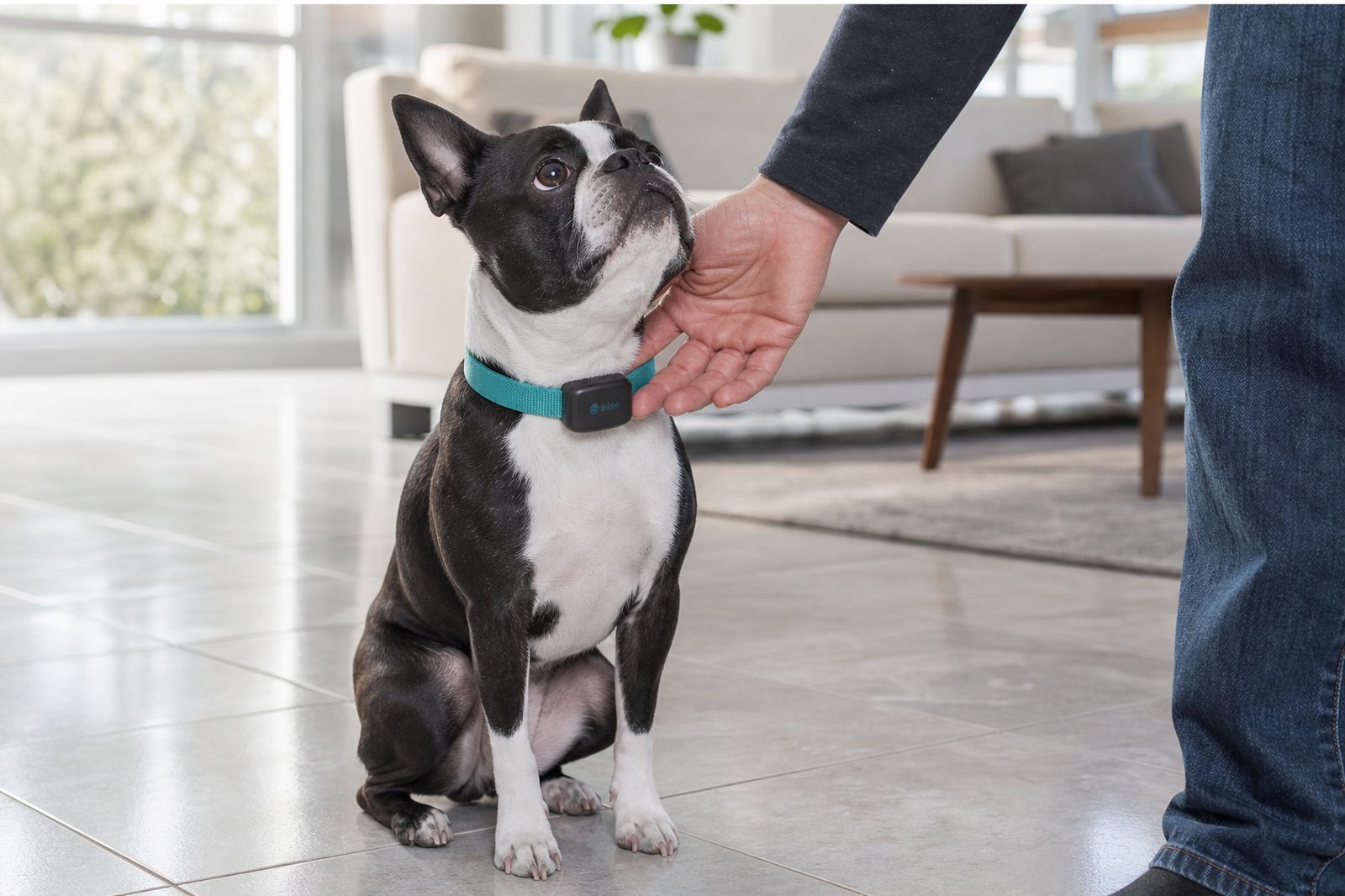
An e-collar used as a reward marker signals good news to a dog instead of delivering a correction, once the tool has been conditioned the right way: taught on a long line, set at a level the dog can barely feel, and paired with something it already wants. The same transmitter that corrects a leash pull can also reinforce a recall at distance, mark a stay through real distraction, or confirm a cue the dog cannot hear once it is thirty yards out. Which job the collar is doing comes down to how it was introduced, not the device itself. At Partners Dog School that introduction is trainer-led and supervised start to finish, never handed off to guesswork.
Most of what people have heard about e-collars comes from the correction side of the tool: a dog pulls, feels a stim, stops pulling. That is one legitimate, defensible use of the collar, and it is not the only one. This piece covers the other use, the one that gets talked about far less: conditioning the collar to work as a reward marker, how that process runs, and where it does and does not apply.
Isn't an E-Collar Only a Correction Tool?
That's the assumption almost everyone starts with, and it is a fair one. The image most people carry of an e-collar is a leash correction: the dog does something wrong, feels a stim, and stops doing it. That is a legitimate function of the tool, defensible when it is fitted and applied correctly. It is also only half the picture. The same transmitter that delivers a correction can deliver a signal faint enough to function closer to a tap on the shoulder than a punishment, and trainers who work with e-collars daily use that signal to reinforce behavior a dog is already doing right, not only to stop behavior that is wrong.
At Partners Dog School, the collar is described as a tool used many different ways when it's paired correctly: reinforcing a cue at distance, correcting a behavior when that's the right call, and, less understood, working as a reward marker in its own right. People who dismiss the tool outright have almost always never watched a properly conditioned dog work off one. That skepticism is reasonable given how badly the tool gets used in untrained hands, but it does not describe every use of it.
What Is the Difference Between a Correction and a Reward Marker?
The mechanical difference is whether the stimulation removes something unpleasant or signals that something good is arriving. A correction works through escape: the dog does the wrong thing, feels a stim, changes behavior, and the stim stops. Compliance is what makes the sensation go away. A reward marker works the opposite direction. The collar gets paired, across repeated short sessions, with a reward the dog already wants (a piece of chicken, a tug toy, a release to go sniff) until the stim itself becomes information that something good is on the way. The dog is not escaping the sensation. It is anticipating what follows it.
Some trainers argue that any stimulation is aversive by definition, and that calling it a reward is a marketing choice rather than a mechanical one. That is a legitimate disagreement inside the training industry, not a fringe complaint, and it deserves a straight answer. At a true working level, a level most owners cannot feel during a fit test on their own hand, the stim functions as a marker the way a clicker or a verbal cue does: a signal paired with reinforcement, well below the intensity a dog works to avoid. Used at correction strength for that same purpose, the tool stops being a reward marker and becomes a correction again. The distinction lives in the level and the pairing, not in what anyone calls it.
How Do You Condition an E-Collar as a Reward Marker?
The order matters more than the collar does. The cue gets taught first, with zero collar involvement, on a long line with food or a toy, until the dog is reliable up close and without distraction. Only after that does the collar enter the picture, and it enters at a level found through a fit test, a stim so low most owners cannot feel it on their own hand or neck. That low level gets paired with the reward the dog already responds to, over and over, until the sensation predicts good things the same way a leash clip predicts a walk. The dog learns the pairing before the collar ever carries any of the weight.
Once that pairing holds up close, distance gets added in small steps, checking that the behavior stays reliable before moving out. A dog is not taken off leash until the low-level stim already produces the response on leash first, every time. That sequencing is run by a multi-trainer team that has put this exact process to work across 70,000-plus dogs since 1997, not a single trainer working from a manual: 30 coursework hours before a new trainer touches facility work, then up to 1,000 supervised hours on the way to Instructor and 2,000 across breeds and behaviors on the way to Senior Trainer, tracked the same way each dog's own progress is tracked through grade-level curriculum and PD360 scoring. Showing the process, not just claiming the collar works, is what earns trust with a new dog and a new family.
What Do E-Collar Critics Get Right?
AVSAB's 2021 Position Statement on Humane Dog Training lists electronic collars among tools "that involve pain," a fair concern about fallout in untrained hands, without separating a correction from a properly conditioned reward marker. That is why every e-collar dog at Partners Dog School is fitted and conditioned by a trainer watching the dog's actual response in person, never handed off to a device and a guess. Positive reinforcement is where every dog starts, and the process here never asks a dog to tolerate more than the productive stress that builds resilience, the way a muscle gets stressed on purpose so it comes back stronger. A dog that is shut down, fearful, or medically unable to handle it is not a candidate for the collar at all.
How Does This Work for Off-Leash Recall and Distance Cues?
A verbal marker or a handful of praise stops being useful the moment a dog is too far away to see or hear it clearly. Picture a dog off leash on a wash near Spur Cross Ranch Conservation Area outside Carefree, nose down, forty yards out and closing on a scent trail. A recall cue shouted from that distance competes with wind, terrain, and whatever the dog is already locked onto. A conditioned reward marker does not have that problem, because it is felt at the same intensity whether the dog is six feet away or sixty. Once it is conditioned to mean the reward is coming, it can confirm a recall, a sit-stay, or a direction change at a distance a raised voice never reaches.
This is where the reward-marker function earns its keep for off-leash recall and e-collar distance cues specifically: a dog on a long line near a trail gets marked and rewarded for checking in on its own, well before the leash comes off, so the behavior is already fluent by the time distance and freedom get added. A dog that has never done that on-leash groundwork is not ready for the collar to do that job off leash, no matter how much its owner wants a faster path to a loose recall.
Is an E-Collar the Right Tool for Every Dog?
No single tool fits every dog, and a stable dog whose owner only wants basic obedience and engagement work may never need one. A social, food-motivated dog working on sit, stay, and loose-leash walking can build a fully reliable recall on a long line and a verbal marker alone; no collar required. The collar earns its place when the goal is distance or off-leash reliability, or when a dog's drive outpaces what a voice can compete with: a scent hound on a trail, a dog with a strong prey response near desert wildlife, a dog that needs to be reachable at forty yards, not six.
Fit and assessment come before any tool decision, not after. A private lesson is where that fit gets sized up dog by dog: temperament, drive, and whether this process is the right next step or premature for where the dog is today.
Frequently Asked Questions
Can an e-collar actually work as a reward instead of a correction?
Yes, once it is conditioned that way on purpose. The collar gets paired with a reward the dog already wants at a stim level so low the dog can barely feel it, until the sensation itself predicts good things coming. That is a different mechanical process than a correction, which relies on the dog escaping an unpleasant sensation by changing behavior. Both uses exist on the same tool; which one is happening depends on how the collar was introduced and at what level it runs.
What is a true working level, and how do you find it?
A working level is the lowest stim setting a dog reliably responds to, found by testing on the trainer's or owner's own hand first, at a level most people cannot feel themselves. That level is where reward-marker conditioning happens. Correction work, when it is called for, uses its own separate level found the same careful way. Neither gets set by guesswork.
How long does it take before a dog is ready to work off leash on the collar?
There is no fixed number of days; it depends on the dog and how quickly the on-leash pairing holds up under distraction. The order does not change: teach the cue first with no collar, pair the low-level stim with a reward the dog wants, and keep the dog on a long line until the response is reliable there before distance or freedom get added. Skipping ahead is where this process goes wrong.
Do veterinary behavior organizations support e-collar training?
AVSAB's 2021 Position Statement on Humane Dog Training lists electronic collars among tools "that involve pain," a fair concern about fallout in untrained hands, without separating a correction from a conditioned reward marker. That is a category-level position: it does not comment on a carefully conditioned specific use. The trainer-supervised fit-and-conditioning process described above, run by a team that has done it across 70,000-plus dogs since 1997, is the direct answer to that concern.
Which dogs should not start e-collar training yet?
A dog that is fearful, shut down, or has not yet built basic trust and engagement with its handler is not ready for collar conditioning, reward marker or otherwise. Medical issues that make a collar physically uncomfortable also rule it out until a vet clears it. A trainer should assess temperament and readiness before any tool gets introduced, not fit the dog to the tool after the fact.
Done right, not guessed
Learn the Conditioning Process With a Trainer, Not a Video
A fit test, a working level, and a reward pairing are easier to get right with a trainer watching the dog's actual response than from a video. A private lesson walks through the process step by step for your dog specifically.
"Training helped establish a line of communication between us and things have never been better."
Emma M., Cave Creek
Read more reviews from Partners Dogs families for the 4.8-star, 2,000+ review record behind results like this one, and see the Mini Educator system in the Partners Dogs shop. The recall training guide covers the on-leash groundwork this piece builds on.
Keep reading