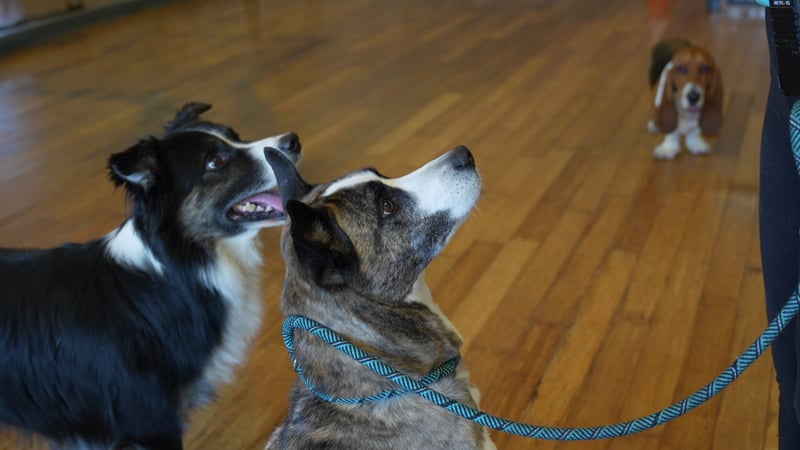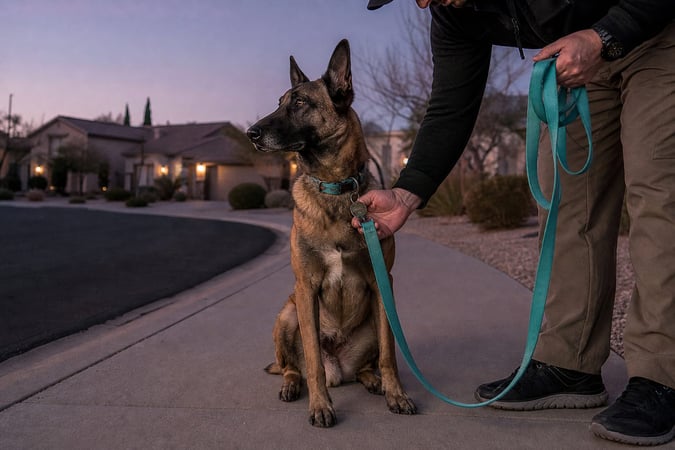
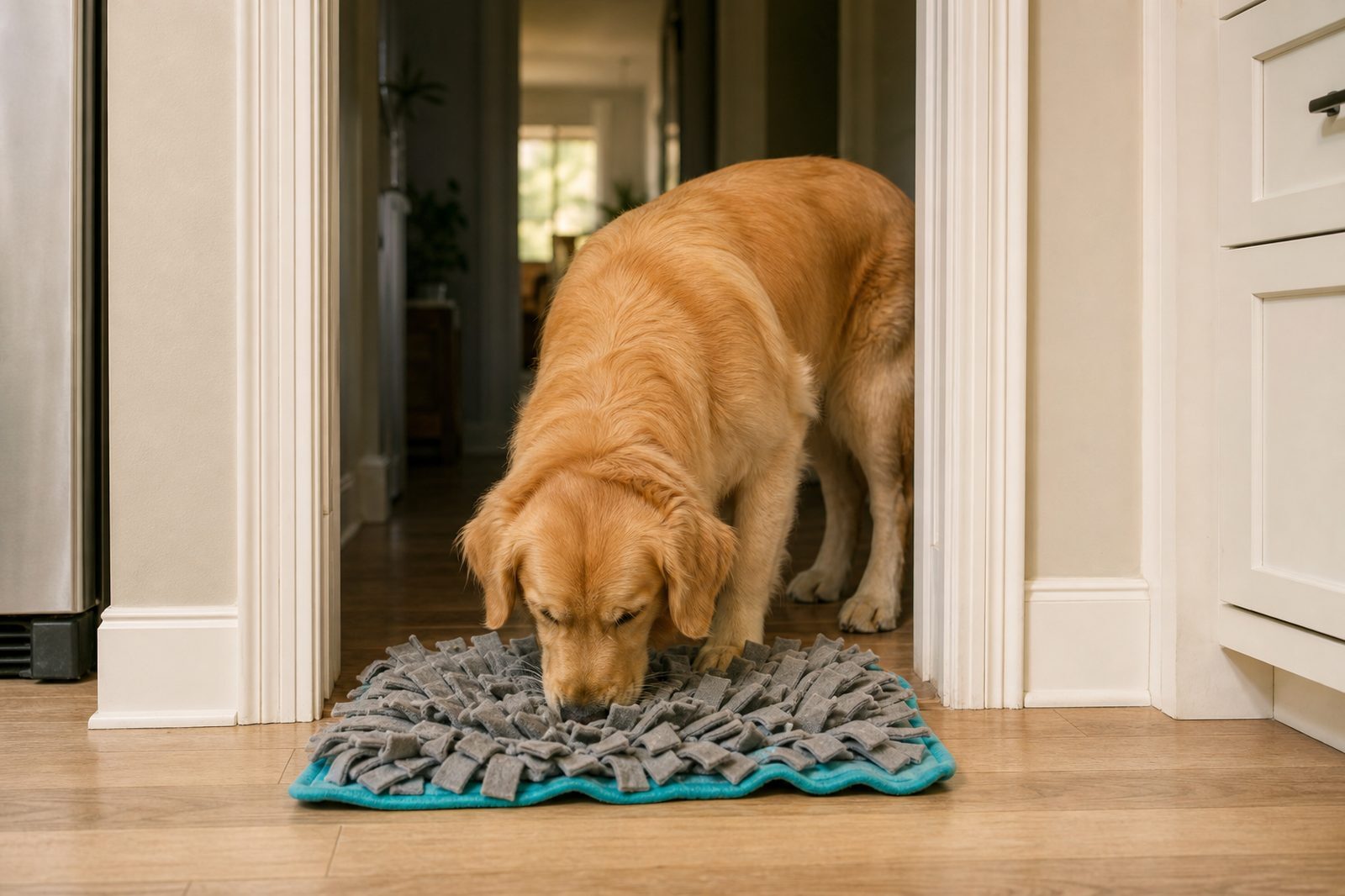
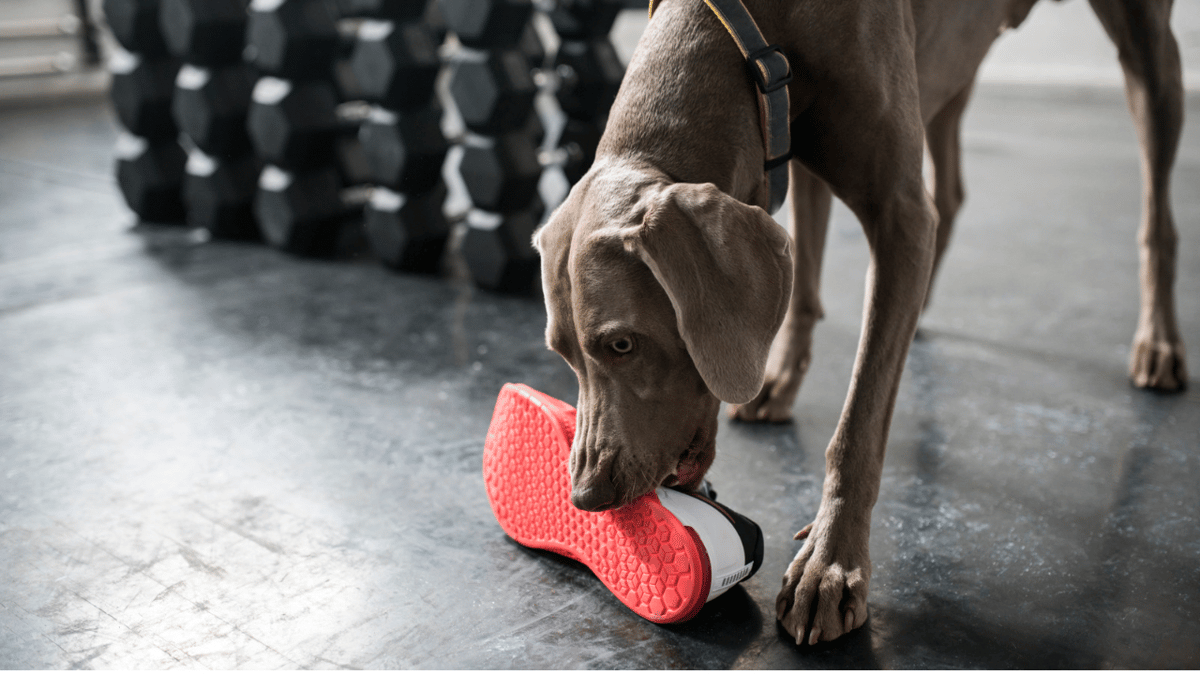
Enrichment for anxious dogs in boarding works best matched to the individual dog, not handed out as one default toy: licking (lick mats), low-arousal foraging and scent work, and a trained settle-on-mat behavior calm a nervous dog more reliably than a chew toy left in a run.
A 2023 study of kenneled shelter dogs (Dare & Strasser, published in Animals) tested six enrichment types across three sensory categories during a real acute stressor, morning kennel cleaning. It found something worth knowing before you book a boarding stay: the enrichment item most facilities reach for first, a food toy, produced the smallest calming effect of any category tested. Calming scent and tactile items outperformed it. That does not mean food enrichment is useless. It means enrichment for anxious dogs in boarding is not one product, it is a match between technique and dog. Here are the six techniques worth asking about, and where a structured Scottsdale or Cave Creek boarding stay should apply them.

| Technique | Best for | Arousal level | Bought or trained |
|---|---|---|---|
| Lick mat | A dog arriving keyed up on day one | Lowest, calming | Bought item |
| Snuffle or foraging mat | A settled dog's daily meal routine | Low, steady | Bought item |
| Scent work | A nervous dog that needs to come down off alert | Low, focused | Bought or trainer-led |
| Puzzle feeder | A dog ready for a solvable problem, not overstimulation | Moderate, if sized right | Bought item |
| Chew work | Nervous energy that would otherwise come out as pacing | Low to moderate, supervised | Bought item |
| Settle-on-mat | A multi-night stay, and any moment nobody planned an activity for | Lowest, on cue | Trained behavior |
What Separates Enrichment From a Toy Left in a Run?
Most boarding facilities offer some form of enrichment, and most mean it well. A stuffed Kong in a kennel run is not nothing. The gap sits in whether anyone is matching the technique to the dog in front of them and staffing that decision every day of a multi-night stay. A dog that self-soothes by chewing needs something different from a dog that needs low-arousal scent work to come down off alert, and a third dog needs an actual taught behavior, not an object at all. Handing every dog the same toy and calling it enrichment is the pattern the research above quietly argues against.
That distinction, technique matched to dog rather than one item issued at check-in, is what "structured" should mean in a boarding program. It is a decision process, tracked daily, not a word on a website.
Licking Enrichment: Why a Lick Mat Calms an Anxious Dog
The American Kennel Club recommends lick mats specifically as a soothing tool for anxious dogs: a mat spread with frozen broth can help a dog through a stressful moment like fireworks, thunderstorms, or a bath, in part because the repetitive licking motion itself has a calming effect. Licking is one of the most reliable low-cost interventions for a dog whose anxiety shows up as pacing, whining, or refusing to settle. For a boarding stay, that makes a lick mat a good first offer for a dog arriving keyed up on day one, before you know yet whether scent work or a taught settle will be the better long-term fit for that particular dog.
Snuffle and Foraging Mats for Scent-Forward Feeding
Scatter-feeding a meal across a snuffle mat, or hiding small portions around a run for a dog to find, turns a routine meal into a foraging task instead of a five-second bowl-empty event. Foraging engages a dog's nose before its adrenaline, which is exactly the order you want for a dog that came into boarding already anxious. This is licking and foraging enrichment's quieter cousin: less immediately soothing than a lick mat for a dog in acute distress, but a strong daily-routine tool once a dog has settled into the first day or two of a stay.
Scent Work: Low-Arousal Activity for a Nervous Dog
Nosework-style activity, hiding a scent or a treat for a dog to search out at its own pace, shows up repeatedly in decompression protocols for nervous and reactive dogs, and it matches what the 2023 shelter-dog study found about calming scent items specifically: scent-based enrichment produced the most relaxed body positions of any single item tested. A dog that is sniffing is rarely also spiraling. Scent work is one of the lowest-arousal activities you can offer a boarding dog, which makes it a better fit than a game of fetch or open group play for a dog whose baseline is already nervous rather than bored. See how trainers build a scent work session specifically for an anxious dog for the full picture beyond a boarding-week routine.
Puzzle Feeders: Problem-Solving Without Overstimulation
A puzzle feeder asks a dog to work a mechanism such as sliding a panel or nosing a lid to release food, and it does double duty: mental engagement plus a slower, calmer version of mealtime. The right puzzle feeder gives an anxious dog a solvable problem instead of an empty stretch of kennel time to sit in its own head. The word "right" matters here. A puzzle that is too hard frustrates a dog that is already anxious and can raise arousal instead of lowering it, so the level needs to match the dog, not just the category of toy.
Chew Work: Giving an Anxious Mouth a Job
Chewing, like licking, is a repetitive behavior with a calming mechanism behind it. An appropriately sized, appropriately supervised chew session gives a dog something structured to do with nervous energy that would otherwise come out as pacing or barking. Chew work has to be sized and timed to the dog, not left in a run unsupervised for hours, or it stops being enrichment and becomes a management shortcut. That supervision detail is exactly where staffing depth shows up: a trainer watching a dog's chew session can catch when a calming activity has tipped into something else and swap it out, an attendant checking runs on a schedule usually cannot.
Settle-on-Mat: The One Technique That Is Trained, Not Bought
Every technique above involves an item. This one does not. Settle-on-mat is a taught behavior: a dog learns that a specific mat means calm, feet down, no pacing, rewarded for holding position. That criteria builds in stages, first for seconds, then for longer stretches, then with distraction nearby. An anxious dog can be taught a default calm behavior, and that default is worth more over a multi-night boarding stay than any toy, because it works even on the moments nobody planned an activity for. This is the technique a warehouse-style kennel staffed by attendants structurally cannot deliver, since teaching a behavior is a training skill, not a supply-closet item, and it is where a structured boarding stay earns that word honestly instead of using it as a marketing adjective.
How Trainers Decide Which Enrichment Fits Your Dog
Matching technique to dog takes a trainer's judgment, not an attendant's routine. A dog that arrives pacing and vocal on day one is a different read than a dog that goes quiet and still, and each needs a different first move: licking or a taught settle for the pacer, scent work to draw the shut-down dog back out gently. That daily read, and the willingness to change the plan mid-stay, is what structured enrichment during a Phoenix-area boarding stay should mean. If your dog has anxiety or reactivity that goes beyond normal first-night nerves, a PD360 Assessment before the stay gives the trainers watching your dog a starting point instead of nothing to go on. It can also flag whether structured day training around the boarding stay, not just boarding alone, is the better fit. It is also worth reading what other anxious-dog parents experienced: Partners Dogs holds 4.8 stars across 2,000+ reviews.
"First time boarding for the pups. I was more anxious then they were. Everyone made an effort to make me feel comfortable with leaving the pups for 4 nights. They kept me updated on how the pups were doing daily and took the time to talk to me when I called to check in. Pups were bathed and ready for pick up."
Kelly H., Scottsdale
Some dogs carry anxiety that runs deeper than new-place nerves: resource guarding, fear of other dogs, or a history of reactivity. Those dogs often benefit from a look at the matching general anxiety support before a long stay, so the enrichment plan and the behavior plan work from the same read of the dog.
For the anxious ones
Get a Trainer's Read on Your Dog Before the Stay
A quick call gets your dog's history in front of the trainers who will be planning enrichment during the stay, so day one is not the first time anyone hears about your dog's triggers.
Key takeaways
- A 2023 study of kenneled shelter dogs found food toys produced the smallest calming effect of any enrichment category tested, while calming scent and tactile items outperformed it.
- A lick mat spread with frozen broth is a common first offer for a dog arriving at boarding already keyed up, since the American Kennel Club notes the repetitive licking motion has a calming effect.
- Scent work produced the most relaxed body positions of any single item in the 2023 shelter-dog study, making it one of the lowest-arousal activities to offer a nervous boarding dog.
- Settle-on-mat is the one technique on this list that is trained rather than bought, and it works even in the moments nobody planned an activity for.
- A PD360 Assessment before a boarding stay gives trainers a starting point on a dog's anxiety or reactivity history instead of a blank slate on day one.
Frequently Asked Questions
What is licking enrichment, and why does it help an anxious dog?
Licking enrichment is any activity built around sustained licking, most often a lick mat spread with a dog-safe food like frozen broth. The American Kennel Club notes the repetitive motion itself has a calming effect, which is why it is a common first offer for a dog that arrives at boarding already keyed up.
Can I request a specific enrichment technique for my dog's boarding stay?
Yes. Tell the trainers what works at home: whether your dog is a chewer, a sniffer, or already knows a settle cue, before the stay starts. That history, combined with a PD360 Assessment for dogs with real anxiety or reactivity, gives the team a starting point instead of a blank slate on day one.
Is settle-on-mat something my dog needs to already know before boarding?
No. It can be introduced during the stay, but a dog that already has some settle training at home will generalize it to a new mat faster than a dog starting from zero. If your dog has never been taught a settle cue, mention that up front so the trainers can build it in gradually instead of expecting it on night one.
How can I tell if a boarding facility actually matches enrichment to each dog?
Ask who decides which enrichment technique a specific dog gets, and how often that decision is revisited during a multi-night stay. A facility that can describe a daily read, not just a standard toy issued at check-in, is staffing enrichment as a decision, which is the difference this article is built around.
What is the best dog boarding in Cave Creek or Carefree (zip 85331) for an anxious dog?
The best fit for an anxious dog is a boarding program staffed by trainers, not just attendants, who match enrichment to that specific dog and can teach a settle-on-mat behavior during the stay rather than issuing the same toy to every dog. Partners Dogs' Cave Creek campus serves both Cave Creek and Carefree, zip 85331, with that trainer-led enrichment approach described above.
After the stay
Give an Anxious Dog Structure Beyond a Single Boarding Trip
If enrichment during boarding helped, structured day training builds on it between trips instead of starting over each time your dog boards.