Four fixed blocks a day, on a repeating clock, calm an anxious dog faster than extra free play. The blocks are rest, feed, enrichment, and potty. A dog boarding away from home settles fastest when the schedule stays the same every day, not when the day gets packed with more stimulation. That predictable rhythm, not a bigger yard or more one-on-one time, is what a structured boarding stay is built around.
Most Paradise Valley families who dread boarding are not worried about the facility. They are worried about their own dog: the one who paces at the vet, who will not settle at a friend's house, who seems to need constant attention just to stay calm. The instinct is to ask a kennel for more of that attention. The better question is what a good routine for anxious dog boarding actually looks like, and whether the day has a shape your dog can predict.
The Anxious-Dog Boarding Myth: More Play Is Not the Fix
The common assumption, extra playtime and extra cuddling will settle an anxious dog, usually backfires. More free play means more novel choices: who to approach, what to react to, when to disengage. For a dog who is already unsure of a new environment, that is a lot of decisions to make in a single afternoon, not a break from stress.
A dog that already struggles with change does not need a bigger version of the unfamiliar. It needs fewer surprises per hour. Open play blocks, group free-for-alls, and constant hands-on attention from rotating staff all add variables. A fixed schedule removes them. That is the entire mechanism, and it is a lot less dramatic than it sounds.
Why a Fixed Daily Rhythm Calms an Anxious Dog
A dog processes a repeated pattern with far less effort than a new one, and less effort reads as less stress. By the second or third day on the same clock, an anxious dog stops scanning for what happens next because it already knows the order. The cycle stays simple: rest, then feed, then enrichment, then a potty break, then rest again. Knowing what comes next is the actual comfort mechanism, not the specific activity that fills the slot.
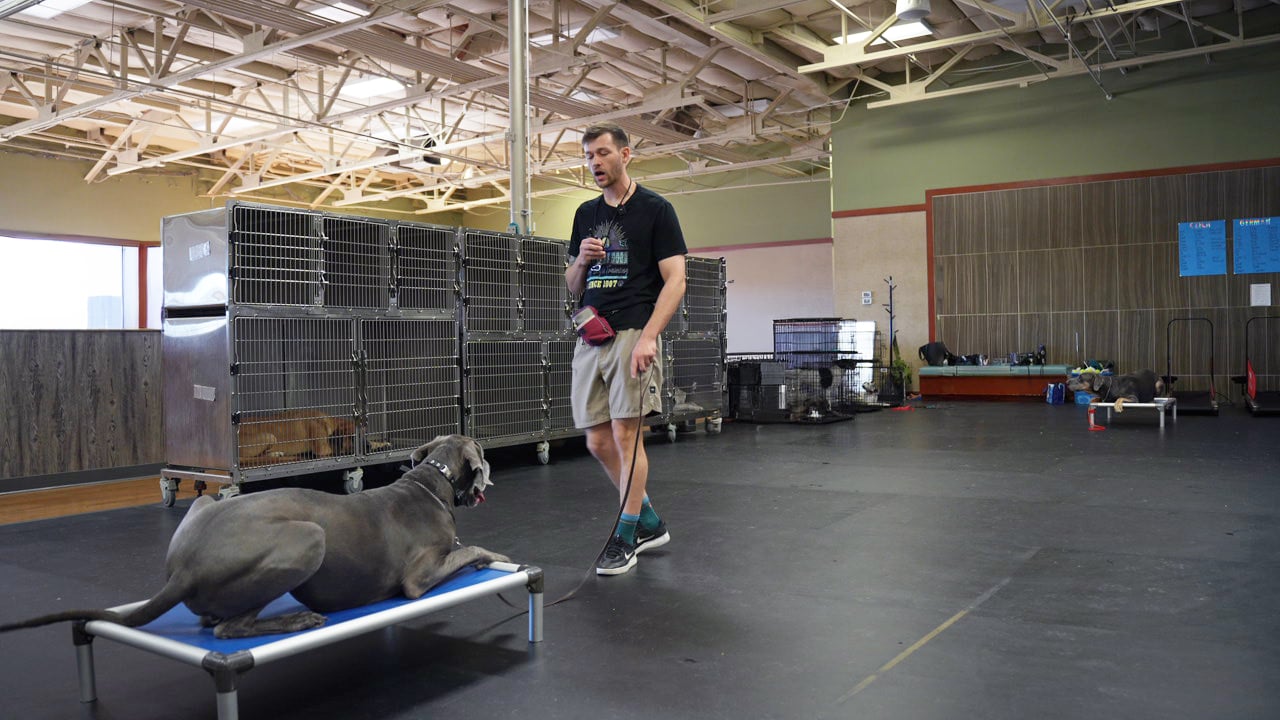
This does not mean the day is boring or the dog sits in a kennel run all day. Enrichment blocks include supervised time with a familiar handler, a scent game, or short skill work. The point is that the blocks happen at the same time in the same order, run by a trainer, not an attendant cycling through a roster of dogs with no plan for any one of them.
What the Four Daily Blocks Look Like
Each day of a boarding stay at Partners Dogs runs on the same structured schedule, four blocks in the same order, at the same time every day:

- Rest. A quiet suite period with no scheduled interaction, so the dog gets true downtime instead of constant stimulation.
- Feed. Meals at the same time each day, on the dog's own food when the family provides it, to avoid one more novel variable.
- Enrichment. Trainer-run time that might be a sniff walk, a scent game, or light skill work, matched to what that dog can handle that day.
- Potty. Scheduled outdoor breaks on a clock the dog can learn, rather than an unpredictable rotation.
The blocks repeat every day of the stay. A dog that came in pacing the suite on day one is usually anticipating the next block by day two, and anticipation of something known is a very different state than the vigilance of not knowing what is coming.
Check the schedule
A Boarding Stay Built Around Your Dog's Clock
Ask about the daily rhythm before you book, not after. A trainer-run floor with a fixed schedule is what keeps an anxious dog settled across a multi-day stay.
What a First Short Stay Can (and Cannot) Tell You
The AKC's public boarding guidance is useful here, and worth conceding up front: a short first stay before a trip is smart, and many kennels ask for one. It lets you and the facility see how your dog handles a new environment, and it is exactly the kind of low-risk prep step anxious-dog owners should take before a longer commitment.
A short first stay only tests the first day, and the first day is the least predictable one no matter how good the schedule is. The harder test of a fixed rhythm is day three or four, once the pattern has had time to sink in. If your dog has never boarded before, a first boarding stay needs its own plan, not just a shorter version of a normal one. Bringing something that smells like home, a worn t-shirt or the dog's own bed, still helps on top of the schedule; it is not a substitute for it.
Will My Anxious Dog Be Less Stressed at Home?
Home is familiar, and that counts for something. A dog with no history of separation trouble who is comfortable with new people usually settles into a fixed daily rhythm within a night or two, and a DayCamp day confirms how your dog takes to the team and the space. If the anxiety shows up on ordinary workdays rather than only on trips, DayCamp and Private Lessons work on it directly.
What a trainer-run floor holds is coverage: a team, a schedule, and a backup plan if one person is out or the day runs long. A facility with a trainer-run floor can keep the same four blocks running even when staff rotate, because the schedule belongs to the dog, not to one person's calendar. Families who worry about not knowing what is happening while they travel get a daily report card, without a single point of failure. Ramona V., whose dogs Lexi and Rambo both came in anxious about new people, put it this way after a week-long stay at the Cave Creek campus:
"We were anxious about boarding Lexi and Rambo... The daily “report cards” we received for each dog kept us up to date on their daily activities and we were thrilled to see those arrive in our email each day. We were able to relax and enjoy our trip."
Ramona V., Cave Creek
That is the mechanism working from the owner's side of a trip: a daily record tied to a routine you can follow, not a vague assurance that the dog is "doing fine."
How to Tell the Difference Between Calm and Shut Down
A dog settling into a routine and a dog going quiet from being overwhelmed can look similar from the outside, so ask what the staff is watching for, not just whether your dog was quiet. A dog adjusting well will eat on schedule, engage during enrichment blocks, and rest with a loose body between blocks. A dog that is shutting down instead of settling tends to refuse food, avoid interaction even during a calm block, or hold a stiff, braced posture that does not soften across the stay.

This is also where a fixed schedule helps with dogs that have a deeper behavior history, not just travel nerves. Miki P.'s dog had already been turned away from a PetSmart daycare for aggressive behavior before coming to the Scottsdale campus:
"We looked for a boarding that can handle dogs with aggressive behavior. We found Partners Dog Training... During the stay, they emailed me the report and some photos of the dog. It was comforting to see my dog and to know that she was getting comfortable with the trainers. At this place, my dog didn't show any aggressive behavior at all!"
Miki P., Scottsdale
That is structure at work, not just a quiet dog in a run. Partners Dogs carries 4.8 stars across 2,000+ reviews from families who came in with exactly this kind of worry. For a dog already mid-program at Partners, the same daily blocks continue their Proofing-stage work during the stay instead of pausing it; for a dog boarding without an active program, a PD360 Assessment is the right next step if the anxiety looks like more than travel nerves. If you are still comparing facilities, these are the questions worth asking before you book.
Key takeaways
- A staffed boarding facility schedules a full team, so one person calling in sick or having an emergency does not leave a boarding dog uncovered.
- A trainer-run floor keeps the same four daily blocks running when staff rotate, so the schedule belongs to the dog, not to one person's calendar.
- A PD360 Assessment is the next step when a dog's anxiety looks like more than travel nerves, and DayCamp and Private Lessons work on it on ordinary workdays.
- Partners Dogs sends daily written report cards on every boarding stay, so Scottsdale and Cave Creek families know what their dog actually did, not just that someone checked on them.
- Partners Dogs holds 4.8 stars across more than 2,000 reviews.
Frequently Asked Questions
What does a typical boarding day look like at Partners Dogs?
Every day runs on the same four blocks in the same order: a quiet rest period, a scheduled meal, a trainer-led enrichment block, and a scheduled potty break. The blocks repeat at the same time each day of the stay, which is what gives an anxious dog something predictable to settle into.
Why does more free play not calm an anxious dog during boarding?
Free play adds new decisions: which dog to approach, what to react to, when to back off. An anxious dog in a new environment already has more to process than usual, and stacking on more open-ended stimulation adds to that load instead of relieving it. A fixed schedule removes those variables instead.
How do daily report cards help while my dog is away?
A daily update tied to the schedule gives you a concrete picture instead of a generic "doing great" text: what your dog ate, how the enrichment block went, how they rested. It also lets you catch a problem early, since the update is measured against the same routine every day.
Does my dog need prior training before a structured routine will help them?
No. The routine itself is the intervention for most travel-related anxiety, and it works whether or not a dog has been through a program. Dogs with a deeper behavior history, such as fear aggression or resource guarding, benefit from the same structure while a trainer also manages the specific behavior during each block.
Is a fixed routine the same as just keeping my dog in a crate all day?
No. A fixed routine is a repeating sequence of rest, feeding, enrichment, and potty time. It is not extended confinement. The rest block happens in the dog's suite. The enrichment and potty blocks are active, supervised, and led by a trainer, not skipped in favor of more time in a run.
Plan the stay
Book a Stay That Runs on a Schedule Your Dog Can Learn
Reserve a boarding stay at Cave Creek or Scottsdale, or start with a PD360 Assessment if your dog's anxiety looks like more than a new-place adjustment.