The short answer
The best Arizona dog training school will show you its staff-to-dog ratios, let you tour before you enroll, and prove exactly how many supervised hours its trainers have logged across many breeds and behaviors, not just point to a certificate on the wall. Most individual credentials test knowledge with self-logged hours and a multiple-choice exam, not hands-on skill. Supervised hours across many breeds and behaviors are what predict results.
Arizona has no shortage of dog trainers, board-and-train facilities, and weekend group classes, and almost none of them are required to prove anything before they take your dog. This guide walks through what to check before you enroll, from the credential on the wall to the ratio on the training floor. It applies whether you are looking in Scottsdale, Cave Creek, or anywhere else in the Valley, and it covers the one case where Private Lessons are the smarter call instead of a camp.
How to Read a Trainer's Credentials
Dog training is not a licensed profession in Arizona. Anyone can print business cards and call themselves a trainer, and a certification is one honest signal that someone invested time in their education.
But before you credit any certification, look at what actually predicts results: hands-on hours across many breeds, behaviors, and temperaments, backed by a multi-trainer team and a facility built for the work. At Partners Dogs, that means: purpose-built Scottsdale and Cave Creek campuses; trainers who work your dog in teams rather than one person carrying the whole caseload; staffing around the clock rather than by appointment; a grade-level curriculum tracked through PD360; and 70,000+ dogs trained since 1997. That is the case a certificate on the wall cannot make by itself.
Look closely at what the most common individual credential actually requires, and the gap gets clearer. The CPDT-KA, the most widely held trainer credential, asks for 300 hours of training experience that the candidate logs themselves, verified by a single attestation statement from one other certified professional rather than an independent audit of the hours. The exam itself is 200 multiple-choice questions with no hands-on or practical component. CCPDT's own 2024 numbers show why that gap matters: of 5,383 active CPDT-KA holders, only 154, about 2.9 percent, also hold the CPDT-KSA, the add-on credential that actually assesses hands-on skill through video-graded exercises. A self-logged hour count and a written test are a real baseline. They are not the same claim as demonstrated hands-on skill across breeds and behaviors.
What that exam cannot confirm is how a trainer reads a dog that freezes at the lobby door, or how many breeds and behavior problems they have actually worked through hands-on. That is the gap Partners Dogs University, our in-house training and certification path for staff, is built to close.
Partners Dogs University's Hour Requirements
Before a candidate works a dog in one of our facilities they complete 30 hours of coursework. Instructor eligibility takes at least 1,000 supervised hands-on hours, and Senior Instructor takes 2,000. See how the full PDU pipeline works, stage by stage.
A campus tour is where that difference actually shows up. Watch how many dogs move through in a single day, and ask how many of them your prospective trainer works with directly, not just supervises from a distance. A trainer who is hands-on with dozens of dogs a week, across many breeds and temperaments, is building a different kind of pattern recognition than one who sees a handful of dogs a month. Partners Dogs University is not recognized the way a CPDT-KA is outside our own walls, and we say that plainly. The case for it rests on the hours, the dogs, and the outcomes behind them, not the acronym. A school whose main pitch is a letter set on the wall is asking you to take its word for it. Its ratios, hours, and outcomes are the case that actually holds up. Ask to see the numbers instead.
What a Facility Tour Should Tell You
Any dog training school worth your time will let you walk the floor before you enroll, and what you see there tells you more than any brochure. Ask to tour in person, whether that means our Scottsdale or Cave Creek campuses or a school closer to Phoenix or Paradise Valley. Watch how the dogs already there respond to the staff around them. Relaxed body language, easy eye contact, and dogs that approach handlers rather than avoid them are good signs.
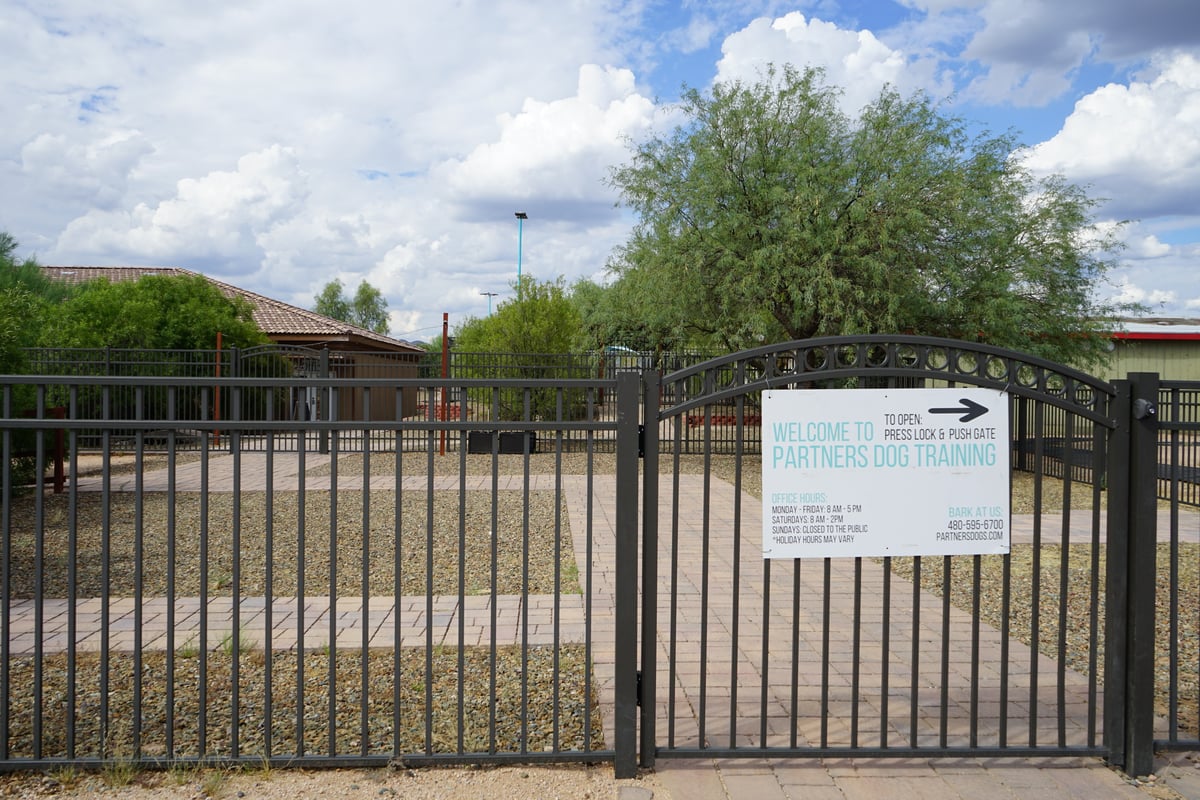
Check the basics too. A legitimate facility verifies vaccination records before any dog steps onto the floor. It keeps water and shaded or climate-controlled rest space available, and it can describe what happens if a dog gets sick or hurt during a session. If a staff member gets vague or defensive about any of that, keep asking, or keep looking elsewhere.
Logistics matter too, and they are a fair test on their own. Ask about drop-off and pickup hours, and whether they fit your commute or a rush-hour drive across town. A school that will not tell you its hours before you enroll is worth a second look, no matter how good the training looks on tour.
Why Staff-to-Dog Ratios Matter More Than the Brochure
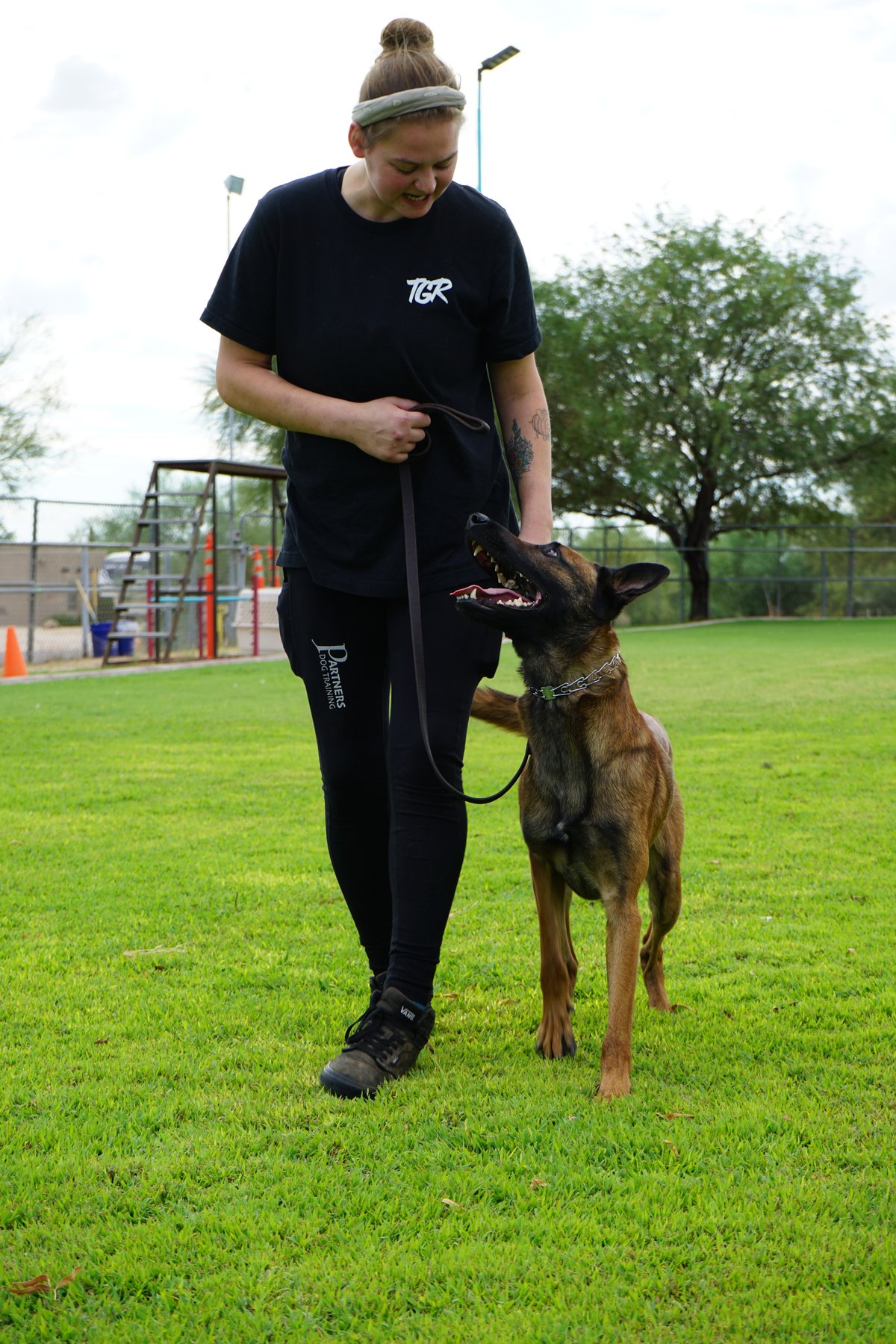
Ask every school the same question: how many dogs is one trainer watching at once, and will more than one trainer work with your dog? A facility running one handler for twenty or thirty dogs cannot give your dog individual coaching, no matter how polished the website looks. At Partners Dogs, DaySchool runs one trainer per 10 dogs. Your dog typically works with more than one trainer across a stay, so they learn to listen to any handler in the building. That rotation is what makes individualized coaching possible inside a day-care format.
Whatever school you are evaluating, get the exact ratio in writing. "It varies" is not an answer worth accepting. For the reasoning behind our number, see why one trainer per 10 dogs changes everything.
Which Program Format Actually Fits Your Dog
The right format depends on your dog's needs and your schedule. Foundation Camp is a 14-night board and train built for dogs that need a fast, structured reset on obedience and manners. Behavior Camp runs 12 to 16 weeks, including a boarded stay plus follow-up coaching, and it is built for behavior problems like reactivity, beyond everyday manners work.
If your dog is social and mainly needs daily reps and supervision, DaySchool combines daycare with daily training for dogs who do well around other dogs. Group Classes work well for dogs with a foundation who mainly need practice around distraction, and they keep you involved every week. Private Lessons make sense when you want a trainer's full attention on one specific issue, in your own home, on your own schedule.
None of these formats is inherently better than another. They solve different problems.
Find your fit
Find the Right Format Before You Tour
Answer a few questions about your dog's age, behavior, and your schedule, then talk it through with a trainer.
How a School Should Evaluate Your Dog First
A school that recommends a program before it has met your dog has not evaluated your dog yet. Ask what the assessment involves before you commit to anything. At Partners Dogs, every dog entering a camp program starts with a PD360 Assessment. Here is what that looks like:
- Drop-off between 9 and 10 a.m. for a 30-minute meet with the trainer and the family.
- A full day of testing in varied environments: people, other dogs, equipment, and everyday commands and rewards.
- Pickup between 2 and 4 p.m. for a second 30-minute meet, where the trainer gives a verbal breakdown of what they saw.
- A revised PD360 score sent afterward, with the plan itself living inside the tracking system rather than handed over as a printed report.
Whatever school you are considering, ask three questions: who evaluates my dog, what do they test, and do I get a conversation with the person who did the evaluating? A form filled out by someone you never met is not the same thing.
Red Flags That Should Make You Walk Away
No responsible trainer promises a fixed outcome by a fixed date, because dogs are individuals and learning does not work on a predictable schedule. Watch for these signs during your search:
- Guaranteed outcomes on a fixed timeline.
- Vague or defensive answers about equipment and methods.
- No visitation policy for dogs staying overnight.
- No willingness to show you a live training session in progress.
If a school cannot answer a direct question about any of these plainly, treat that as your answer.
When Private Lessons Beat a Camp
A camp is not always the right answer. Private Lessons can be the smarter choice for a specific kind of problem. If your dog has one narrow issue in one specific environment, a Private Lesson in your home can often address it faster than a boarded stay. Common examples: jumping on guests at the front door, guarding a spot on the couch, or refusing to walk past a neighbor's fence.
Private Lessons are also worth considering when your dog does not travel well or when your household needs coaching more than your dog does. They run on campus, online, or in your home, and a PD360 Assessment shows whether lessons or a camp fits. Whichever you choose, ask us the credential and hours questions in this guide as well.
If that describes your situation, our Private Lessons page covers how lessons run on campus, online, and in your home.
Our Approach: Tools Matched to the Dog
We run a balanced program, which means we choose tools based on the individual dog in front of us. A dog still learning a new skill gets taught with reward-based methods first. Once a dog fully understands what is being asked, we add fair, clear feedback so the behavior holds up in daily life, on a busy sidewalk as much as in a quiet training room.
Every skill your dog learns moves through four stages: Teaching, Reinforcing, Proofing, and Maintenance. That structure is also how we track a curriculum of over 130 specific behaviors across eight grade levels, so progress is documented at every stage.
If you tour a school and a trainer cannot explain which stage your dog is in and why, or cannot describe how they will move your dog from a quiet room to a busy sidewalk, ask about it directly.
Key takeaways
- Dog training is an unregulated industry in Arizona, so any certification is a useful signal but no substitute for checking a school's actual ratios and hours yourself.
- The CPDT-KA credential requires at least 300 attested hours plus a passing exam, making it a legitimate independent baseline for a trainer's knowledge.
- Partners Dogs University requires 30 hours of coursework before a candidate works a dog, at least 1,000 supervised hands-on hours for Instructor eligibility, and 2,000 for Senior Instructor.
- Partners Dogs runs DaySchool at one trainer per 10 dogs, and your dog typically works with more than one trainer across a stay.
- Every dog entering a camp program at Partners Dogs starts with a PD360 Assessment, with progress tracked across four stages: Teaching, Reinforcing, Proofing, and Maintenance.
Frequently Asked Questions
Do dog training schools in Arizona need a license to operate?
No. Dog training is an unregulated industry in Arizona, so anyone can advertise as a trainer. That is why a tour, a written ratio, documented hours, and watching a session tell you more than any title on a website.
How do I compare two dog training schools after touring both?
Get each school's trainer-to-dog ratio in writing, watch a working session at each, ask how progress gets documented, and weigh drive time and pickup hours against your week. The school that shows you its work beats the school that describes it.
What red flags mean I should walk away from a dog training school?
Be wary of any school offering guaranteed outcomes on a fixed timeline, vague or defensive answers about equipment and methods, no visitation policy for boarded dogs, or no willingness to show you a live training session. Dogs are individuals, and results are not something a responsible trainer promises on a schedule.
When are Private Lessons a better fit than a camp?
Private Lessons often make more sense than a camp when your dog has one narrow issue in one specific environment, such as jumping on guests at the front door or guarding a spot on the couch. They can also be the better choice when your dog does not travel well, since lessons can run in your home or online.
What should a training facility show you about vet and emergency protocols?
A legitimate facility verifies vaccination records before any dog steps onto the floor, keeps water and shaded or climate-controlled rest space available, and can describe exactly what happens if a dog gets sick or hurt during a session. If a staff member gets vague or defensive about any of that, treat it as a reason to keep looking.
Your next move
See Exactly Where Your Dog Stands
Every camp program at Partners Dogs starts with a PD360 Assessment, and a trainer meets your dog in person.