The first thing to understand about leash training is that it is not the tool that makes the carpenter. There are hundreds of leashes, collars, and harnesses on the market, and a favorite move of retailers is to sell you a new gadget instead of a skill. Some of that equipment is genuinely useful and you should be willing to experiment. None of it will do the work for you.
Leash training depends on three things, and every one of them lives with you rather than in the equipment.
- Your foundation. What your dog already understands before the leash is in the picture.
- Attentiveness. Whether your dog is checking in with you at all.
- Willingness to please. Whether working with you is worth something to him.
Build the foundation step by step
Start slower than feels necessary. Most leash problems come from starting at the end of the process rather than the beginning.
- Let him drag the leash. Clip it on and let him move around the house or yard with it trailing. He learns the leash is just a thing that exists, not a restraint that appears when fun ends. Always supervise a dog dragging a leash, because they snag on furniture, fences, and each other.
- Pick up the end and walk it off. No destination, no corrections. You are simply both moving while connected.
- Lure him to you with food. Get him used to choosing to come into your space while the leash is on.
- Pay him when he comes. Every time, early on. He is learning that being near you is the position that earns things.
The point of that sequence is this: do not make it about the leash. Make it about you. A dog who wants to be near you walks well on almost anything. A dog who does not will fight whatever you clip on him.
If your dog is already fighting the leash
Go back to a quiet setting and rebuild the foundation there. A driveway, a hallway, a back yard, somewhere with nothing to react to. Then increase exposure gradually. Adding one new distraction at a time is slow and it is the only approach that holds.
Watch your own energy while you do it. If you wind your dog up before a walk, you pay for it the entire way around the block. Start calm, stay calm, and keep sessions short enough to end while things are still going well.
If the specific problem is a dog who drags you down the street, that is its own skill with its own fixes. Our guide on getting a walk you can actually relax on covers what to do when your dog has already learned that pulling works.
Reactive dogs need a different setup
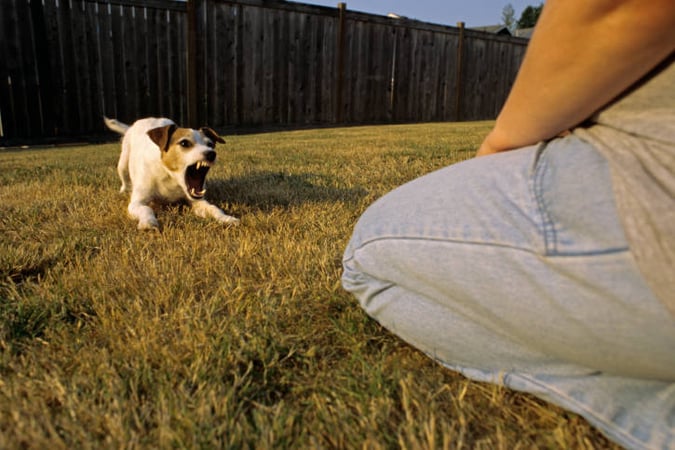
If your dog lunges or reacts toward people or other dogs, consider working him in a basket muzzle while you build the foundation. Owners tend to resist this, and it is one of the most freeing tools available. It does two things at once. It removes the possibility that your dog hurts someone, and it takes the tension out of your own hands, because you are no longer bracing for the worst on every walk. Dogs read that tension. A handler who has stopped white-knuckling the leash makes faster progress than one who has not.
Be patient with the dogs who take longer. Some dogs need weeks on step one, and there is no prize for rushing them through it.
Walk before you run
Literally. The goal is not a dog who tolerates a leash. It is a dog you can take anywhere without thinking about it, on a normal walk, on a normal street, without the whole thing being a negotiation. That comes from foundation and repetition, not from the right collar.
If you are stuck, we can help. Call us at 480-595-6700. Partners Dog Training School has worked with dogs in Scottsdale and Cave Creek since 1997.