Bottom line
Walking your dog in monsoon season is safe between storms, never during them. Check the forecast before every walk, never cross a wash with moving water, get to shelter at the first sound of thunder, and wait 30 minutes after the last rumble before heading back out.
- Walk when no storms are forecast. Cut the walk the moment dark clouds build or the wind shifts.
- Thunder means the walk is over. Lightning can strike 10 miles from where it is raining.
- Any moving water in a wash is a no-cross zone. Six inches of moving water can knock a person down.
- A haboob can drop visibility to zero in seconds. Get to a building or your car, and stay put.
- After a storm passes, wait 30 minutes after the last thunder before resuming the walk.
Arizona's monsoon runs June 15 through September 30, and it does not negotiate. A walk that starts in sunshine can end in a flooded wash. Walking dog in monsoon season is safe. Walking your dog through a storm is dangerous. The rule: walk between storms, never in one.
Pet Parents ask us when a walk becomes unsafe. The sky tells you before the rain does. Storms spike arousal, dogs get jumpy, and your handling gets worse exactly when the footing does. You did not get a dog to spend four months a year scanning the sky like an air-traffic controller, but the sky check is the price of the good walks. We train walk behavior the same way we train everything else (our methodology). Group Classes are where that walk behavior gets proofed against real distractions a Pet Parent could never stage alone, which is exactly the handling a monsoon walk demands. This article is the weather half of that protocol.
When is it safe to walk your dog in monsoon season?
The short version: walk when the forecast is clear, cut the walk when the sky changes, and treat thunder as a full stop.
The National Weather Service keeps it simple: check the forecast before your trip, and postpone outdoor activities if thunderstorms are imminent. Storms can develop within minutes, so "it looks fine right now" is not a forecast. Five rules:
- Check the forecast before you leash up. Read the hourly forecast for your exact area. If storms are possible during your walk window, move the walk or skip it.
- Do not start a long loop under building clouds. If dark clouds are already stacking over the mountains, you are already late.
- Cut the walk at the first sign. Dark towering clouds, a sudden wind shift, a temperature drop, dust lifting off the ground. Any one of these ends the walk. Turn around and head for the car.
- Hear thunder and the walk is over. The NWS says if you can hear thunder, you are within striking distance. Do not finish the loop. Get to shelter.
- Wait 30 minutes after the last thunder before going back out. Sunshine is not an all-clear. Trailing clouds can still throw lightning after the rain ends.
Heat rides with monsoon season, so your timing has to beat two hazards. Scottsdale's hiking guide says skip the trail if temperatures are forecast above 90°F at any point during the hike, and in Phoenix, city code closes trails to dogs at 100°F and above. Our Phoenix heat walking guide covers the heat side. This article covers the storm side.
The safest storm protocol is boring: turn around early, every time. The walk you cut short is the walk that keeps you both safe.
Why are flooded washes so dangerous?
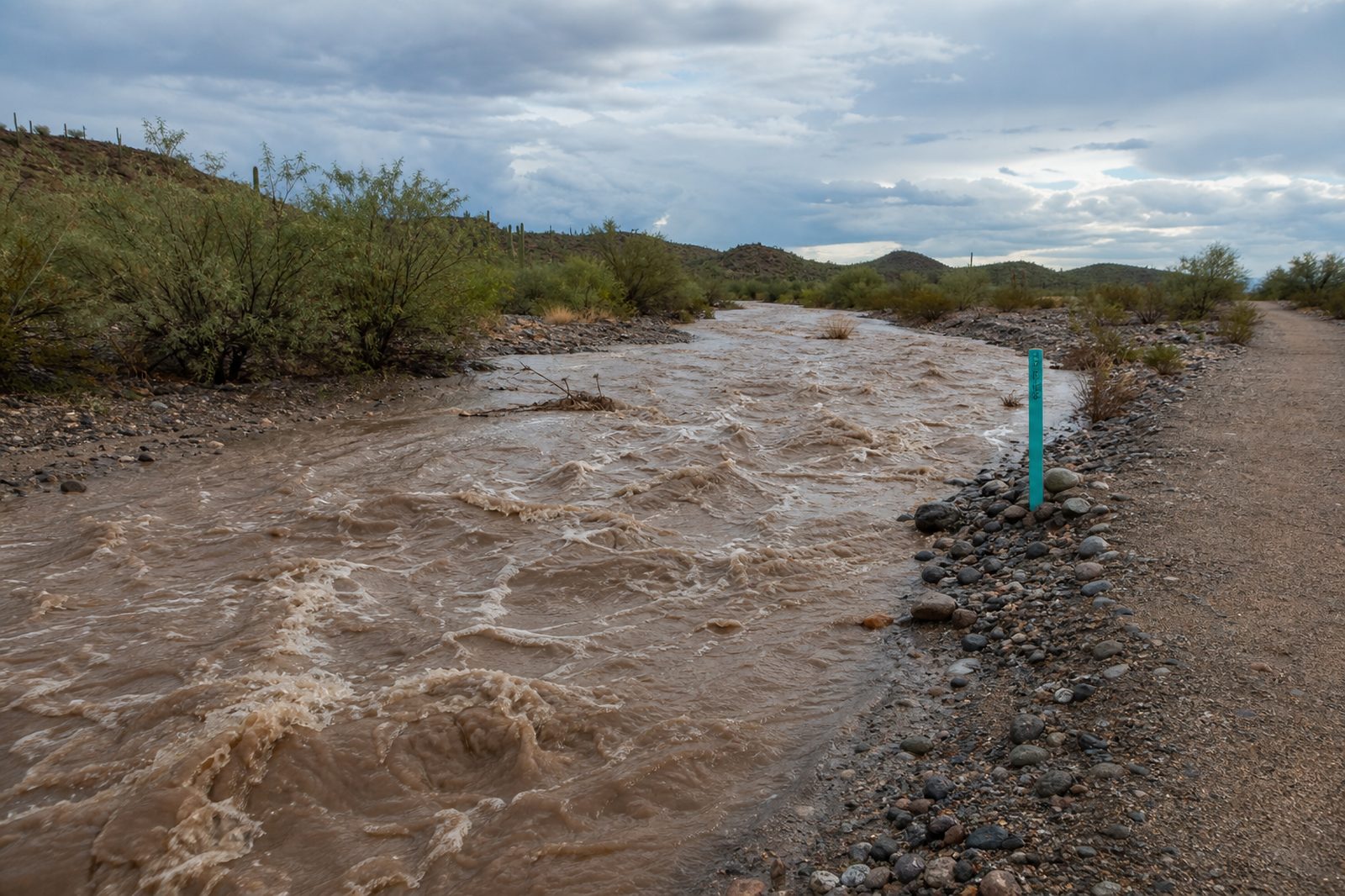
The short version: washes look harmless and kill fast, because the danger is upstream where you cannot see it.
Arizona washes are dry most of the year, which is what makes them dangerous. Rain falling miles away on higher ground funnels into those channels and arrives as moving water, debris, and mud. It can be sunny over your head and deadly at your feet. The Goodyear Fire Department puts it plainly: stay out of riverbeds, because it may not be raining where you are.
The numbers leave no room for argument. As little as 6 inches of moving water can knock a person down. Two feet can sweep a vehicle away. Your dog is lower, lighter, and leashed to you, so a current that takes your footing takes your dog too. The NWS campaign is called Turn Around, Don't Drown, and more than half of flood deaths happen inside vehicles, so this applies to your drive to the trailhead as well.
Four rules for washes:
- Never cross a wash with moving water. Any flow, any depth, any speed. Turn around.
- Never shelter in a wash when rain starts. Washes flood quickly. Low ground is where the water goes.
- Never let your dog play in flood water. It carries debris, sharp objects, chemicals, and sewage.
- Never drive around a "Road Closed" sign at a flooded crossing. Under Arizona's Stupid Motorist law, you can be billed for the cost of your own rescue.
McDowell Sonoran Preserve: Why are its washes so tricky?
The short version: 230 miles of trails cross countless washes, and storm water off the McDowells can reach a dry crossing in minutes.
The McDowell Sonoran Preserve covers more than 30,500 acres with over 230 miles of multi-use trails, per the City of Scottsdale. That scale is the point. Trails cross wash after wash, and those washes drain the McDowell Mountains. A storm cell dumping rain up high sends water down channels that look bone dry where you stand.
Our McDowell Sonoran Preserve trail etiquette guide treats wash crossings as a planning step, not scenery. Before a preserve walk, check which trails cross major washes, tell someone your route, and pick a loop you can bail out of fast. Stay on designated trails so rescuers can find you, and keep your phone fully charged.
What do you do if lightning catches you on a walk?
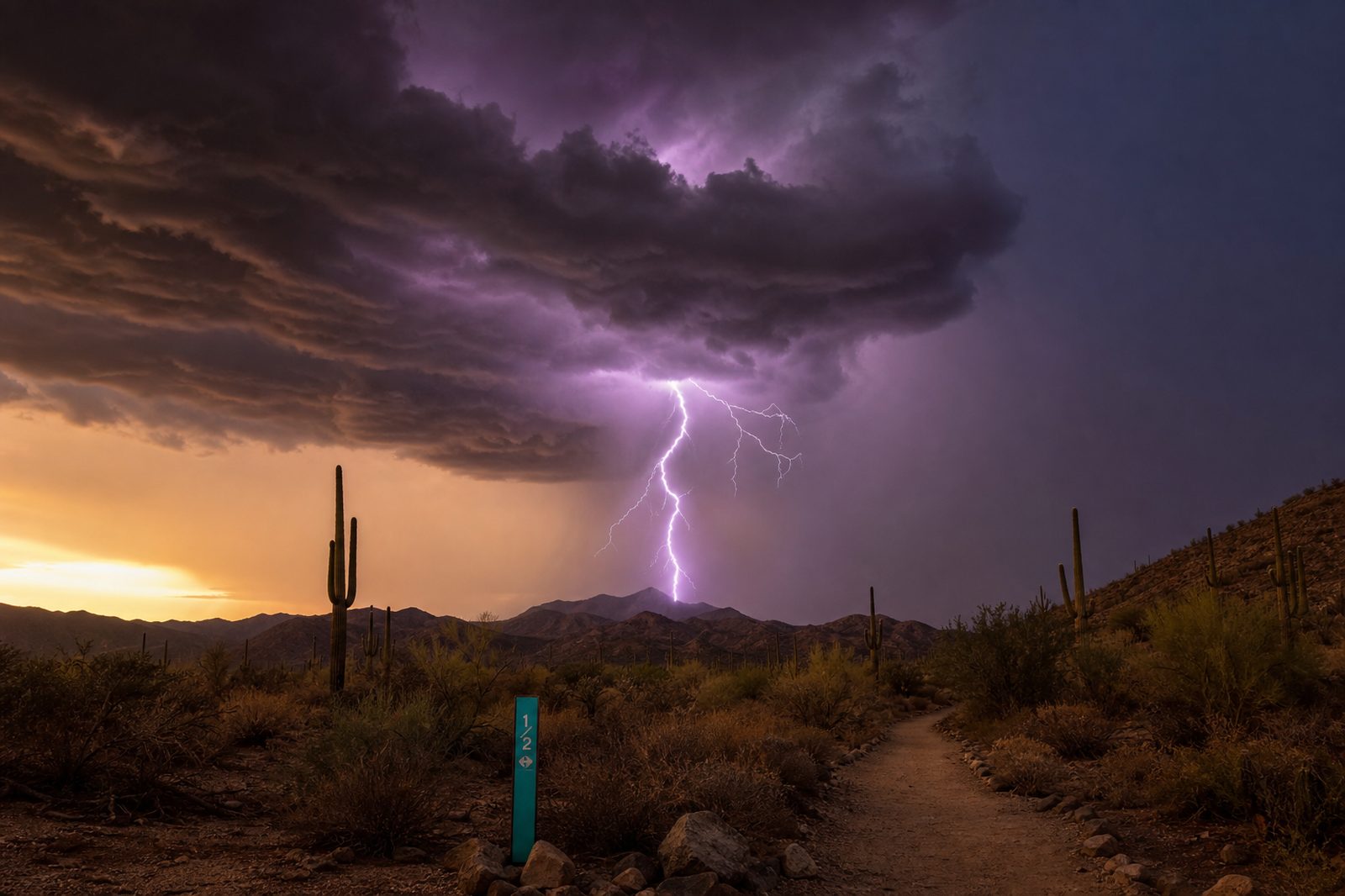
The short version: get inside a real building or your car immediately, and do not come back out for 30 minutes after the last thunder.
The NWS rule is six words: when thunder roars, go indoors. Lightning can strike 10 miles from where it is raining, so a storm that looks far away can reach you. No place outside is safe during a thunderstorm. Safe shelter is a large enclosed building or a hard-topped vehicle. A ramada, a picnic pavilion, a porch, a carport, or a lone tree is not shelter.
If you cannot reach either, reduce your risk the NWS way: get off elevated areas, never shelter under an isolated tree, never use a cliff or rocky overhang, get out of and away from any water, and stay away from metal fences.
Keep the leash short and the dog at your side while you move to shelter. A panicking dog that bolts is a second emergency. Longer term, train a storm recall as a default response.
If your dog falls apart at the first rumble, that is a training project, not a walk-day problem. Start with our monsoon storm anxiety desensitization plan.
What do you do if a haboob rolls in on your walk?
The short version: get to a building or your car before the wall reaches you, because visibility can drop to zero in seconds.
A haboob is the towering wall of dust that rolls ahead of some monsoon storms. ADOT's warning is blunt: visibility can drop to zero in an instant. You cannot see the trail or the wash crossings, and fine dust gets into every set of lungs on the walk.
When you see a dust wall building, stop the walk and move to the nearest building or your vehicle. Do not wait for it to arrive. Cover your nose and mouth with a cloth, keep your dog on a short leash at your side, and wait out the storm where you are.
If you are driving when one hits, follow ADOT's Pull Aside, Stay Alive protocol: do not drive into the dust, pull completely off the paved road, turn off all your lights including flashers, set the emergency brake, take your foot off the brake, and stay belted in the vehicle until the storm passes. Lights off matters. Drivers behind you will follow your lights straight into your parked car.
Before the program
Need Help With Your Dog?
We can help you build a safer, calmer dog.
What goes in a monsoon walk kit?
The short version: pack for the storm you might meet, not the sky you see.
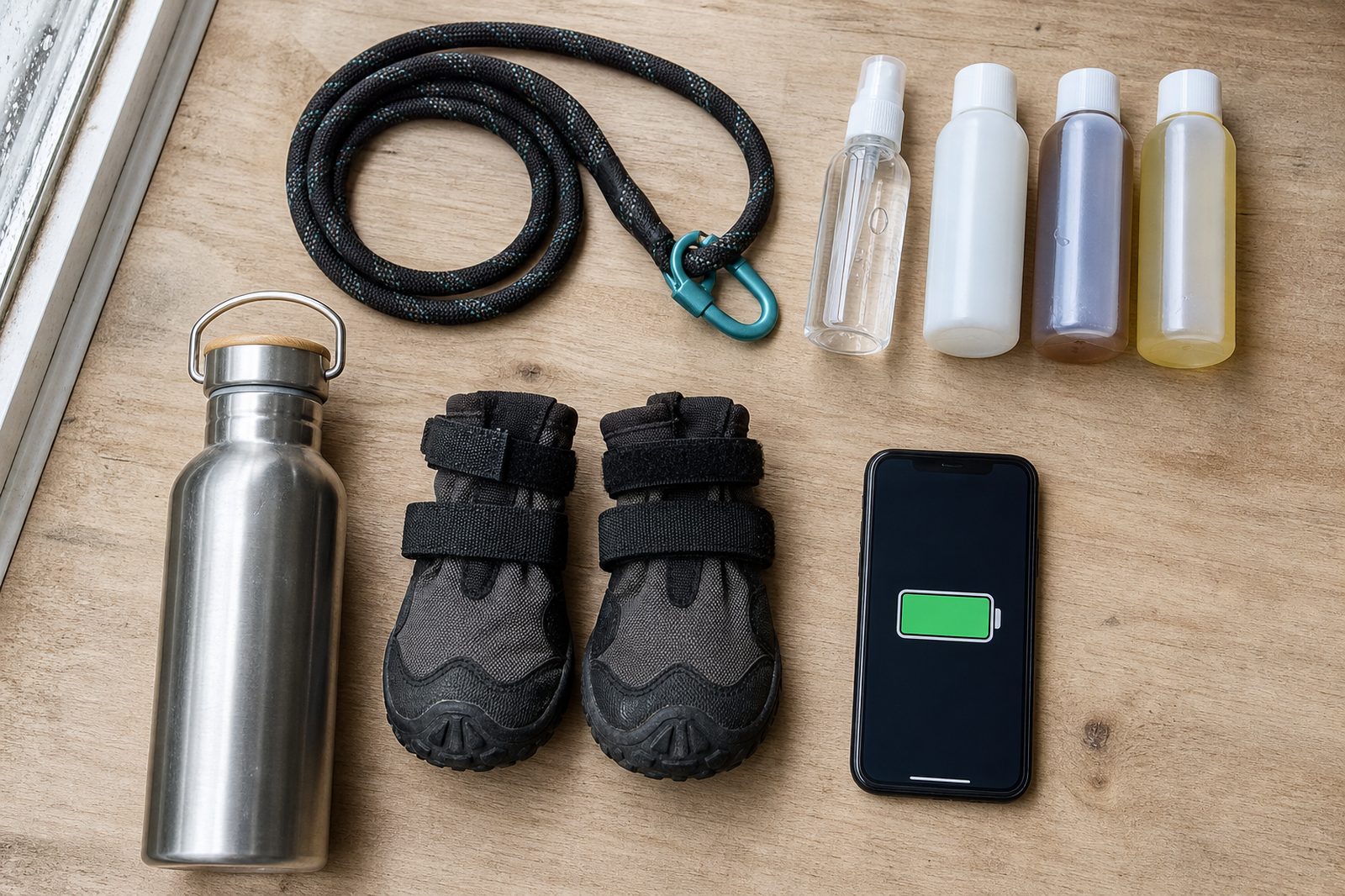
A monsoon walk kit is small, because you are not packing for a storm. You are packing to get out of one fast.
- A fixed-length leash. Wind gusts hit hard. A fixed leash keeps your dog close when they panic at the first thunder crack.
- A fully charged phone. The fire department's hiking guidance says it plainly: you need to reach 911 if you get in trouble, and rescue teams use your phone to locate you.
- Water for both of you. Monsoon season is still summer. Bring water for everyone in the party, dog included.
- Current ID tags and a registered microchip. Dogs bolt during storms and gates blow open. If your dog gets loose in a haboob, tags are the fastest way home.
- Dog boots in the car. Hot pavement before the storm, sharp debris after it.
For the full seasonal loadout, our desert hiking gear checklist covers the rest.
Should you walk or wait? The decision table
The short version: match what you see to one row, and do what it says. Use it like a traffic light: green rows walk, amber rows cut it short, red rows stop.
| What you see | What you do |
|---|---|
| Clear sky, no storms in the forecast | Walk. Normal route, normal distance. |
| Dark clouds building, wind shifting, temperature dropping | Cut the walk short. Head straight for the car. |
| You hear thunder | The walk is over. Get to a building or hard-topped vehicle now. |
| Storm just ended, sky clearing | Wait. 30 minutes after the last thunder before heading back out. |
| Dust wall visible on the horizon | Get to a building or the car before it arrives. Cover your nose and mouth. |
| Any moving water in a wash on your route | Do not cross. Turn around, even if the crossing looks shallow. |
| Flash flood warning issued for your area | Stay home. If you are out, get to high ground away from washes. |
Mistakes that make monsoon walks worse
- "No rain here" thinking. The water that fills a wash falls miles away. Judge the storm upstream, not the sky overhead.
- Sheltering under a tree or ramada. Neither is safe in a lightning storm. Buildings and hard-topped vehicles are.
- Finishing the loop after the first thunder. The strike that hurts you usually comes before or after the storm's peak, not during it.
- Walking right after the rain stops. Trailing clouds still carry a charge. The 30-minute wait is the rule, not a suggestion.
- Letting the dog off leash "because the trail is empty." A thunder crack turns an empty trail into a lost-dog search.
- Driving into a dust storm to get home faster. Pull aside, lights off, and wait. The storm passes. A pileup does not unhappen.
By the numbers
Match the program to the dog
Ready for the Next Step?
Find the right training program for your dog.
Key takeaways
Key takeaways
- Walk between storms, never in one. Check the forecast before every walk, June 15 through September 30.
- Six inches of moving water can knock a person down. Never cross a wash with any flow, and never shelter in one.
- When thunder roars, go indoors. Lightning reaches 10 miles from the rain, and no spot outside is safe.
- A haboob drops visibility to zero in seconds. Get to a building or your car before the wall arrives.
- After any storm, wait 30 minutes past the last thunder before the walk resumes.
Frequently Asked Questions
Can I walk my dog at all during monsoon season?
Yes. Most monsoon days are walkable; the danger is the storm, not the season. Walk when the forecast is clear, cut the walk when clouds build, and keep the outing short enough that you can get back to the car fast.
What is the first thing to do if I hear thunder on a walk?
Get to shelter immediately. The National Weather Service says if you can hear thunder, you are within striking distance. Head for a large enclosed building or a hard-topped vehicle. Do not finish the loop, and do not shelter under a tree or ramada.
How long should I wait after a storm before walking my dog?
Wait 30 minutes after the last clap of thunder. This is the National Weather Service rule, and it exists because trailing storm clouds can still produce lightning after the rain ends. Sunshine alone is not an all-clear, so reset the clock with every new rumble.
Are flooded washes really that dangerous for dogs?
Yes. Six inches of moving water can knock a person down, and your dog is lower, lighter, and leashed to you, so a current that takes your footing takes your dog too. Flood water also carries debris, chemicals, and sewage. Never cross a wash with moving water.
My dog panics during monsoon storms. What do I do?
Do not try to fix storm panic on walk day. Walk and potty your dog before storms build, keep gates locked and ID tags current in case of a bolt, and work the anxiety as a separate project. Our monsoon storm anxiety desensitization plan runs the full June-to-September season.
Where to go from here
Monsoon season is three and a half months of great walking with a few hours you have to respect. Learn the five walk rules, memorize the decision table, and keep the kit in the car. The storms will do what they do. Your job is the turnaround. If your dog's walk manners, or its storm panic, need real work beyond this protocol, a PD360 Assessment is where a senior trainer reads your dog and routes it honestly.
Scottsdale: 8642 E Shea Blvd, 85260. Cave Creek: 4640 E Forest Pleasant Pl, 85331. Serving the Phoenix Valley.