Sixty-second answer
Which one costs less once you count the whole path to a well-mannered dog: weekly group classes or a boarded Foundation Camp? For an adolescent dog with everyday gaps (pulling, jumping on guests, a leash that goes tight around every distraction), a Group Classes series has the lower ticket price, but a single grade level runs about 12 weeks of weekly sessions, and the timeline stretches further across a full command set while leaning on a family doing homework between sessions. A 14-night Foundation Camp board and train compresses that same rep volume into two weeks under one trainer team, then hands the skills back with parent lessons built in. Current rates for both live on the pricing page; a PD360 Assessment is the fastest way to find out which path fits the dog in front of you.
Is weekly group class training or board and train the better fit for an everyday obedience gap?
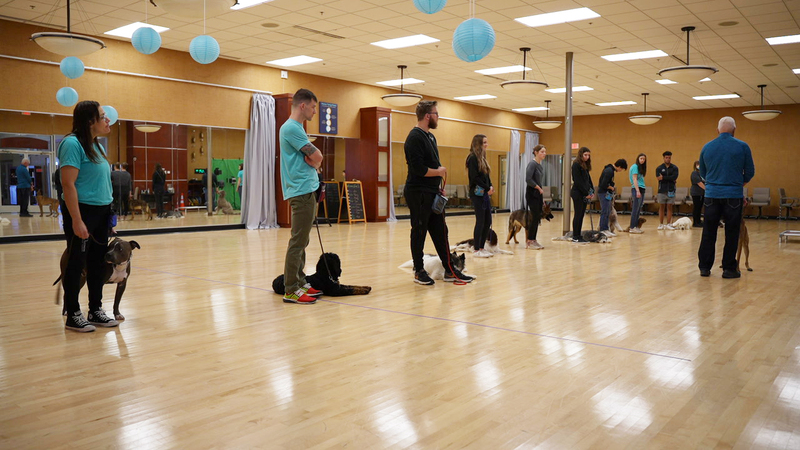
Group classes and board and train close the same everyday obedience gap on two very different timelines, and the timeline is most of what the sticker price is hiding. Both paths are built to fix the same short list of household problems: a dog that pulls toward every jogger on the canal path, jumps on the neighbor at the mailbox, and won't hold a sit while the front door opens. Neither is wrong for that dog. The honest starting point: a social, food-motivated dog whose owner has three or four weeknights free every week for a couple of months can get there in Group Classes. The eight-level curriculum at Partners Dogs teaches, reinforces, and proofs a command set against real distraction rather than quiet-room compliance alone, and a dog that starts at Pre-School can work up through Kindergarten and Elementary a level at a time.
Where that math changes is when the gap is wider than one command at a time, or the household calendar can't reliably deliver a weeknight every week without a gap. Cost per outcome adds up the ticket price, the weeks it takes to reach the specific behavior a family wants fixed, and the odds the plan survives a missed week or a monsoon-season evening nobody wants to walk the dog through. A camp stay and a class series can land at a similar total once all three are counted honestly.
How do group class and board and train costs compare over time?
A single class session costs far less than a night of board and train, but a family rarely buys one session or one night. The fairer comparison lines up what it takes to reach a specific, repeatable outcome, like a dog that holds a sit at the door instead of mobbing guests, or walks a full loop of a Desert Ridge neighborhood on a loose leash. Current rates for every format are posted on the pricing page, and the pattern holds regardless of the exact numbers on a given week: a class series is the lower up-front number, and a boarded camp is the higher single payment that compresses far more repetition into far less calendar time.
| Path | Time to a measurable outcome | What "outcome" looks like | What can stretch the timeline |
|---|---|---|---|
| Group Classes (weekly, 45-minute sessions) | About 12 weeks per grade level (24 weeks for Masters and Dogtorate), often longer for a full command set | Reliable sit, down, and loose-leash walking in a controlled, low-distraction setting | A missed week, inconsistent home practice, or a dog not yet proofed against real-world triggers like other dogs or delivery trucks |
| Foundation Camp (14-night board and train) | 14 straight nights, one stay | The same command set proofed across home, walk, and daycare settings, handed back with parent lessons | A behavior need beyond everyday manners, which points to Behavior Camp instead |
| Foundation Camp graduate on ongoing Group Classes | Ongoing, at a lower weekly cost than starting cold | Maintenance of camp-level skills plus new socialization and distraction reps | Rarely stretches; this is the maintenance stage, not the building stage |
That third row matters more than it looks. Most board and train families do not stop training the week they pick their dog up; they move into Group Classes as the maintenance stage of the same Teaching, Reinforcing, Proofing, Maintenance method. The real cost-per-outcome question is which path gets a family to the maintenance stage without the plan falling apart first.
What’s the best group class option for families in North Phoenix, 85085, and Desert Ridge?
The best group class option for a North Phoenix, 85085, or Desert Ridge family is the one matched to the dog's actual starting point, not the one closest to home. Partners Dogs runs Group Classes at both the Scottsdale and Cave Creek campuses, and families driving in from Desert Ridge, Anthem, or the 85085 corridor already treat that drive as a destination trip the same way they would for a boarding stay or a snake avoidance clinic. Placement starts at PD360 score, not age or breed, so a nine-month-old dog with no prior training and a three-year-old rescue with a few gaps can land in the same Elementary-level room if that is genuinely where each one tests.
The honest caveat: a class is the best option only when a dog is stable enough to work in a room with five or six other dogs without flooding. A dog already reactive to other dogs (at the door, on leash, or in the car) needs that piece addressed first: a private lesson or a PD360 Assessment conversation, not a first group session.
How much do group classes cost, and does location change the price?
Group class pricing at Partners Dogs is the same for every family regardless of zip code, whether the drive starts in Desert Ridge or right around the corner from either campus. Classes run in a drop-in format or as a multi-class package, and current rates for both are posted on the pricing page rather than restated here, since rates change and the page is the version that stays accurate. What does change by household is how many classes it takes to reach the level a family actually wants: a dog that already knows a marker word and a loose-leash basic needs fewer repeat sessions than one starting from a jumping, mouthing, door-bolting baseline.
The number that matters more than the per-class rate is the total weeks a family should plan for. A single grade level typically runs about 12 weeks of weekly sessions plus daily home practice; a dog moving through two or three grade levels to close a wider gap is closer to a year than a single season. That total, not the price of one Tuesday night session, is the number to compare against a camp stay.
How long does it take to close an everyday obedience gap with each path?
A weekly class delivers roughly 45 minutes of guided repetition a week; a board and train stay delivers structured immersion across most of the day, every day. That reflects a deliberate design choice. Group Classes are built around a rhythm families can sustain alongside work and school, and the homework between sessions is where most of the actual behavior change happens. A camp stay compresses that same rep volume, plus the follow-along coaching, into a fraction of the calendar.
One review in our own files puts the frustration plainly: The training I took her too (not Partners) became exhausting for us as it was one hour a week class. Sparr wasn't making any progress on her anxious behaviors.
(Kelly M., Scottsdale) The problem was not the class format itself; it was that one hour a week left too much dead time for an anxious dog to hold onto anything. Our Group Classes build in graded proofing specifically so that gap does not open, but the underlying math holds for any weekly format: fewer reps per week means a longer calendar to catch up.
When does an adolescent dog need board and train instead of weekly classes?
An adolescent dog needs board and train over weekly classes when the gap is wide, the household calendar can't guarantee consistent weeknights, or the behavior needs to be proofed across more environments than a weekly class can reach in a reasonable timeline. Odin, a Pitbull mix who came to us during adolescence, is a fair example. His family's first concern was jumping, made worse by a smaller dog in the home who got away with the same thing. The original plan was two weeks of leash handling, socialization, and basic obedience; by the second week the team extended the stay to a third because Odin was still working through leash pressure and some barrier reactivity at daycare, and everyone wanted him fully ready before going home to a two-dog household. By the final week, his owner was handling the leash himself on a real walk with another dog present, coached from the side, with recalls coming back reliably mid-play.
That kind of proofing against a real dog, a real leash, and a real household dynamic is the piece a weekly class cannot compress into one calendar month. It is a difference in what one hour a week versus 8 to 12-plus hours a day of structured immersion can cover before a family's next milestone arrives. For a dog like Odin, whose gaps were everyday rather than dangerous, Foundation Camp was the shorter path to an outcome that months of stacked class levels would have eventually reached too.
A trainer can tell you
See the class level that matches your dog's gap
A PD360 Assessment places your dog at the Group Classes level that matches real skills right now, then shows whether weekly sessions close the gap or a Foundation Camp stay gets there in less calendar time. See the level and format before enrolling in either one.
Key takeaways
Group Classes run weekly, 45-minute sessions across an eight-level curriculum, about 12 weeks per level (24 weeks for Masters and Dogtorate). Foundation Camp is a 14-night board and train that proofs the same skills across home, walk, and daycare settings in one stay. Cost per outcome counts total weeks and the odds a plan survives a missed week, not just the price of one class or one night. Most Foundation Camp graduates move into Group Classes afterward as the maintenance stage. A PD360 Assessment, not age or zip code, decides which path fits a given dog first.
Frequently Asked Questions
Can a family switch from Group Classes into Foundation Camp partway through a class series without losing the progress already made?
Yes. Trainers can pick up from wherever a dog's skills currently sit; nothing taught in Group Classes has to be retaught from zero in a camp stay. Families usually make this switch when a dog is progressing but the household calendar can no longer support a weekly session, or when a new gap shows up that a class format proofs too slowly.
Does a membership make ongoing Group Classes a cheaper way to maintain skills long-term?
For a dog already past Foundation Camp or an early class series, a membership through Partners Dogs bundles ongoing classes with other services at a lower recurring cost than paying for each one separately, since it is built around the maintenance stage rather than first-time learning. Details on what each membership tier includes are on the memberships page.
If a family starts in Group Classes and later enrolls in Foundation Camp, does the PD360 Assessment fee still apply as credit?
Yes. The PD360 Assessment fee is applied as store credit when a family enrolls in the recommended program, whether that recommendation is a camp or a membership; it does not apply to a la carte bookings or general reservations like a single class, a boarding stay, or a drop-in day.
Keep reading