The Mini Educator E-Collar Training System runs on 100 distinct stimulation levels, a half-mile range, and a receiver waterproof to 500 feet, and that granularity is the entire reason Partners Dogs trainers reach for it over a generic big-box collar. It is not a shortcut. It is a communication tool that only works the way it is supposed to when a dog is conditioned to it first, which is why the process matters as much as the product.
Pet parents ask us about the Mini Educator more than any other single piece of gear on the shop shelf, usually somewhere between "is this the shock collar thing" and "what do the professionals actually use." It is a fair question, because the answer determines whether the tool helps a dog or just startles one. We carry the Mini Educator E-Collar Training System because of what it lets a trainer do at the low end of the dial, not the high end. It fits directly into the same stage progression every dog moves through with us: Teaching, Reinforcing, Proofing, Maintenance, no matter which tools end up in the mix.
What Makes the Mini Educator Different From a Big-Box Collar
| Tool | Best for | Levels / range | Price | Where fitted |
|---|---|---|---|---|
| Mini Educator 1-Dog System | Single-dog households, the default pick | 100 stim levels, plus tone and vibration only | $209.99 | Conditioning walkthrough in-store, Scottsdale or Cave Creek |
| Mini Educator 2-Dog System (ET-302) | Two dogs training in parallel on separate collars | Same 100-level range, remote addresses a second receiver | $309.99 | Conditioning walkthrough in-store, Scottsdale or Cave Creek |
| Generic big-box collar | Occasional, low-stakes correction only | Four to eight preset levels, no vibration-only mode on most | Not sold by Partners | Not fitted, no conditioning process included |
| Dogtra-brand systems | Larger, tougher working dogs or long-range field use | Comparable multi-level range, built for field distance | Higher price point than the Mini Educator, not sold by Partners | Not fitted here, suited to a working-dog specialist |
Prices shown reflect 2026 rates and can change; see the current pricing page for today's numbers.
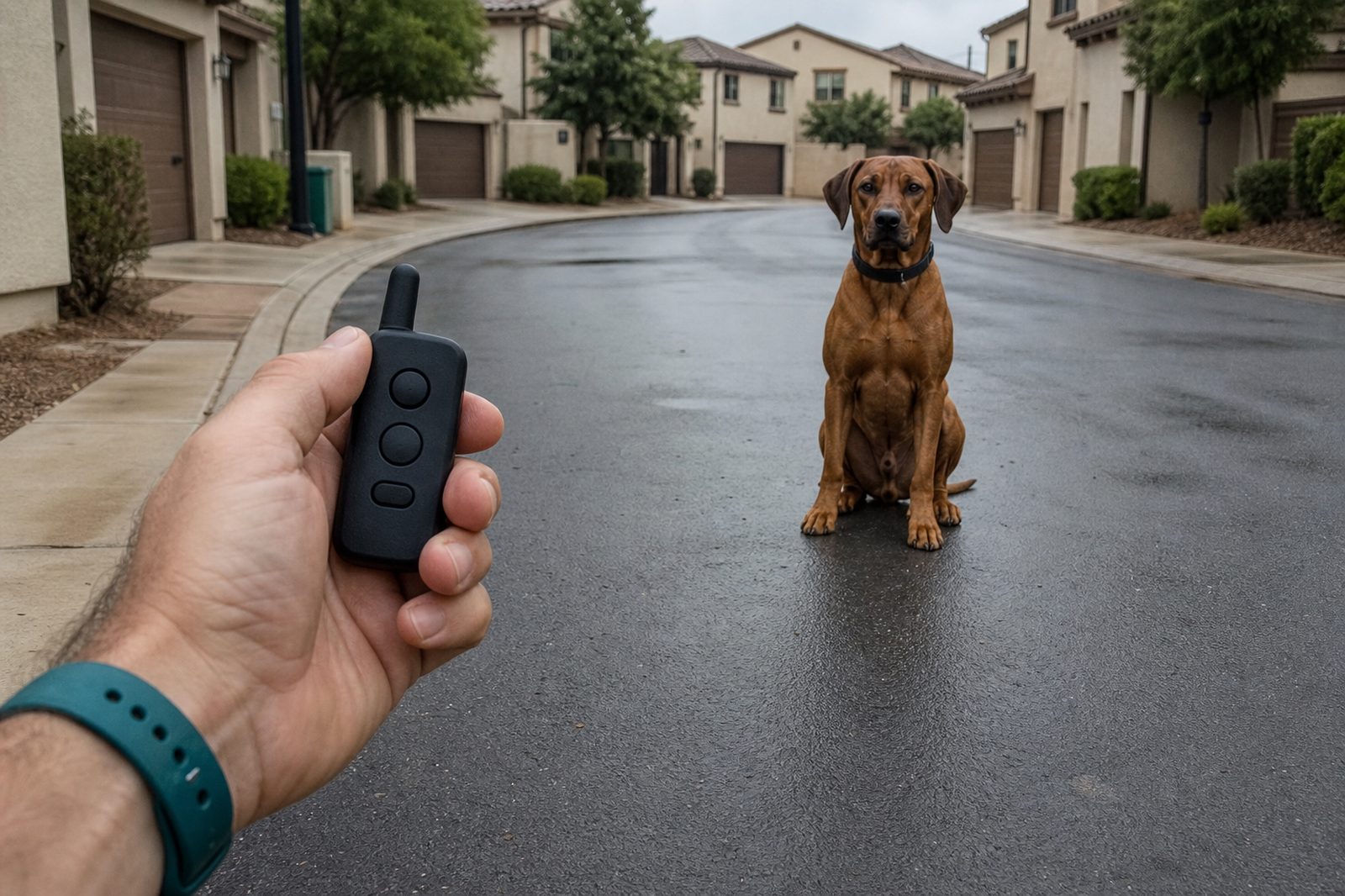
The number that matters is 100, not the word "shock." Most collars sold at a pet store or a mass retailer compress their power range into somewhere between four and eight settings, which means the jump from "nothing" to "noticeable" is often a big, blunt step. The Mini-Educator (SKU #28313 for the 1-dog system) spreads that same range across 100 low increments, plus separate tone and vibration modes that carry no stimulation at all. In practice that means a trainer can find the exact level a dog first notices, which for most dogs is a level so low a person holding the remote cannot feel it on their own palm. That is the opposite of the blunt-instrument image the word "shock collar" conjures, and it is the actual mechanism at work, plainly described.
Two other features earn the Mini Educator a spot in a professional kit rather than a drawer. Lock & Set keeps the chosen level from drifting mid-session if the dial gets bumped, which matters more than it sounds like it should when you are managing a leash, treats, and a dog's attention at the same time. And the whole system is waterproof to 500 feet with a floating remote, which is a useful spec for Arizona trail work and pool-season yards, not a throwaway line on a spec sheet.
How We Condition a Dog to the Collar Before It Ever Goes Live
A dog is never introduced to stimulation as the first thing the collar does. The collar goes on for several sessions before it is ever turned on, so wearing it becomes background noise rather than a signal that something is about to happen. Once a dog is neutral to the collar's weight and fit, we find the working level the same way every time: start at zero, move up one increment at a time while watching for the smallest ear flick or head turn, and stop the instant the dog notices anything. That level, not a higher one, is where real training work begins. It is always paired with a known cue and a leash, and never used to introduce a command the dog has not already learned.
This is where the process becomes the actual differentiator, not the box it comes in. The reason a fine-grained dial matters is that it lets a trainer stay at that just-noticeable level for weeks of proofing instead of guessing between four settings and accidentally landing on one that is too strong. It is the same logic behind our full training methodology, where a dog progresses from learning a skill under no distraction to holding it reliably under real-world pressure, and an e-collar becomes one more way to reinforce a cue at distance or off leash once that foundation is already built, not a replacement for building it.
Kim K., Scottsdale, described that same order from the intake side:
"They took time to explain training, collar options and how they handle daily potty breaks."
Kim K., Scottsdale
The class and the walkthrough come before the collar ever leaves the box, which is the order that makes the tool work.
Find your dog’s working level
Talk Through Fit and Timing First
If you are not sure whether your dog has the foundation for e-collar work yet, a quick conversation beats guessing with the remote in hand.
Which System to Buy, the 1-Dog or the 2-Dog
Buy the 1-dog system unless you are actively training two dogs on separate collars at the same time. The 2-dog version (ET-302, SKU #28314) uses the same 100-level range and the same receiver, the only difference is a remote that can address a second collar independently, useful for a two-dog household working parallel sessions. It is not a stronger or longer-range unit, so a single-dog home gets nothing extra by upgrading. Compared to the larger Dogtra-brand systems some trainers use for bigger, tougher working dogs or longer-range field applications, the Mini Educator's half-mile range and lighter roughly 2.4-ounce receiver suit the large majority of family and companion dogs we see day to day, at a lower price point than those larger systems. Both variants sit inside the full training gear lineup in the shop, alongside the leashes, prong collars, and place cots that carry a dog through the same four training stages.
Where the Welfare Concern Is Right, and Where It Misses
The caution against e-collars is reasonable advice for the situation most people picture when they hear the word. AVSAB's 2021 Position Statement on Humane Dog Training names prong collars, choke chains, and electronic shock collars specifically as tools "that involve pain" that an appropriate trainer should avoid. That statement describes real risk when a tool is used without skill, which is exactly the case for a first-time owner who orders a random collar online, skips any fit or level-finding process, and treats the dial like a volume knob. We agree with that specific concern completely.
Where the caution misses is the assumption that every e-collar gets used that way. A properly fitted Mini Educator at the level a dog barely notices is not the same category of experience as an unconditioned dog getting jolted at a guessed setting, and lumping the two together is where the debate stalls out. This tool sits alongside positive reinforcement as part of the same toolkit, not as a substitute for it. A dog can be conditioned to the collar as a reward marker just as easily as a correction, and most of our clients use it far more often to reinforce a recall or a stay at distance than to correct anything at all. Used this way, and paired with a known cue, it is not stress beyond what builds resilience, the way a muscle rebuilds stronger after being worked. It is generally frowned upon mainly by people who have not watched it used well.
Who Should Not Buy One Without a Trainer
Three groups should not self-apply this tool without coaching, full stop. A first-time owner with no conditioning plan and no way to find the dog's actual working level. A fearful or shutdown dog that has not done foundation obedience work yet, since stimulation on top of an already anxious dog compounds the problem instead of solving it. And anyone who treats the stimulation dial as a strength setting rather than the lowest level a dog notices, which is the single most common way an otherwise good tool gets used badly.
- No conditioning sessions before the first stimulation, ever
- No known cue paired with the correction or the reward marker
- A dog with unaddressed fear, anxiety, or unresolved medical pain
- Guessing the level instead of finding it with a leash and full attention
If any of those describe your situation, that is a signal to learn the process first, from someone who has run it hundreds of times, before running it yourself at home. This is the same honesty we bring to every tool in the shop: an incredible option used correctly, and one we would rather walk a family through than simply sell.
Judy L., Cave Creek, said it plainly about the trainer who walked her through the process:
"She explained everything so well."
Judy L., Cave Creek
For Molly M., Cave Creek, whose dog is deaf, the collar became something more specific than a correction tool:
"He is also training with the e-collar so we have a consistent form of communication with him - which was only made possible by the trainers at Partners."
Molly M., Cave Creek
It is one review among the 2,000+ that hold Partners Dogs to a 4.8-star rating. It is the kind of specific, checkable outcome that number represents, not a general claim to take on faith. Read more reviews from families who have run this same process.
If you want the fuller ethics and mechanics case for balanced training before deciding whether this tool is right for your household at all, our e-collar training guide for pet parents covers that ground in full. This piece is narrower on purpose: why this specific system, and how we teach it.
Frequently Asked Questions
Why does the Mini Educator use 100 stimulation levels instead of a few strengths?
The fine-grained range lets a trainer find the exact level a specific dog first notices, which for most dogs is far lower than people expect, and hold there for weeks of proofing. A collar with only a handful of settings forces a bigger jump between levels, making it harder to stay at a low, effective stimulation the dog barely registers.
Can the Mini Educator be used as a reward marker instead of a correction?
Yes. Once a dog is conditioned to the collar and a working level is found, the vibration or a very low stimulation can mark and reinforce a cue at distance, the same way a clicker marks a behavior up close. Many of our clients use it more often this way, especially for recall, than for correction.
What does Lock & Set protect against?
Lock & Set locks in the chosen stimulation level on the remote so it cannot drift up or down if the dial gets bumped mid-session, whether that is by an accidental brush of a hand, a jacket pocket, or a dropped remote. That matters because a level that quietly climbs is exactly how a well-run session turns into an over-correction.
How is the Mini Educator different from a bark collar or a citronella collar?
A bark collar or citronella collar fires automatically based on sound or motion, with no handler controlling the timing, level, or pairing to a known cue. The Mini Educator is remote-operated by a person who has already conditioned the dog and found its specific working level, which is the difference between a communication tool and an automated deterrent.
Does the Mini Educator work for off-leash recall training in the desert?
Once a dog already has a reliable on-leash recall, the collar's half-mile range makes it useful for reinforcing that same cue off leash at distance, which is common for trail work near Brown's Ranch and Pinnacle Peak. It reinforces a recall the dog has already learned, rather than teaching one from scratch.
Learn the Conditioning Process Hands-On
The tool is only as good as the process behind it. Work through fit, level-finding, and pairing with a trainer instead of guessing at home.
More on the Mini Educator