What matters here
A dog daycare webcam shows you footage of a playroom, not the behavior screening, staffing depth, or curriculum decisions that determine whether your dog is safe and well cared for while you are gone.
A dog daycare webcam is a live or recorded video feed a facility offers so you can check on your dog from your phone during the day. The myth attached to it is simple: more cameras mean more safety, and a facility willing to put a camera in the room must have nothing to hide. That is not quite how it works. A camera records what is happening in front of the lens at that moment. It does not record whether your dog was screened before joining that group, how long the person watching the room has been on the job, or whether the day follows any plan at all. Watching a feed can feel like due diligence. Often it is closer to a nice video, one more browser tab open next to your actual work.
A webcam does not prove a daycare is safe
A webcam proves a camera is running, not that the dogs on screen were matched, supervised, or trained correctly. Several Phoenix-area daycare brands advertise public or portal-based webcams as a peace-of-mind feature, and for a lot of families that convenience is genuinely appealing: you can glance at your phone between meetings and see your dog moving around a room. That is a real benefit, and there is no reason to pretend otherwise. What it is not is a safety audit. A facility can run a camera and still place an under-socialized dog in the wrong group, still staff a floor with someone three days into the job, still let arousal build all afternoon because nobody is trained to see it coming. The camera shows the room. It does not show the decisions that got each dog into that room.
What a daycare webcam actually shows you
A webcam shows motion, coat color, and general activity level, roughly what you would get glancing through a window. You can usually tell whether your dog looks like it is playing, resting, or standing near a door, and sometimes count how many dogs are in frame. What a phone screen rarely shows, especially on a shared feed compressed for bandwidth, is the body language that matters most: a stiff spine before a scuffle, a tucked tail during one, a dog gone quiet in a corner for the last twenty minutes because nobody noticed it disengage. Reading a dog's stress signals takes training and a clear sightline, not a grainy overhead angle and a coffee break. The feed is real. What it tells you is thinner than it looks.
What a webcam cannot show you about screening and staffing
A webcam cannot show you whether a dog was behavior-screened before joining group play, or whether the person on the floor has been trained to break up a scuffle before it starts. A play-space camera answers one question: are dogs moving around a room. It cannot answer whether every dog passed an evaluation first, whether dogs are grouped by temperament and energy instead of arrival time, or whether the person supervising is three years into the job or three days. Staffing depth, the ratio of trained people to dogs at any given hour, is the biggest safety variable in group daycare, and it is invisible on a video feed. You are not watching a ratio. You are watching whatever the camera happens to be pointed at.
A camera cannot show you whether there is a curriculum at all
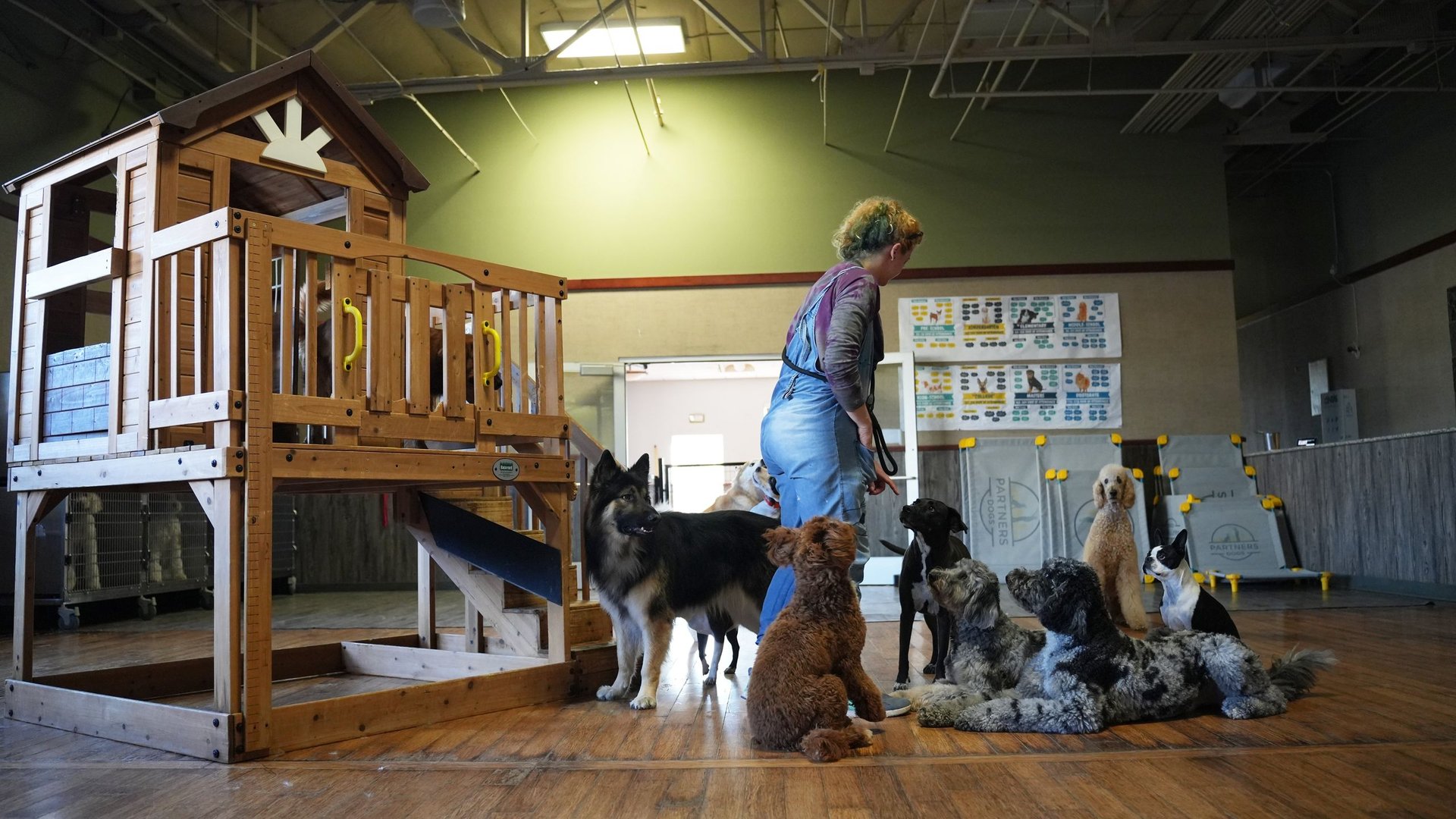
A webcam cannot tell you whether your dog's day has any structure, or whether it is unstructured open play from open to close. A dog running at full arousal for eight straight hours is not having a great day, even though it looks like fun on a screen; it is rehearsing over-arousal, and it usually comes home wired instead of settled. At Partners, our DaySchool programs run on a curriculum built by trainers rather than a big room and a gate: structured rest cycles between play sessions, a floor run by staff trained to redirect a dog before a small disagreement becomes a real one, and a temperament assessment before any new dog joins the group. None of that shows up in frame. It shows up in whether your dog comes home tired in a good way or wound up in a bad one.
Turn this into a plan
Request the screening a webcam cannot show you
A feed only shows you the room after your dog is already in it. The part that actually decides whether your dog is safe there happens first: a trainer evaluation that checks temperament and energy before any dog joins group play. Request that same assessment at Scottsdale or Cave Creek before you decide where your dog spends the day.
Partners Dogs skips the public webcam, and here is why
Partners Dogs does not run a public live camera in the DaySchool play spaces, and that is a deliberate choice, not an oversight. Our own daycare page explains why: a public feed is compressed and generic by design, built for a wide audience rather than one parent's honest read on one dog. Instead, the plan is a daily Pupdate through the Pet Parent Portal, photos and short clips a trainer selects because they show what your dog did that day, paired with notes from the person who was in the room. It is a narrower window than a live feed, and a more honest one, because a trainer tells you what mattered instead of leaving you to guess from a wide shot. That is the version of peace of mind we build toward: not a stream you interpret yourself, but a trained person telling you how the day went.
What makes the best DaySchool in the Phoenix area
The best DaySchool across Scottsdale, Cave Creek, Phoenix, and North Phoenix comes down to three things: a real trainer-to-dog ratio, a temperament assessment before day one, and a curriculum a staff member can describe in specific terms. Our standard at both campuses is one trainer watching every ten dogs, not one person eyeballing twenty-five between other tasks, which leaves time to notice a dog going quiet before it becomes a problem. Families from Paradise Valley and Carefree who tour both campuses tend to ask the same question once they see the floor: not "do you have a camera," but "who is watching my dog, and what have they been trained to see." That same grouping question matters most for high-energy dogs, who need staff watching for arousal, not just headcount. Families driving in from North Phoenix are usually choosing that question over a facility five minutes closer, because a webcam-forward tour left them with more footage than answers. That is the right question, and no webcam can answer it for you.
Walking the floor tells you more than watching a feed
A ten-minute tour answers questions a camera never will: what the evaluation before day one checks, how staff are trained to read a dog going quiet in a corner, and what the ratio actually looks like at 11am on a Friday instead of a slow Tuesday. A feed just plays in the background while you decide based on how the room looks, not how it runs. If you are choosing between two Phoenix-area programs and only one will show you the floor and answer those questions in person, that is the one worth the extra ten minutes in the car.
What an anxious traveler should check besides a webcam
An anxious traveler leaving a dog at Phoenix-area daycare or boarding should ask about screening, staffing, and daily communication, beyond whether there is a camera in the room. The best daycare for a traveler who worries the whole flight is rarely the one with the most camera angles, and that is especially true for an undersocialized dog who needs a smaller, matched group rather than open play. It is the one that answers these plainly, before you book:
- What does the assessment before day one check, and who runs it?
- What is the trainer-to-dog ratio at the busiest hours, not a slow Tuesday?
- How will I hear about my dog's day, and from whom?
- What happens if two dogs do not get along, and who catches it early?
- Can I see the actual play space in person before my dog's first day?
A family weighing daycare against a destination stay at Scottsdale or Cave Creek gets further asking those five questions than scrolling a live feed. A camera answers none of them.
Key takeaways
- A daycare webcam shows a live feed of a room, not the screening, staffing, or curriculum decisions that decide whether your dog is safe there.
- Body language that signals rising stress or arousal is hard to read reliably on a compressed public video feed, even for a trained eye.
- Partners Dogs skips the public webcam and sends a daily Pupdate through the Pet Parent Portal instead, photos and notes a trainer chooses because they show what mattered.
- One trainer watches every ten dogs at both campuses, which means someone is trained to notice a dog disengaging, not just watching a wide shot from a desk.
- The right questions before booking are about assessment, ratios, and daily communication, not camera access.
Frequently Asked Questions
Can I request video of my dog if Partners Dogs doesn't run a public webcam?
Yes. Families get a daily Pupdate through the Pet Parent Portal, photos and short video clips a trainer selects to show what your dog actually did that day, along with notes on how the day went. It is a curated update from a person in the room, not a live public feed anyone could watch.
Is a public webcam a sign that a daycare is safer than one without one?
Not on its own. A webcam proves a camera is running, not that dogs were screened before grouping, that staffing stays adequate during peak hours, or that the floor follows any curriculum. Safety comes from ratios, training, and screening, none of which a video feed can confirm.
How do I know if a Phoenix-area daycare's supervision ratio is actually good?
Ask the facility directly for its ratio during peak hours, not a slow Tuesday, and ask what training the staff on the floor has received for reading dog body language. Partners Dogs holds a 1:10 trainer-to-dog ratio at both campuses; a facility that cannot answer with a specific number is worth a second question.
What is a Pupdate, and how is it different from a live webcam?
A Pupdate is a daily update sent through the Pet Parent Portal, curated photos and video clips a trainer chooses because they show something specific about your dog's day, paired with written notes. A live webcam shows a continuous, unedited feed of a room, which requires you to interpret it yourself with no context from the people actually supervising.
Should I choose a daycare for my dog based on webcam access alone before traveling?
No. Webcam access is a convenience feature, not a substitute for asking about behavior screening, staffing ratios during peak hours, and how the facility communicates about your dog's actual day. An anxious traveler is better served by those answers than by a video tab left open on a phone.
What questions should I ask a Phoenix metro daycare before booking, besides whether they have a camera?
Ask about the essentials: what the pre-daycare assessment checks and who runs it, what the trainer-to-dog ratio is at peak hours, how you will hear about your dog's day and from whom, what happens when two dogs do not get along, and whether you can walk the actual play space in person before your dog's first day.
Put a trainer on it
See what actually happens on the other side of the feed
A camera shows you a room. It cannot show you the ratio, the rest cycles, or the screening that decided who is allowed in it. See the daily structure behind our DaySchool programs, then talk with a trainer about whether it fits your dog before you book.
Keep reading
"The pet portal is great and you get pictures letting you know your dog is okay."
Taylor F., Cave Creek
/Programs/Boarding/Top%20of%20Page.jpeg?width=800&height=450&name=Top%20of%20Page.jpeg)