Straight answer
Quick answer: you can condition an e-collar as a redirect cue for a reactive dog. The dog learns, with no triggers present, that a low-level signal means "check back in with me," and checking in gets rewarded.
- The stim is conditioned as a cue, like a tap on the shoulder: check in, then get paid. Correction never enters the learning.
- Conditioning happens with no triggers present. Stim predicts check-in; check-in predicts reward.
- Grabbing and body-blocking in a reactive moment can join the trigger picture and stack arousal. The collar cue keeps your hands neutral.
- Lunging to gain space is self-rewarding. The distance the dog buys pays for the outburst. The cue breaks the loop at the response link.
- Treats mid-reaction risk chaining the outburst to the reward. Teach the default first, then reward the default.
That one conditioned default gives you a clean redirect in real moments, without grabbing your dog, flooding it with treats, or leading with correction.
If you walk a reactive dog in Scottsdale or Cave Creek, the standard advice is a dead end. Yank the leash and you add your hands to the chaos. Shove treats at the dog mid-reaction and you can chain the explosion to the paycheck. This article lays out how we condition the collar first and use it as a cue. For the framework behind every term below, see our methodology.
What is an e-collar redirect cue?
The short version: a redirect cue is a low-level signal that tells the dog what to do next, conditioned long before any trigger shows up.
Most people meet the e-collar as a punishment device. That is a failure of conditioning, not a fact about the tool. In our hands, the collar starts as a communication device: the dog learns one chain. Feel the signal, look back at the owner, get the reward. The signal sits at the lowest level the dog perceives, a physical tap that interrupts and redirects.
Tools improve communication, and every tool is conditioned before use, the omni-technical position argued in our methodology flagship. Skill before tool. Correction is never the starting point.
"You don't shout at a dog you can tap on the shoulder."
Why does the collar need meaning before the moment?
The short version: a cue with no meaning in a reactive moment is just another thing startling the dog.
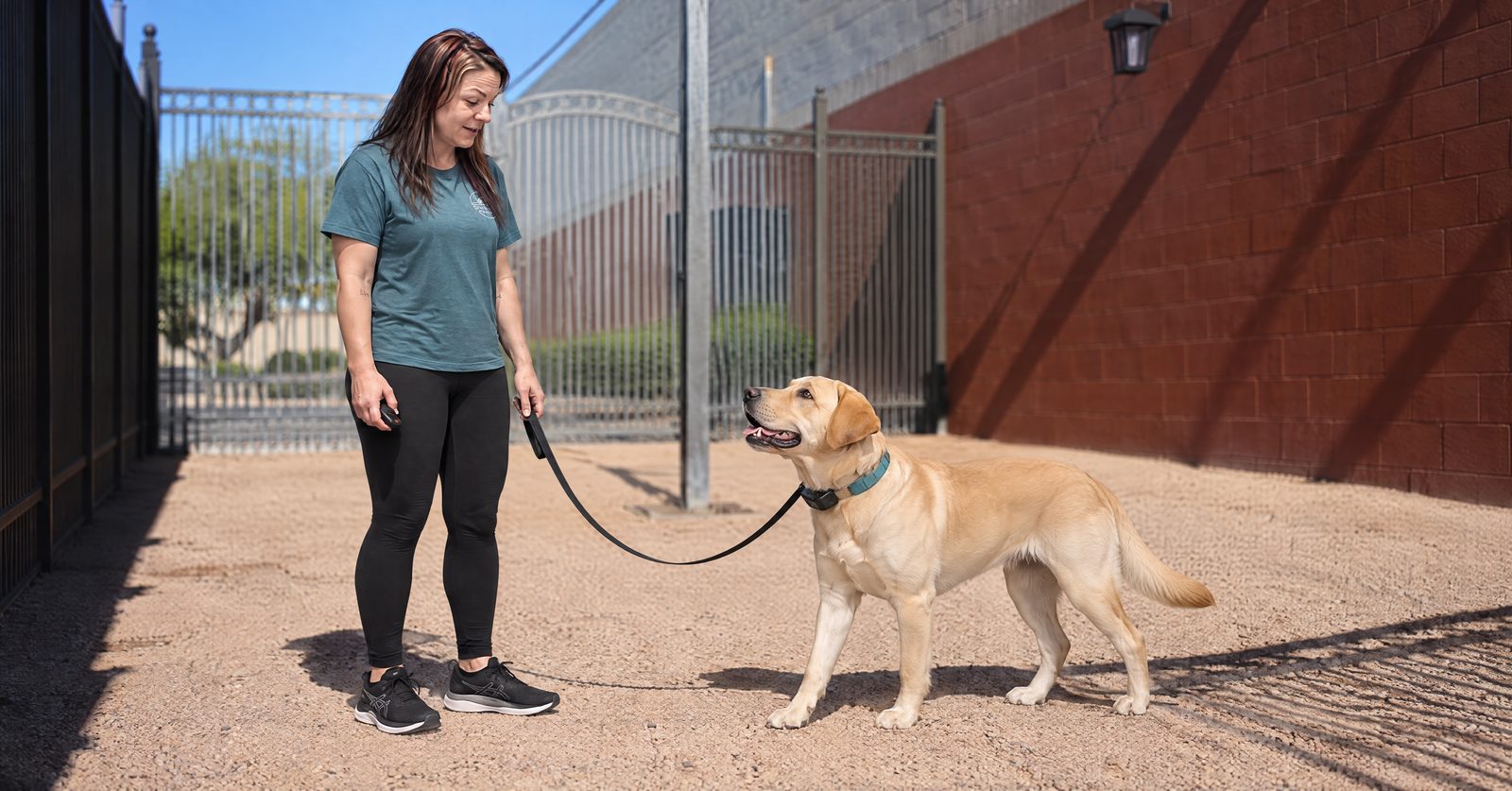
Conditioning runs in a quiet place with zero triggers around. Deliver the signal, mark the check-in the instant the dog looks back, pay with something the dog values. Repeat until the dog feels the signal and turns to you by default. You are installing a reflex. Like learning a fire exit route on a calm day: you don't study the map while the alarm is ringing. In a reactive moment, your dog has no bandwidth left for learning. Install the meaning when the dog is calm, and it survives when the dog is not.
The stim must predict the check-in, and the check-in must predict the reward, in that order, every time. A signal that fires at random teaches the dog nothing except that its neck sometimes buzzes. Like a smoke detector that beeps for no reason: nobody evacuates, they just stop trusting it.
This is phase one: Teach. We teach the dog, then we teach you. No triggers, no correction, lightest perceptible level only. If the dog startles, the level is too high. Drop it.
Why shouldn't you grab your dog mid-reaction?
The short version: your hands in a reactive moment can become part of the trigger picture, and they stack arousal instead of lowering it.
The dog explodes, the owner grabs the collar, drags the dog sideways, body-blocks. Each move adds physical pressure on top of a flooding system. Worse, the grabbing gets paired with the trigger: the dog starts to anticipate your hands as part of what happens when another dog appears. You meant to help. The dog's nervous system files it as more threat.
Reactivity runs on four fuels: fear, frustration, over-arousal, and self-rewarding chemical loops (see reactivity vs. aggression and the live reactive dog training guide). When your body joins the chain, you feed whichever fuel your dog runs on. The collar cue solves it mechanically: the redirect comes from the conditioned signal, and your hands stay neutral. Your hands stay free to reward. The tool is the microphone, never the voice; you are the mentor the dog checks in with.
Holding your dog back is management, and management is not punishment. A conditioned check-in is a trained response. We want the response.
How does reactivity buy your dog space?
The short version: many reactive dogs bark and lunge to make the scary thing go away, and the space they gain pays for the next outburst.
Read the behavior chain: trigger (another dog appears), chemical release (adrenaline and cortisol flood), response (the lunge and bark), outcome (the other dog leaves, or you retreat). The outcome is the teacher. Every time the explosion buys distance, the explosion gets stronger: the behavior removes something the dog wanted gone, and negative reinforcement does the rest.
The trap: retreating rewards the outburst. You pull your dog away, the pressure drops, the dog learns the drill. It ends the moment, and it ends every future moment the same way, because the pattern gets paid. Some dogs run this on frustration instead of fear: the leash blocks access, the dog explodes, and you turning the walk around teaches the dog that the route to the other dog runs through the explosion.
The redirect cue breaks the loop at the response link. The dog feels the tap, checks in. No distance gained by the outburst. No payoff for the explosion.
When does a treat become part of the problem?
The short version: a treat delivered after a reaction can teach the dog that the reaction is what earns the treat.
This is the chaining trap. Reaction, then treat, repeated across weeks. The dog is a pattern animal: reaction predicts treat. You intended to redirect. The dog learned a sequence. This is how Pet Parents end up with a dog that lunges first and looks for the paycheck second. The treat failed on the order of operations.
The fix is the order, not the treat. Get the default behavior first, then reward the default. The conditioned cue fires, the dog checks in, and the check-in earns the reward. Positive reinforcement stays the base of the program, and the sequence protects it. A dog mid-reaction is past the threshold where a food reward lands cleanly. The tap-level cue cuts through the arousal and asks for one simple, already-conditioned move: look at me. Then we pay that move.
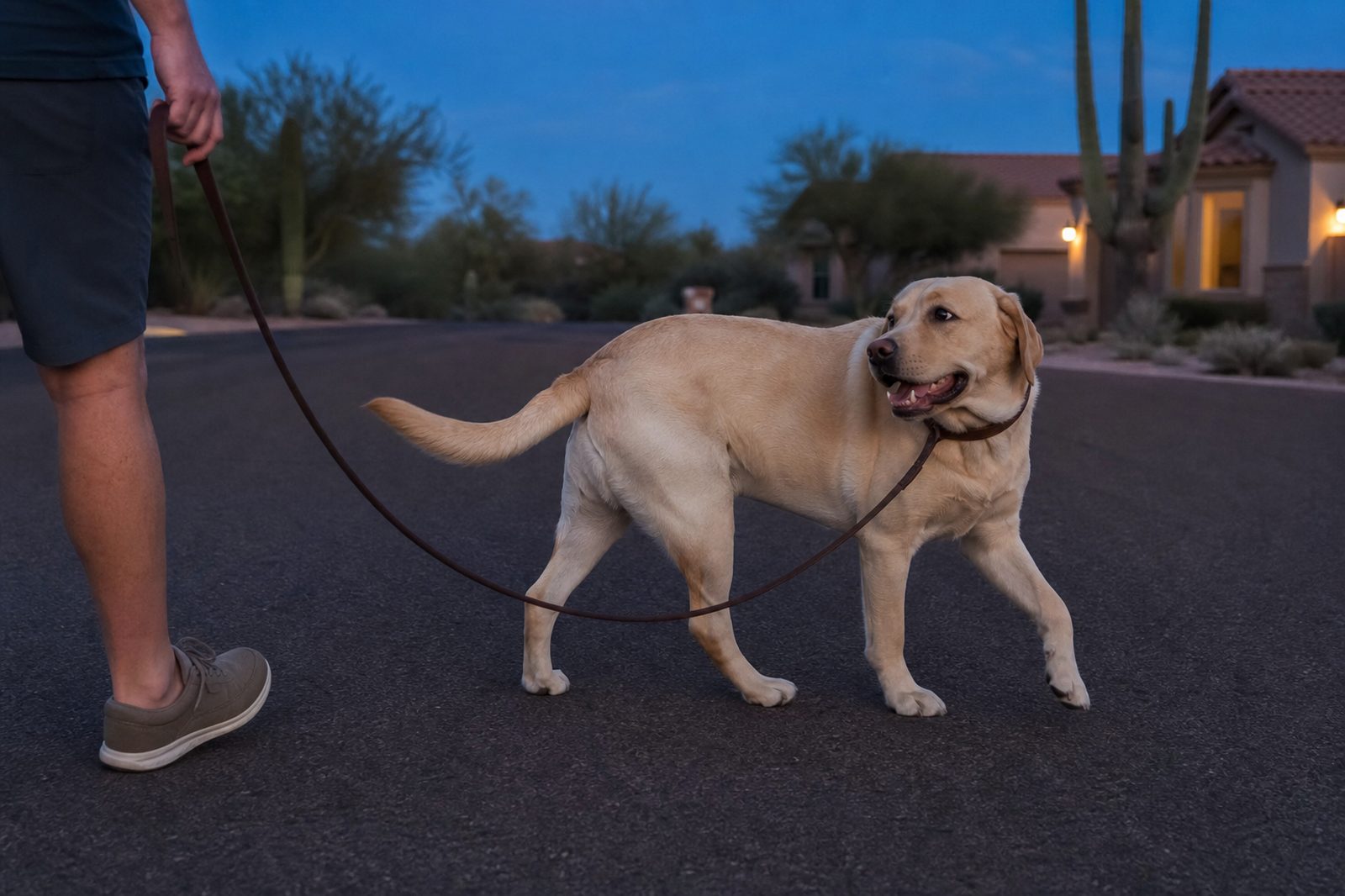
What does the conditioning protocol look like?
The short version: condition the meaning in a calm place, proof the response at distance, then use it in real scenarios. Three phases, in order, no skipping.
This is Teach > Reinforce > Proof. Proofing runs the five D's: duration, distraction, distance, direction, difficulty. Each step earns the next.
- Find the working level. With no triggers present, deliver the lowest level and watch for a head tilt, ear flick, or glance. That is your level. If the dog startles, you went too high.
- Pair the signal with the check-in. Deliver the signal. The instant the dog looks back, mark it and pay generously. Ten to fifteen short reps a session. You are installing signal predicts check-in predicts reward.
- Name the default. Once the dog turns to you reliably at the signal, you have a conditioned default: a tap means check in. This is the Teach phase, and it stays boring on purpose. No triggers, no drama.
- Reinforce until it is a reflex. Run short sessions for a week or two. The response should get faster, not slower. If it stalls, your reward is not paying enough or your timing is late. Adjust the reward, not the level.
- Proof at distance. Larger space, mild distractions, long line on, no leash pressure. Fire the cue when the dog is sniffing grass or watching a bird. Proof the default against the five D's one at a time.
- Proof near triggers, under threshold. Work at a distance where the dog notices the trigger but can still think. A dog across the parking lot, not across the sidewalk. If the dog cannot check in, you are too close.
- Run real scenarios. Normal walks, normal life. The cue fires in the real moment. The dog checks in instead of exploding. Pay the check-in every time early on, then move to intermittent pay as the pattern holds.
Skip a step and the protocol bills you later. A dog never proofed at distance will not offer the check-in at the trailhead. The five D's are the difference between a trick and a reliable behavior. For the leash-specific version, see our leash reactivity walk-ready protocol.
Your first step
Condition the Cue Under Professional Eyes
Tool conditioning runs in every camp here, matched to the dog's goals: Foundation Camp for obedience proofing, Behavior Camp for moderate reactivity. Start with a PD360 Assessment so a senior trainer reads your dog and sets the working level correctly.
Cue or correction: what is the actual difference?
The short version: a cue tells the dog what to do. A correction tells the dog what to stop. This protocol only ever installs the first one.
| Redirect cue | Correction | |
|---|---|---|
| Purpose | Starts the check-in behavior | Stops an unwanted behavior |
| Level | Lowest perceptible, always | Set by what the moment needs |
| Timing | Conditioned before any trigger exists | Applied in the moment of behavior |
| Meaning | "Look at me" | "Don't do that" |
| Phase | Teach: first thing the dog learns | Later phases, only after the alternative is understood |
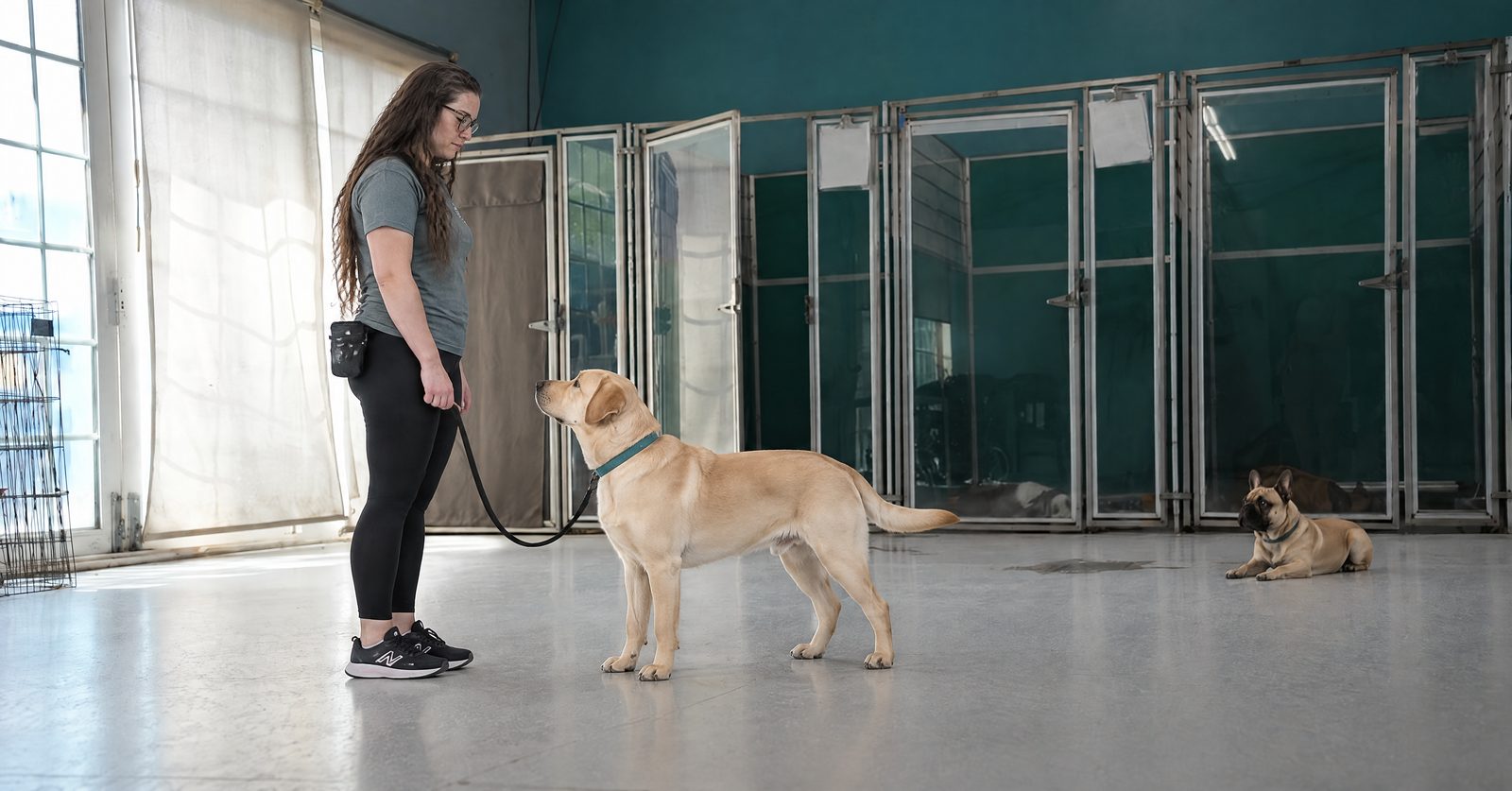
Now the honest framing, per the balance rule. Positive reinforcement is the primary method and the base of every program. Fair, minimal, well-timed correction is legitimate and necessary across all four operant-conditioning quadrants (PetMD corroborates the quadrant definitions). And positive-only pressure turns aversive when the dog or the owner grows frustrated. But correction is never the starting point: only after the alternative is understood, at the lowest level the dog notices. This protocol never needs a correction, because the dog was taught the alternative first. Skill before tool, conditioning before use. For the research on the tool itself, see our article on what the science says about e-collars.
Mistakes that make it worse
- Strap the collar on at the park and start pressing buttons. No conditioning, no meaning, no check-in. The dog learns its neck surprises it at random. Condition first.
- Start at a level the dog flinches at. If the dog startles or shuts down, you skipped the working-level search. Drop the level until the reaction is a head tilt. The tap is the ceiling.
- Fire the cue during the explosion without a conditioned default. A cue the dog was never taught is a startle. The order is condition, proof, real scenarios. Skipping to step 7 is correction-first handling with a friendlier remote.
- Pay the reaction and the check-in with the same enthusiasm. The dog notices what gets paid. Pay the check-in big. Keep the reaction unpaid and boring.
- Condition for a week, then wing the real scenarios alone. The transfer from quiet yard to live street is where most protocols die. Private Lessons are built for exactly that handoff. In those sessions you practice the part the protocol cannot run on its own: reading your dog's arousal before it spikes, firing the cue while the dog can still think, keeping your leash and your body neutral while the trigger passes.
Choose by case, not by tool
Match the Program to the Dog
Moderate reactivity routes to Behavior Camp: a 21-night stay of daily structured sessions with full PD360 tracking. Severe cases, multi-bite histories or child reactivity, go to Transform Camp's 28-night intensive with senior trainers. Private Lessons coach you through the protocol at home, session by session.

Key takeaways
Key takeaways
- The e-collar is conditioned as a redirect cue: tap-level signal, check-in, reward. Correction never enters the learning.
- Condition with no triggers present. Signal predicts check-in predicts reward, in that order, every time.
- Grabbing and body-blocking can join the trigger picture and stack arousal. The cue keeps your hands out of it.
- Reactivity that buys space gets paid by the space. The cue breaks the loop at the response link.
- Treats after a reaction chain the reaction to the reward. Get the default first, then pay the default.
- Teach > Reinforce > Proof, one step earning the next. Proof the five D's before real scenarios.
Frequently Asked Questions
What is the first step if I want this conditioning done for my dog?
Book a PD360 Assessment at Scottsdale or Cave Creek. A senior trainer reads your dog across nine dimensions, sets the working level correctly, and tells you whether your dog's reactivity runs on fear, frustration, arousal, or a chemical loop. The plan comes after the assessment, never before.
Will the stim hurt my dog?
The working level is the lowest level your dog perceives: a head tilt, not a flinch. If the dog startles, the level is too high and we drop it. A tap on the shoulder, never a correction.
Can't I just use treats to redirect my reactive dog?
You can, and the order decides whether it works. A treat delivered after a reaction teaches the dog that the reaction earns the treat. We condition the check-in first, then pay the check-in. Same treat, different contingency.
Is my dog too sensitive for an e-collar?
That is exactly what the assessment answers. Sensitive dogs often do best on this protocol because the cue is a whisper, and the working level is found before any trigger exists. The collar is conditioned, never cranked.
Do you work with reactive dogs in Scottsdale and Cave Creek?
Yes. Reactive and aggressive cases are our specialty across the Phoenix Valley, handled as boarded stays and coached through Private Lessons at home. Start with the PD360 Assessment so we can read your dog first.
Where to go from here
A reactive dog needs a conditioned default, not a louder owner. Condition the meaning in a calm place, proof it at distance, then run real life. The walk that made you dread the front door can become ordinary again. Ordinary is the whole goal. The dog you brought home is still in there, behind the reactions. The cue gives you both a way back to each other.
Scottsdale: 8642 E Shea Blvd, 85260. Cave Creek: 4640 E Forest Pleasant Pl, 85331. Serving the Phoenix Valley.