Opening answer
Four zones, one mindset: a structured dog walk sets aside separate space for potty, play, exploration, and training, and the dog learns that the entire walk counts as training time, not just the stretches spent in heel.
By the end of this walk-through you will know how to split one walk into four working zones, keep training running between the formal exercises, why we ask new Carefree and Cave Creek families to hold off on off-property walks for a couple of weeks after camp, and how to add distractions without undoing the work. One Cave Creek client summed up the payoff this way, in Dar B.'s words: “It's so nice to go for a walk and not be dragged along.”
What is a structured dog walk, and how is it different from just walking your dog?
A structured dog walk is a walk where the handler decides the zones, the pace, and the timing, instead of the dog deciding all three. On a free walk, a dog that pulls toward a smell or another dog gets there, and arrival is its own reward. The dog is not being stubborn. It is learning, correctly, that pulling works. A structured walk removes that lesson by fixing, ahead of time, which stretches are for heeling and which are for sniffing. Around Cave Creek and Carefree, one loop can cross a wash, a gravel shoulder, and open desert in the same ten minutes. That decision matters more there than on a flat suburban sidewalk.
Why does a structured walk protocol need designated areas for potty, play, exploration, and training?
Dogs read location as part of the cue: mixing potty, play, exploring, and formal training into the same few steps teaches all four at once and none of them well. A potty spot, usually the first stop outside the door, tells the dog relief happens here and now. A play loop, a fenced yard or a flat trail section, is where a release cue lets the dog move at its own pace. An exploration zone, a quiet path near Spur Cross Ranch or Cave Creek Regional Park, allows a longer line. A training zone, a driveway or a wash-side stretch near Black Mountain, stays reserved for heel work. The same ground tied to the same job builds the pattern faster than rotating locations ever will.
How do you turn an ordinary walk into an always-be-training mindset?
An always-be-training mindset treats every step on leash as a rep, because a dog left untaught in the moment is usually rehearsing a habit instead. In practice, this means staying alert to the dog's body and redirecting before a bad habit repeats itself. A sequence that works on almost any route:
- Set the zones before you clip the leash, so today's route already has a potty, play, exploration, and training spot.
- Leave the threshold in heel, leash slack, rather than letting the dog surge through the door first.
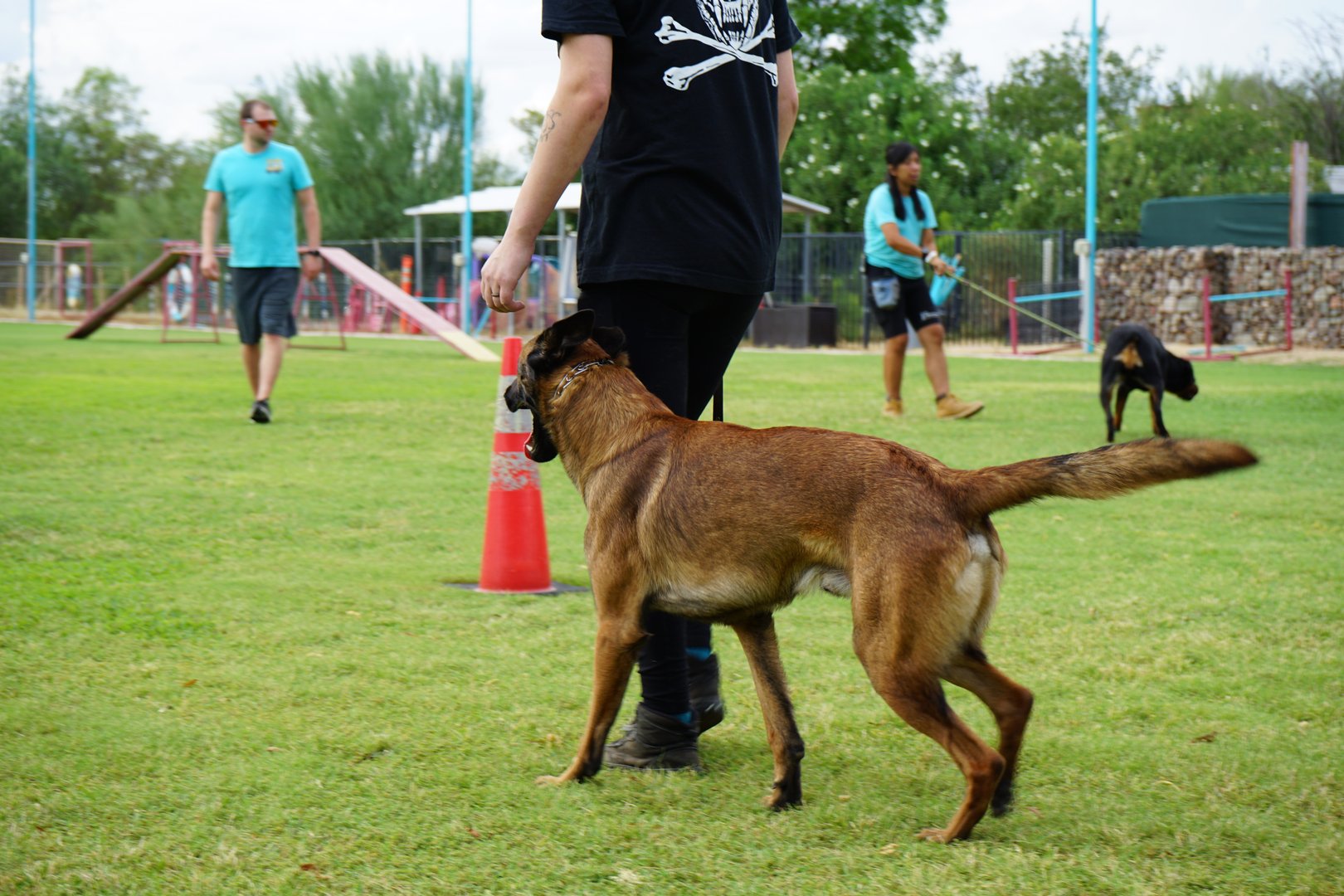
- Work a short structured segment first, heeling through the training zone, before any freedom is offered.
- Release with a clear, consistent cue for the sniff or potty zone, so freedom is granted, not taken.
- Return to structure before the next zone change, calling the dog back to heel rather than letting it drift.
- End at the door the same way you started, in heel, closing the walk on the structure it opened with.
Run in that order, a 20-minute walk near a Carefree cul-de-sac becomes several small lessons, not one long negotiation.
Why do trainers recommend delaying off-property walks in the first weeks after training?
A dog fresh out of a boarded stay has only practiced the protocol on familiar ground with one trainer, and a public trail adds new handlers and new distractions at once. We ask families to keep walks on the property for a couple of weeks so they can run the same zones the dog just learned before adding an off-leash dog, a javelina crossing a wash, or a bike rider on a shared path. It can feel like a step backward, but a skill that only exists in one location is not a skill yet. Odin, a Pitbull mix from Foundation Camp, followed that order: obedience first, supervised meetings with another dog later, reliable recalls off property by the final week. That sequencing is the backbone of private lessons, where a trainer walks the property first.
From reading to results
Not sure this protocol fits your dog's stage yet
A two-minute program finder matches your dog's age, behavior, and household to the right starting point, whether that is a private lesson or a full camp. Current rates are on the pricing page.
What does the PD360 Assessment track about a dog’s heel and leash response?
The PD360 Assessment scores heel response and leash response among its tracked dimensions, alongside where the dog sits across four stages: Teaching, Reinforcing, Proofing, and Maintenance. Assessment day runs a 30-minute drop-off meet, evaluation across varied environments, a 30-minute pick-up meet, and a verbal breakdown with a PD360 score for the family. That score turns a walk protocol from a guess into a plan: a dog scoring low on leash response needs more training-zone reps before exploration expands. The fee is applied as store credit when the family enrolls in the recommended camp or a membership; it does not apply to a la carte bookings or general reservations. More on the day is on the methodology page.
Who offers the best structured-walk coaching for families in Carefree, Cave Creek, and the 85262 corridor?
The best fit is the program that teaches the protocol in person and sends the family home able to repeat it, the standard we have run out of Cave Creek since December 1997, and now also run at our Scottsdale campus. Families across Carefree, Cave Creek, and the 85262 corridor work with a team of 50+ trainers at a 1:10 ratio, with a 4.8 stars across 2,000+ reviews. We also run closer to open intake than most: dogs with a bite history that other schools decline are dogs we regularly take on. Hands-on teaching plus a family that can run the protocol at home matters more here than a trail location, because the desert does not wait for a dog to be ready.
What is the fastest way for a busy family to fit this protocol into a packed week?
Book one private lesson on your own property before building the protocol from a blog post, because a trainer who sees your actual yard, door, and dog can hand you zones and a sequence in a single session. Busy families rarely need more time on the leash. They need the first session efficient: a trainer walks the property, marks the zones, runs the sequence once, then coaches the owner through a rep. From there, five or ten minutes of structured walking twice a day beats one unstructured hour on the weekend. Private lessons slot around DayCamp or DaySchool for families juggling both.
How do you know a dog is ready to add distractions like other dogs, wildlife, or foot traffic?
Readiness shows up as a dog that holds the training-zone sequence without a lapse for several sessions in a row, not as a fixed number of days on a calendar. A dog that still breaks heel for a passing jogger in its own driveway is not ready for a shared-use path with cyclists and other dogs on it. The exact order for layering in other dogs, wildlife scent, and foot traffic is built individually in private lessons and camp follow-up. What holds across every dog is the order itself: structure proves itself on quiet ground first, before it meets something that moves, barks, or rattles.
Key takeaways
Four fixed zones carry the whole protocol: potty, play, exploration, and training. A six-step sequence starts and ends every walk in heel. Off-property walks wait for the first couple of weeks after training ends. A PD360 score shows exactly when a dog is ready for real-world distractions.
Frequently Asked Questions
How many designated zones does a backyard need for a structured walk routine?
Most homes need three or four: a potty spot, a play loop, a training stretch, and an exploration area if there is room. One consistent fence line can serve as the training zone in a small yard.
What is the difference between a sniff break and free time on a structured walk?
A sniff break is released on a cue in a specific zone and ends when the handler calls the dog back to heel. Free time with no cue and no end point is how pulling gets rehearsed.
Why do trainers ask families to skip off-property walks for the first couple of weeks after camp?
The dog has only practiced the protocol with one trainer on familiar ground. Running the same zones at home first lets the family take over before new handlers and distractions arrive at once.
Can a structured walk protocol work for a dog with no yard at all?
Yes. A hallway can serve as the training zone, a stretch of sidewalk as the exploration zone, and a patch of grass or a pad for potty. The zones matter more than the square footage.
How do I know my dog is ready to add another distraction to the walk?
Look for a clean run of sessions, not a date on a calendar. A dog that holds heel through the training zone on quiet ground is ready to test one new distraction at a time.
Choose the next step
Build the protocol on your own property
A private lesson brings the zones and the six-step sequence to your driveway, your yard, and your dog, not a generic script read off a blog post.
Keep reading