Read this first
Partners Dogs moves an apprentice trainer through 30 hours of coursework, then 1,000 supervised hours to reach Instructor, then 2,000 more across breeds and behaviors to reach Senior Instructor. That volume of supervised repetition is what builds a trainer: faster pattern recognition, tighter timing on markers and releases, and the judgment to recover cleanly the moment a read goes wrong.
What does 1,000 supervised hours mean at Partners Dogs?
Supervised means every session happens under a working trainer's direct oversight, never solo practice logged after the fact. An apprentice at Partners Dogs follows a fixed ladder: 30 hours of coursework, then 1,000 hours on the floor to reach Instructor, then 2,000 more across a wider spread of breeds and behavior cases to reach Senior Instructor. The full ladder, along with the honesty clause that comes with it, is broken down on the Partners Dogs University page; PDU is not a nationally recognized credential the way a CPDT-KA exam is (see our side-by-side on how dog trainer certifications compare). What matters for this piece is what those hours build: the number of dogs, the number of breeds, and the number of times a trainer has had to adjust a plan mid-session because the dog in front of them was not behaving like the last ten.
Why does variety across breeds and behaviors matter more than raw hours?
A trainer who works the same ten dogs for a thousand hours learns ten dogs, and stops there, not dog behavior in general. That is the reasoning behind the PDU ladder's later stage, which keeps counting hours specifically across breeds and behavior categories rather than crediting more repetitions of the same caseload. A Labrador puppy pulling toward every dog on a leash teaches a different lesson than a Cattle Dog nipping at joggers, and neither prepares a trainer for a Great Pyrenees guarding a food bowl. Partners Dogs runs a 1:10 trainer-to-dog ratio across campuses in Scottsdale and Cave Creek, so an apprentice rotates through a wide caseload daily instead of staying parked with one dog for weeks. Partners Dogs has worked with 70,000+ dogs since December 1997. That caseload covers nearly every breed, age, and behavior profile a family in the Valley is likely to bring through the door.
How do supervised hours sharpen a trainer's timing?
Timing is the gap between the moment a dog offers a behavior and the moment a trainer marks or releases it, and that gap only shrinks with repetition. A new apprentice marks late, rewards the wrong half-second, or releases a dog from a stay right as its attention starts to drift, and none of that is obvious from a textbook description of a marker cue. It becomes obvious only after watching a working trainer do it correctly a few hundred times, then doing it themselves under correction. The same holds for release criteria: knowing when a dog has held a down-stay long enough to earn a release, versus releasing too early. Supervised hours are where a working instructor catches a beat-late marker in real time and says try that again, which an apprentice practicing alone has no way to catch.
What happens when a trainer misreads a dog, and how does supervision catch it?
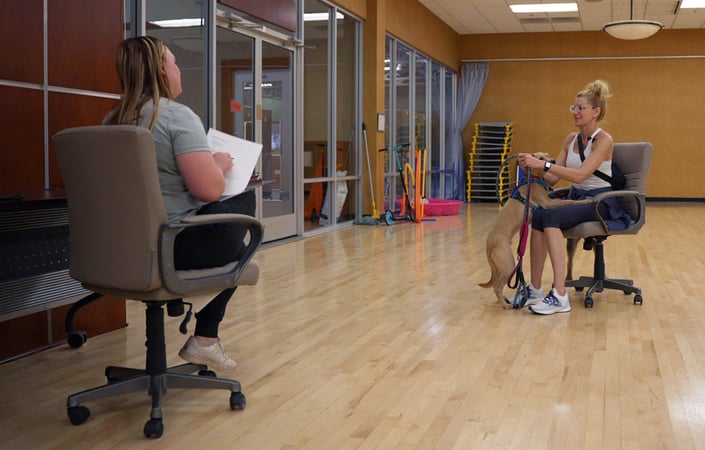
Every trainer misreads a dog at some point, mistaking a stress yawn for boredom or a stiff, still body for calm, and the recovery from that mistake is exactly what supervision exists to catch. A dog that looks settled can be one breath away from over threshold, and the difference between the two often shows up only in small signals: a closed mouth, weight shifted forward, ears pinned rather than relaxed. Missing that signal and pushing forward anyway is simply what every new trainer does before the pattern becomes automatic; what matters is what happens next. Under direct supervision, a senior trainer steps in before the dog escalates, walks the apprentice back through what the dog's body was saying, and resets the session at a calmer level of arousal. That correction, repeated across enough sessions, is what teaches a trainer to catch their own misreads before a supervisor has to.
Line it up
Watch a supervised session in person
Reading about pattern recognition only goes so far. Book a visit to a Partners Dogs campus in Scottsdale or Cave Creek, watch an apprentice trainer work a session under direct supervision, and talk with our team about what the path to Instructor looks like for you.
How does repetition build pattern recognition across arousal states?
Pattern recognition is the ability to see a dog crossing from alert into aroused before the dog itself seems to notice. That skill builds from watching hundreds of dogs cross that line at slightly different speeds and for different reasons, far more than from reading a description of the arousal curve. Three cases show the same arc from calm to alert to reactive, though the pace and the trigger differ every time: a dog on a leash locking onto a jogger, a dog at daycare fixating on a ball, a dog in a behavior session reacting to a doorbell three rooms away. An apprentice who has seen the pattern a dozen times treats each dog as a new mystery. One who has seen it hundreds of times under supervision starts recognizing the shape of the curve itself, which is what lets a trainer intervene a half-second earlier, before a dog crosses from manageable to over threshold.
How does training through Arizona's desert conditions add to those hours?
Reading a dog's fear response under high stakes is a different skill than reading it in a controlled room, and the desert supplies stakes on its own schedule. A wash-side trail can put a rattlesnake in a dog's path, a Carefree property line can back up to a rooting javelina, and a dog spooked by either reacts nothing like a dog spooked by a vacuum indoors. An apprentice who has helped run snake avoidance sessions during the spring window or the second one in the fall has practiced that specific read on a live animal, not a recording of one. Monsoon season, roughly mid-June through the end of September, adds thunder sensitivity and flash-flood judgment calls to the caseload, and Arizona's 6-foot leash law shapes how every outdoor session gets structured before a trainer even leaves the building. A classroom can describe an arousal curve. Only the hours put a trainer in front of the dog while it happens.
How does Partners Dogs structure supervised hours for an apprentice trainer?
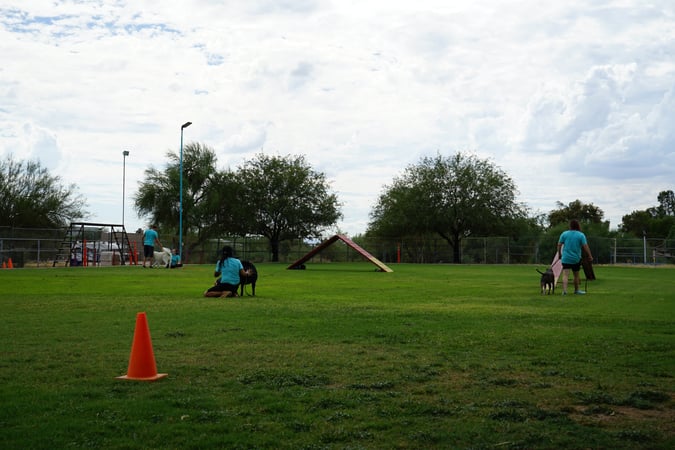
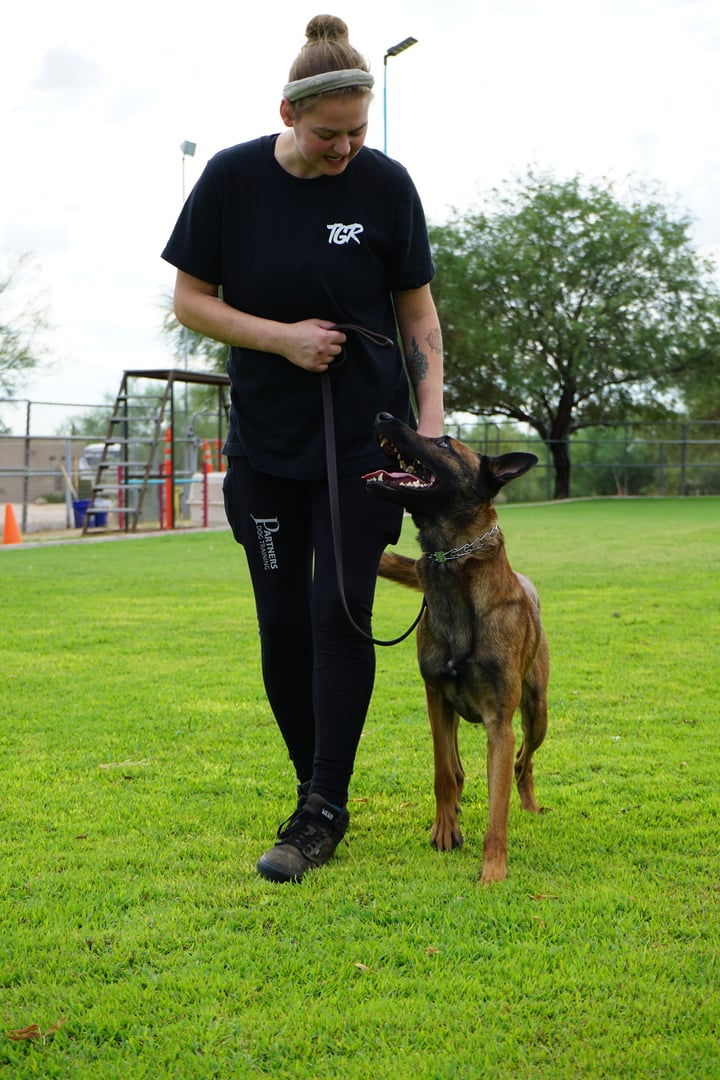
Every apprentice trainer at Partners Dogs starts on the floor under a working instructor, not behind a desk or in a classroom alone. After the initial coursework, an apprentice shadows and then co-runs sessions across four settings: DaySchool, DayCamp, private lessons, and camp programs, building hours across the full range of what the caseload includes rather than specializing early. Hours are logged and reviewed by the supervising instructor, not self-reported, and an apprentice does not move to solo sessions on a given case type until a senior trainer signs off. For anyone considering the path, Partners Dogs careers lists open apprentice and trainer roles at both campuses, and the full PDU structure is laid out on our breakdown of how we certify dog trainers.
“Feel comfortable trusting your dog's experience with their clean facilities and professional staff/trainers.”
Zach T., Scottsdale
Key takeaways
- The PDU hour ladder is covered in full elsewhere; here, the 1,000 hours to Instructor are what the rest of this piece is about.
- Supervised hours build timing: the gap between when a dog offers a behavior and when a trainer marks or releases it.
- Supervision exists to catch a misread before it escalates, then walk the apprentice back through what the dog's body was saying.
- Partners Dogs runs a 1:10 trainer-to-dog ratio across Scottsdale and Cave Creek, giving apprentices a wide daily caseload instead of a narrow one.
- Desert conditions, rattlesnake season, monsoon storms, and Arizona's 6-foot leash law add hours a purely indoor facility cannot replicate.
Frequently Asked Questions
Do the 30 coursework hours count toward the 1,000 supervised hours at Partners Dogs?
No. The 30 hours of coursework happen before an apprentice takes a leash on the floor, and the 1,000 supervised hours toward Instructor start once hands-on floor work with dogs begins.
Can an apprentice trainer work with client dogs before finishing all 1,000 supervised hours?
Yes, but always under a working instructor's direct oversight. An apprentice moves to running a session solo on a given case type only after a senior trainer has signed off on that specific skill.
How closely does Partners Dogs supervise an apprentice trainer's hours?
Hours are logged and reviewed by the supervising instructor rather than self-reported by the apprentice, and sessions happen on-site at Scottsdale or Cave Creek where a senior trainer can step in directly.
What is different between an apprentice at 200 supervised hours and one at 900?
At 200 hours, an apprentice is still building the basic pattern library, learning what a stress signal or a threshold moment looks like across a range of dogs. By 900 hours, the same apprentice recognizes those patterns fast enough to adjust a session in real time instead of after the fact.
Does reaching 1,000 supervised hours mean a trainer has seen every kind of dog behavior?
No single number guarantees that, which is why the PDU ladder keeps going. Senior Instructor requires 2,000 hours spread specifically across breeds and behavior categories, because a trainer can log a thousand hours and still be light on certain case types.
What happens when an apprentice trainer misreads a dog during a supervised session?
A senior trainer steps in before the situation escalates, walks the apprentice through what the dog's body was signaling, and resets the session at a calmer level. That correction is part of how supervised hours are meant to work.
Meet the trainers
Learn the path from apprentice to instructor
The hour ladder, the coursework, and the case mix are all part of how Partners Dogs builds a trainer from the ground up. See the full structure and find out what it takes to start.
Keep reading