
CPDT-KA, the credential most daycare bios mean by "CCPDT certified," tests written knowledge of dog behavior and learning theory from a self-logged hours count and one third-party attestation. It does not test hands-on floor skill. Only 2.9% of CPDT-KA holders have ever had their handling independently assessed by CCPDT, through the separate CPDT-KSA tier. A "CCPDT-approved curriculum" on a daycare's wall and one staffer's personal CPDT-KA are two different claims, and neither tells you how many supervised hours the person handling your dog today actually has.
The Certified Professional Dog Trainer – Knowledge Assessed credential, CPDT-KA, shows up in daycare marketing from Scottsdale to Cave Creek for a real reason: dog training is entirely unregulated in the United States, and CPDT-KA is one of the only bars in the industry with a stated hours requirement and a proctored exam behind it. That is worth taking seriously. It is also worth reading closely, because what the exam actually tests, and what it leaves untested, is not what most daycare marketing implies.
What Does CPDT-KA Actually Require?
CPDT-KA's eligibility requirements are real, and they are published on CCPDT's own certification page. To sit for the exam, a candidate must:
- Be 18 or older, with a high school diploma or GED
- Log 300 hours of dog-training experience within the prior three years, 225 of them direct hands-on or instructional hours and up to 75 "related" hours (shelter volunteering, case consulting, assisting without instructing); training a candidate's own dog does not count
- Self-log those hours into CCPDT's online Training Log, with no independent hour-by-hour audit: verification is a single signed Attestation Statement from a CCPDT certificant, an IAABC consultant, or a veterinarian. That form asks the signer to vouch for safe handling and client relationships, not to confirm the specific hours logged
- Pass a 200-question, roughly three-hour written exam covering ethology, learning theory, training technique, and instruction skills, with no hands-on component
Dog training itself is unregulated: no license is required, no mandatory education, no oversight body a facility has to answer to before it opens its doors. Against that backdrop: a certifying body with a stated hours minimum, a written exam, and a code of ethics is doing more vetting than most of the industry bothers with. That is a genuine credit to CCPDT. The industry needs a strong certification standard. That is exactly why Partners Dogs University exists, an hours-based pipeline of our own, covered further down.
But 300 hours is worth reading as what it is: a number a candidate reports about themselves, cross-checked by one person willing to sign a form, with CCPDT's own audits applied at random rather than to every applicant. That is a meaningfully lower bar than an independent body verifying a person's hands-on competence, and the two get conflated in daycare marketing more often than they should.
What Certification Risks Costing a Trainer: The Ideology Constraint
CCPDT certification is not only a competence bar, it is a methodology commitment, and stepping outside that methodology is one of the more concrete ways a certificant can lose the credential. CCPDT's own position statement on electronic training collars requires certificants to exhaust a specific list of alternatives first, restricts how a device can be used if it is used at all, and states plainly that a certificant "risks losing his or her certification" for violating those directives, with the certificant's name published on CCPDT's own site as the consequence. A separate appendix lists specific practices as never acceptable for any reason, regardless of a trainer's individual read of a case.
None of that makes CCPDT's standards unreasonable on their face. It does mean the credential functions as a philosophy membership as much as a skill certification: a certificant who gets a better result for a specific dog using a tool or technique outside CCPDT's approved framework is choosing between that result and the letters after their name. A parent evaluating "is this trainer certified" is really evaluating two different things at once, whether the trainer cleared a competence bar and which training philosophy they are contractually bound to, and daycare marketing rarely separates the two.
CPDT-KA vs. CPDT-KSA: Only 2.9% Are Hands-On Tested
CPDT-KA tests what a trainer knows on paper. CPDT-KSA, a separate and much rarer credential, is the one that puts a trainer's hands-on skill in front of an evaluator. To sit for CPDT-KSA, a trainer must already hold an active CPDT-KA. From there, they submit four hands-on training and instruction exercises, self-filmed at a location of their own choosing, for review. As of CCPDT's most recently published counts, 5,383 people worldwide hold CPDT-KA. Only 154 hold CPDT-KSA, roughly 2.9% of the CPDT-KA population.
That means the letters most commonly listed in daycare bios, CPDT-KA on its own, generally represent a trainer who passed a written exam and never had their actual handling independently assessed by CCPDT at all. That is not a knock on any individual; plenty of CPDT-KA holders are excellent hands-on trainers who simply never pursued the optional, harder-to-earn skills tier. It is a reason to ask which tier a credential you are being shown actually is, rather than reading "certified" as a stand-in for "hands-on tested."
Is There a "CKA" Credential? What CPDT-KA Means
Searches for "CKA" or "CKA CPDT-KA" turn up nowhere on CCPDT's own certification pages, because there is no credential by that name. The credential is CPDT-KA, Certified Professional Dog Trainer – Knowledge Assessed, and "CKA" is almost always a garbled version of that abbreviation. Above CPDT-KA on CCPDT's ladder sits CPDT-KSA, the hands-on-tested tier described above. Higher still is CBCC-KA (Certified Behavior Consultant Canine – Knowledge Assessed), a separate credential for behavior consulting rather than general training or daycare handling. None of the three is interchangeable with the others, and none of them is called "CKA."
Does a "CCPDT-Approved Curriculum" Mean Every Staffer Is Certified?
Some daycares market a training curriculum itself as CCPDT- or IAABC-approved for continuing-education credit, a claim that shows up on a facility's wall or website separate from any individual staffer's own letters. Taken at face value, that can be a legitimate credential if a qualified professional built the program and an outside body reviewed it. But a CCPDT-approved curriculum credentials the training program, not a claim that the specific person on the floor with your dog today holds a personal CPDT-KA, CPDT-KSA, or any other individual CCPDT certification. These are two different questions with two different answers: was this curriculum designed by someone qualified, and is the person handling my dog right now individually certified, with how many hours behind them. A logo on the wall answers the first question. It does not automatically answer the second, and it is worth asking directly rather than assuming.
What Actually Predicts a Handler's Skill
Partners Dogs answers the individual-competence question with logged hours instead of external letters, through the Partners Dogs University instructor pipeline: 30 coursework hours before a new hire ever works the floor, 1,000 supervised hours to reach Instructor, and 2,000 hours across breeds and behaviors to reach Senior Instructor. That pipeline runs across a multi-trainer team on purpose-built Scottsdale and Cave Creek campuses, staffed around the clock rather than in shifts sized for an open-play headcount, running dogs through a grade-level curriculum with PD360 progress tracking instead of unstructured group play. It is the same operating discipline that has run 70,000-plus dogs through since 1997.
PDU is not as widely recognized outside Partners Dogs as CCPDT is across the training industry, and this is not a claim that it should be treated as an equivalent credential. It is a different, verifiable way of answering the same trust question a CCPDT badge is trying to answer, hours logged and independently supervised inside our own system rather than self-reported and attested to once from outside it. Where a team member does hold an outside certification, it is listed on their team page profile, current as of the last update. Neither replaces the other; a credential built entirely around letters, with no supervised-hours story behind it, is the red flag worth asking about.
What Should You Ask a Daycare About Staff Credentials?
A useful credential checklist has to include at least one question a facility could fail, not just questions built to be answered a certain way. Before you enroll in DaySchool or any daycare program, ask:
- Is any staff credential curriculum-level (a program was reviewed) or individual-level (a specific person passed an exam)? Ask which.
- If a handler holds a CCPDT credential, which tier: CPDT-KA (knowledge-tested only) or CPDT-KSA (knowledge and hands-on skill tested)?
- How many supervised floor hours does the specific person handling your dog have, independent of any letters after their name?
- How many dogs is one handler supervising at a time during open play?
- Does the facility screen a dog's temperament before placing it in a group, and who makes that call?
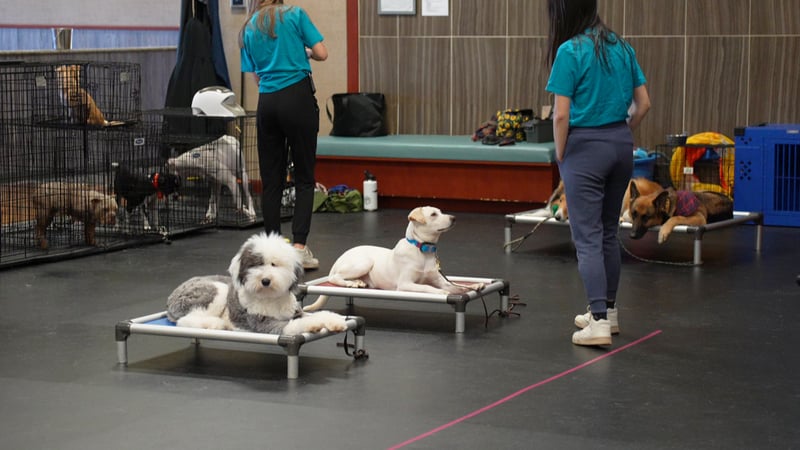
The ratio question and the screening question are the two most facilities can fail outright. Some daycares run a full evaluation day before enrollment; some do a five-minute meet-and-greet; some skip it. Partners Dogs runs a 1:10 trainer-to-dog ratio on trainer-run floors, not attendant-staffed open play, which is the structural answer to both questions at once.
Verify before you enroll
Ask the Floor Staff Yourself
The fastest way to answer these questions is a tour, not a marketing page. Walk our Cave Creek or Scottsdale floor, ask the handlers directly, and ask how many hours they have logged.
How Partners Dogs Answers the Same Question
The full answer is staffing structure, not a single certification claim: a multi-trainer team instead of a solo operator or a rotating attendant roster, around-the-clock coverage instead of shift-sized headcount, and a 1:10 trainer-to-dog ratio on purpose-built campuses in Scottsdale and Cave Creek. Every dog on the floor is on a grade-level curriculum with PD360 scoring, so daycare time advances a dog's education instead of just supervising it until pickup. Handler-to-dog ratio has its own full explanation at why a low trainer-to-dog ratio changes everything, worth reading alongside credentials rather than instead of them.
Reviewers notice the staffing and screening side of this more than the letters.
"Today was the first time that we left our pups at a day camp. They had a great day. The 10 to 1 dog to trainer ratio meant they received direct human care all day."
Shelagh A., Cave Creek
"Doggie daycare with experienced trainers is exactly what our doggo needs. The staff is wonderful and our pup is always excited to go with them."
Meghan B., Cave Creek
Key takeaways
- CPDT-KA requires 300 self-logged hours of dog-training experience and one signed attestation, verified by random audit rather than a full independent check.
- The 200-question CPDT-KA exam tests written knowledge only; hands-on skill is tested exclusively in the separate, much rarer CPDT-KSA tier.
- Only 2.9% of CPDT-KA holders (154 of 5,383) also hold CPDT-KSA, so most "CCPDT certified" bios represent knowledge-tested, not hands-on-tested, trainers.
- CCPDT certificants who use certain tools or techniques outside its approved framework risk losing the credential, and being publicly named for it.
- Partners Dogs University requires 1,000 supervised hours to reach Instructor and 2,000 across breeds and behaviors to reach Senior Instructor, run across a multi-trainer team on trainer-run floors.
Frequently Asked Questions
Is CCPDT certification required to work at a dog daycare?
No. Dog training is an unregulated industry in the United States, so CCPDT certification is not legally required to handle dogs at a daycare. It is a voluntary credential that signals a trainer logged hours, passed a written exam, and agreed to a code of ethics. That is more vetting than the industry requires by default, even though the hours themselves are self-reported.
Does the CPDT-KA exam test hands-on handling skill?
No. CPDT-KA is a 200-question written exam covering ethology, learning theory, training technique, and instruction skills. It has no hands-on component. Hands-on skill is tested only in the separate CPDT-KSA tier, which requires an active CPDT-KA plus four self-filmed training exercises, and only about 2.9% of CPDT-KA holders also hold it.
Is there really a credential called "CKA"?
No. There is no CCPDT credential called CKA. It does not appear on CCPDT's own certification pages or in any established credential glossary. The entry-level credential is CPDT-KA, and "CKA" is almost always a garbled version of that abbreviation.
Does a "CCPDT-approved curriculum" mean the staff are individually certified?
Not necessarily. A CCPDT-approved curriculum means a training program was reviewed and approved for continuing-education credit, often because a qualified professional designed it. That credentials the program, separate from whether any individual staff member personally holds a CPDT-KA, CPDT-KSA, or other CCPDT certification.
What predicts a handler's actual skill if a credential alone doesn't?
Supervised hours across a range of breeds, behaviors, and situations predict skill better than a written exam score does. Partners Dogs University requires 1,000 supervised hours to reach Instructor and 2,000 across breeds and behaviors to reach Senior Instructor, verifiable inside our own system rather than self-reported and attested to once.
Watch the hours in action
Meet the Team on the Floor
Letters after a name are one data point. Supervised hours, ratio, and a purpose-built campus are the rest of the story. Come see ours in Cave Creek or Scottsdale.